 Back
Linkage, Recombination, and Genetic Mapping in Eukaryotes
Study Guide - Smart Notes
 Tailored notes based on your materials, expanded with key definitions, examples, and context.
Linkage and Recombination
Mendel’s Law of Independent Assortment
Mendel’s Law of Independent Assortment states that during gamete formation, the segregation of any pair of hereditary determinants (genes) is independent of the segregation of other pairs. This principle predicts a 9:3:3:1 phenotypic ratio in dihybrid crosses, assuming genes are on different chromosomes or far apart on the same chromosome.
Independent assortment: Genes located on different chromosomes or far apart on the same chromosome assort independently.
Example: Dihybrid cross in sweet pea plants for flower color and pollen shape.
Exceptions to Independent Assortment: Linkage
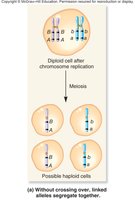
Some traits do not assort independently because their genes are physically linked on the same chromosome. This phenomenon is called linkage. Linked genes tend to be inherited together, resulting in a greater proportion of parental-type offspring than expected by independent assortment.
Linked genes: Genes located close together on the same chromosome.
Synteny: Physical linkage of genes on the same chromosome; chromosomes are called linkage groups.
Example: Bateson and Punnett’s sweet pea cross showed deviation from the expected 9:3:3:1 ratio.
Crossing Over and Recombination
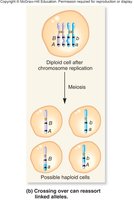
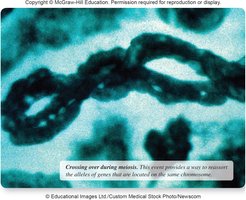
Crossing over during meiosis can break the linkage between genes, resulting in recombinant offspring with new combinations of alleles. The likelihood of crossing over depends on the distance between genes: the farther apart two genes are, the more likely a crossover will occur between them.
Recombination: Exchange of genetic material between homologous chromosomes during meiosis.
Genetic diversity: Recombination shuffles allele combinations, increasing genetic diversity.
Linked genes: Genes close together on the same chromosome may not independently assort.
Genetic Mapping and Linkage Analysis
Genetic Mapping Principles
Genetic mapping uses recombination frequencies to estimate the relative distances between genes on a chromosome. The frequency of recombinant offspring is proportional to the physical distance between genes.
Map distance: Calculated using the formula:
Map unit (mu): Also called centimorgan (cM); 1 mu = 1% recombination frequency.
Example: If 76 + 75 recombinants are observed among 542 + 537 + 76 + 75 total offspring, map distance = 12.3 mu.
Genetic Mapping in Drosophila
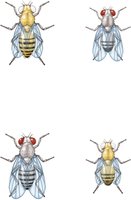
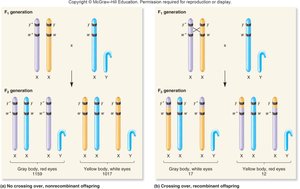
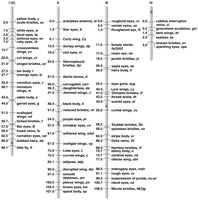
Thomas Hunt Morgan’s experiments with Drosophila (fruit flies) demonstrated linkage and recombination of X-linked genes. He observed that most offspring had parental combinations of traits, but some had recombinant phenotypes due to crossing over.
X-linked genes: Body color, eye color, and wing length are located on the X chromosome and tend to be inherited together.
Recombinant offspring: Fewer in number than non-recombinant (parental) offspring.
Calculating Recombination Frequency and Map Distance
Recombination frequency is used to estimate the map distance between genes. If the distance between two genes is 16 map units, and a mapping cross produces 500 offspring, the expected number of recombinants is:
recombinants
Limitations of Genetic Mapping
As genes get farther apart, the chance of multiple crossover events increases, which can result in underestimation of actual map distance. The maximum observable recombination frequency is 50%, which is the same as independent assortment.
Multiple crossovers: Not all crossover events are detected, especially when genes are far apart.
Quantitative limit: Maximum measurable recombination frequency is 50%.
Mitotic Recombination
Rare Crossing Over During Mitosis
Although recombination typically occurs during meiosis, rare crossing over can also happen during mitosis. If mitotic recombination occurs early in embryonic development, it can produce patches of tissue (twin spots) with different genetic characteristics.
Mitotic recombination: Rare event producing recombinant chromosomes in somatic cells.
Twin spots: Adjacent patches of tissue with different phenotypes due to mitotic recombination.
Applications of Genetic Mapping
Uses of Genetic Maps
Genetic maps are essential for understanding the genome of a species, cloning genes, inferring evolutionary relationships, and improving agriculture through selective breeding. Other types of maps include physical maps (based on DNA sequence) and cytogenetic maps (based on chromosome features).
Genetic map: Based on recombination frequencies.
Physical map: Based on DNA nucleotide sequence.
Cytogenetic map: Based on chromosome features.
Gene Linkage and Human Disease
Retinoblastoma Tumor-Suppressor Gene
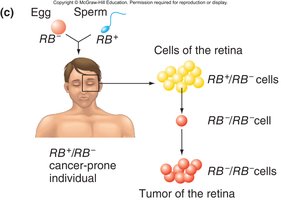
Retinoblastoma is caused by mutations in the RB gene. Individuals who inherit one copy of the RB− allele are prone to cancer of the retina. During proliferation of retinal cells, the RB+ allele can be lost, resulting in tumor formation.
RB gene: Tumor-suppressor gene; loss of function leads to retinoblastoma.
Inheritance: Individuals with RB+/RB− genotype are cancer-prone.
Summary Table: Linkage vs. Independent Assortment
Feature | Independent Assortment | Linkage |
|---|---|---|
Gene Location | Different chromosomes or far apart on same chromosome | Close together on same chromosome |
Offspring Ratio | 9:3:3:1 (dihybrid cross) | More parental types, fewer recombinants |
Recombination Frequency | Up to 50% | Less than 50% (unless far apart) |
Genetic Mapping | Not applicable | Used to estimate gene distance |
Practice Problems
Calculate map distance given recombinant and total offspring numbers.
Draw genetic maps based on recombination frequencies between three genes.
Explain why observed recombination frequencies may underestimate actual map distances.
Additional info: Academic context was added to clarify genetic mapping, linkage, and recombination principles, and to provide definitions and examples for key terms.
