 Back
Linked Genes and Genetic Mapping: Study Notes for Genetics Students
Study Guide - Smart Notes
 Tailored notes based on your materials, expanded with key definitions, examples, and context.
Linked Genes and Genetic Mapping
Introduction to Genetic Mapping
Genetic mapping is a fundamental technique in genetics that allows researchers to determine the relative positions of genes on chromosomes. It is based on the principle that genes located close together on the same chromosome tend to be inherited together, a phenomenon known as linkage.
Genetic mapping helps identify gene locations and understand inheritance patterns.
It is essential for studying genetic diseases and traits in both model organisms and humans.
Mapping relies on observable phenotypes and recombination events during meiosis.
Forward and Reverse Genetics
Forward and reverse genetics are two complementary approaches used to study gene function.
Forward genetics: Starts with a phenotype and seeks to identify the underlying gene. Commonly used in mutagenesis screens.
Reverse genetics: Begins with a known gene and investigates the effects of its mutation on phenotype.
Gene mapping is a key tool in forward genetics, enabling researchers to locate genes responsible for specific traits.
Alleles and Mapping
Alleles are different versions of a gene, and their presence is crucial for genetic mapping.
Each individual carries two alleles for each gene, one from each parent.
Alleles can be naturally occurring or experimentally induced.
Phenotypic differences between alleles allow for the tracking of inheritance and recombination.
Independent Assortment and Linkage
Independent assortment: Genes on different chromosomes segregate independently during meiosis, resulting in equal frequencies of all possible gamete types.
Linkage: Genes located close together on the same chromosome are inherited together more frequently than expected by independent assortment.
Linked genes form linkage groups and are referred to as syntenic.
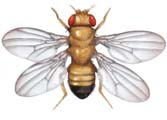
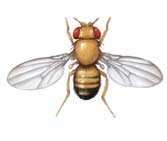
Example: Drosophila melanogaster
Mechanistic Cause of Linkage
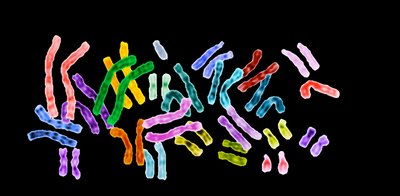
Linkage occurs because alleles on the same chromosome are physically connected and often segregate together during meiosis.
Each chromosome defines a linkage group.
Crossovers during meiosis can break linkage, creating new allele combinations.
Recombination and Crossovers
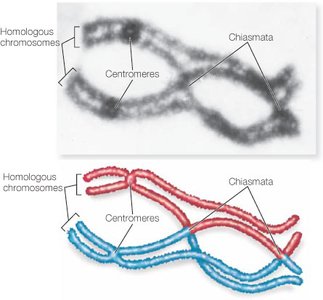
Recombination is the process by which genetic material is exchanged between homologous chromosomes during meiosis, resulting in new allele combinations.
Crossovers occur at chiasmata between non-sister chromatids.
Recombination increases genetic diversity and is essential for mapping genes.
Quantifying Gene Distance: Map Units
The frequency of recombination between genes provides a measure of their distance on a chromosome.
1 centimorgan (cM) = 1 map unit (mu): corresponds to a 1% recombination frequency.
When crossovers are rare, recombination frequency is a good approximation of map distance.
Maximum recombination frequency is 50%, indicating genes are either on different chromosomes or far apart on the same chromosome.
Test Crosses and Two-Point Mapping
Test crosses are used to estimate recombination frequencies and map distances between pairs of genes.
True-breeding populations are crossed, and recombination is inferred from F2 phenotypes.
Parental types are the most frequent genotypes; recombinant types are less frequent.
Map distance is calculated as the sum of recombinant frequencies (if small enough).
Three-Point Crosses and Gene Order
Three-point crosses allow for the determination of gene order and the detection of double crossovers.
Trihybrid individuals are crossed with strains homozygous for recessive alleles.
Double recombinants are the least frequent gamete types.
The gene in the middle is identified by comparing parental and double recombinant genotypes.
Physical vs. Genetic Map Distance
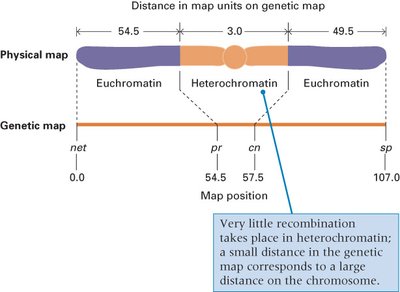
Physical distance (measured in base pairs) and genetic map distance (measured in cM) are not always proportional due to variations in crossover frequency along the chromosome.
Regions with low recombination (e.g., heterochromatin) may have large physical distances but small genetic distances.
Recombination hotspots increase genetic map distance relative to physical distance.
Crossover Interference
Crossover interference describes the phenomenon where the occurrence of one crossover reduces the likelihood of another nearby crossover.
Measured using three-point crosses.
Interference =
Coefficient of coincidence =
Interference ranges from 0 (no interference) to 1 (complete interference).
Applications of Genetic Mapping
Genetic mapping is used to identify genes responsible for diseases and traits.
Over 10,000 human diseases are caused by defects in single genes.
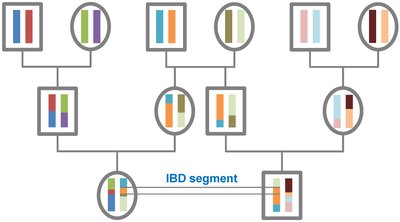
Mapping is used in genetic genealogy to detect identical-by-descent (IBD) segments.
Segment length and recombination events can estimate the number of generations since a common ancestor.
Summary Table: Key Concepts in Genetic Mapping
Concept | Definition | Example/Application |
|---|---|---|
Linkage | Genes inherited together due to proximity on chromosome | Drosophila body color and wing shape |
Recombination | Exchange of genetic material during meiosis | Crossovers at chiasmata |
Map Unit (cM) | 1% recombination frequency | Genes recombine 1% of the time |
Test Cross | Cross to infer gamete genotype from phenotype | Estimating map distance |
Crossover Interference | Reduction in likelihood of nearby crossovers | Three-point cross analysis |
IBD Segment | DNA segment inherited from common ancestor | Genetic genealogy |
Additional info:
Some explanations and examples were expanded for clarity and completeness.
Equations were formatted in LaTeX as requested.
