 Back
BackMendelian Genetics: Principles, Experiments, and Applications
Study Guide - Smart Notes
 Tailored notes based on your materials, expanded with key definitions, examples, and context.
Chapter 3: Mendelian Genetics
Mendel and the Garden Peas
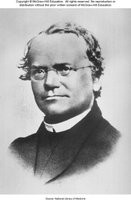
Gregor Mendel, a botanist and mathematician, conducted pioneering experiments with Pisum sativum (garden peas) to uncover the basic principles of heredity. He selected peas due to their distinct binary traits, ease of cultivation, and ability to self- and cross-pollinate. Mendel's work laid the foundation for modern genetics by demonstrating how traits are inherited in discrete units.
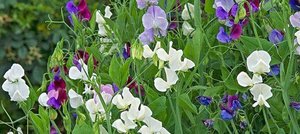
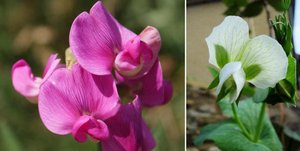
Binary traits: Traits with two distinct forms (e.g., purple vs. white flowers).
Non-binary traits: Traits with a range of forms, more common in nature.
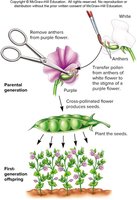
Experimental design: Mendel removed anthers from flowers to prevent self-pollination and transferred pollen from one plant to another to control crosses.
Importance: Mendel's systematic approach allowed him to track inheritance patterns across generations.
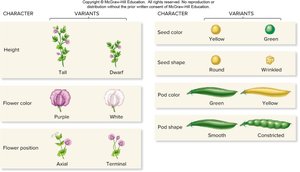
Characters studied: Height, flower color, seed shape, seed color, pod shape, pod color, and flower position.
Mendel’s Traits or Characters
Mendel selected seven easily distinguishable traits in peas, each with two contrasting variants. This allowed clear observation of inheritance patterns.
Examples: Tall vs. dwarf plants, purple vs. white flowers, round vs. wrinkled seeds, yellow vs. green seeds, green vs. yellow pods, smooth vs. constricted pods, axial vs. terminal flower position.
Framework of Mendelian Genetics
The basic framework of Mendelian genetics involves the inheritance of traits through genes, which exist in different forms called alleles. Mendel's experiments demonstrated that traits are not blended but inherited as discrete units.
Gene: A unit of heredity encoding a trait.
Allele: Different forms of a gene.
Phenotype: Observable trait resulting from a specific allele.
Genotype: The genetic makeup of an organism.
Key principle: Genes and environment determine traits, but Mendel controlled the environment to focus on genetic inheritance.
Historical Theories of Heredity: Pangenesis
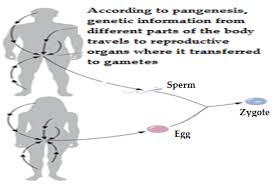
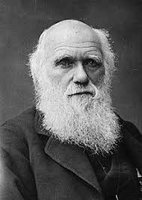
Before Mendel, Charles Darwin proposed the theory of pangenesis, suggesting that all cells shed particles (gemmules) that travel to reproductive organs and are passed to offspring. This theory was later refuted by Mendel's findings.
Pangenesis: Genetic information from all parts of the body is transferred to gametes.
Gemmules: Hypothetical particles carrying hereditary information.
Monohybrid, Dihybrid, and Trihybrid Crosses
Single Factor (Monohybrid) Crosses
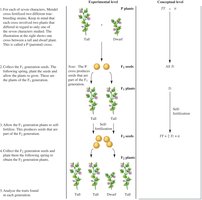
Monohybrid crosses involve one trait with two alleles. Mendel observed that the F1 generation showed only one parental trait, while the F2 generation exhibited a 3:1 ratio of dominant to recessive traits.
Dominant allele: Expressed in the phenotype when present.
Recessive allele: Masked in the presence of a dominant allele.
Law of Dominance: In a heterozygote, one allele dominates over the other.
Law of Segregation: Two alleles segregate during gamete formation; each gamete receives one allele.
Data from Single-Factor Crosses
Mendel's data from single-factor crosses consistently showed a 3:1 ratio in the F2 generation, supporting the particulate theory of inheritance and the law of segregation.
Particulate theory: Genetic determinants are inherited as discrete units (genes).
Law of Segregation:
Punnett Squares
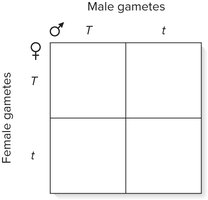
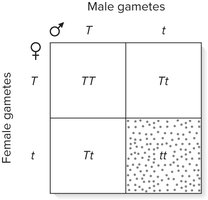
Punnett squares are grids used to predict the outcomes of genetic crosses. They visually represent the segregation and combination of alleles.
Application: Used to analyze monohybrid, dihybrid, and trihybrid crosses.
Example: Cross between heterozygous tall plants (Tt x Tt).
Dihybrid Crosses
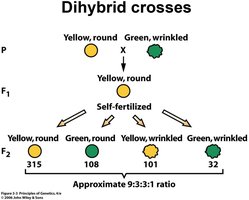
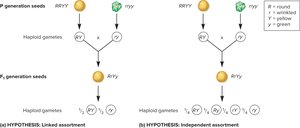
Dihybrid crosses involve two traits, each with two alleles. Mendel observed a 9:3:3:1 ratio in the F2 generation, supporting the law of independent assortment.
Law of Independent Assortment: Alleles of different genes assort independently during gamete formation.
Example: Cross between plants with yellow, round seeds and green, wrinkled seeds.
Trihybrid Crosses
Trihybrid crosses involve three traits, each with two alleles. The Punnett square and forked line methods are used to predict outcomes.
Example: TtRrYy x TtRrYy (Tall/dwarf, round/wrinkled, yellow/green).
Forked line method: Efficient for calculating probabilities in multi-trait crosses.
Linked vs. Independent Assortment
Some genes are linked because they are located close together on the same chromosome, which can affect the expected ratios. Independent assortment applies when genes are on different chromosomes or far apart on the same chromosome.
Genetic recombination: Offspring receive allele combinations different from parents due to independent assortment or crossing over.
Summary Table: Mendel's Laws and Cross Types
Law | Cross Type | Phenotypic Ratio (F2) | Key Principle |
|---|---|---|---|
Law of Dominance | Monohybrid | 3:1 | One allele masks the other |
Law of Segregation | Monohybrid | 3:1 | Alleles segregate during gamete formation |
Law of Independent Assortment | Dihybrid/Trihybrid | 9:3:3:1 (dihybrid) | Alleles of different genes assort independently |
Additional info:
The notes expand on Mendel's experiments, the historical context of heredity theories, and the mathematical tools used in genetics.
Images included are directly relevant to the explanation of Mendelian principles, experimental design, and genetic crosses.
