 Back
BackMendelian Genetics: Principles of Heredity and Transmission
Study Guide - Smart Notes
 Tailored notes based on your materials, expanded with key definitions, examples, and context.
Mendelian Genetics: Principles of Heredity and Transmission
Areas of Genetics
Genetics is the study of heredity and variation in organisms. Transmission genetics, also known as classical or Mendelian genetics, focuses on how traits are passed from one generation to the next and the behavior of chromosomes and genes.
Alleles: Different versions of a gene.
Genotype: The exact allelic composition of an organism.
Phenotype: The observable traits or behaviors of an organism.
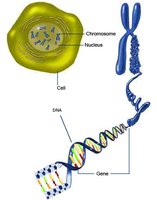
Genotype and Phenotype
The genotype determines the phenotype, but environmental factors can also influence the expression of traits. Mendelian genetics investigates the relationship between genotype and phenotype using controlled crosses.
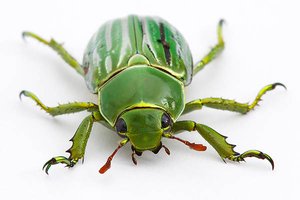
Historical Concepts of Heredity
Before Mendel, two main theories dominated:
Inheritance of Acquired Characteristics: Traits acquired by parents could be passed to offspring (e.g., long neck in giraffes).
Blending Inheritance: Offspring are a blend of parental traits, like mixing paint colors.
Mendel's experiments disproved these ideas by showing discrete inheritance.
Gregor Mendel and His Experiments
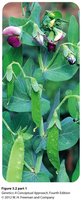
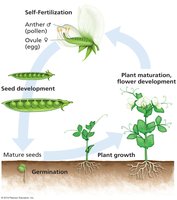
Gregor Mendel, an Austrian monk, conducted experiments with garden peas to uncover the basic principles of heredity. He chose peas because they are annual, self-fertilizing, and can be cross-fertilized manually.
Annual Plant: Completes its life cycle in one season.
Self-fertilization: Ensures true-breeding strains.
Manual Cross-fertilization: Allows controlled genetic crosses.
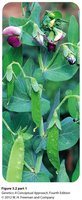
Mendel's Experimental Approach
Mendel focused on traits with only two alternative phenotypes (discontinuous traits), counted all results, performed reciprocal crosses, and studied monogenic traits without genetic linkage.
Discontinuous Traits: Traits with distinct phenotypes (e.g., round vs. wrinkled seeds).
Monogenic Trait: Controlled by a single gene.
Continuous vs. Discontinuous Traits
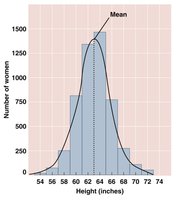
Some traits, like human height, are continuously variable and influenced by many genes and the environment. These require statistical and population genetics techniques.
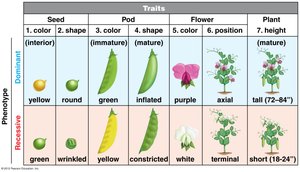
Mendel's Seven Traits
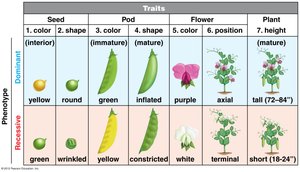
Mendel selected seven traits in peas, each with two phenotypes, to study inheritance patterns.
Monohybrid Crosses and F1 Generation
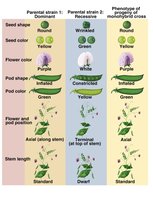
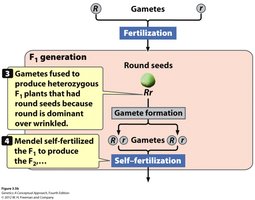
Mendel cross-fertilized true-breeding parent strains for each trait and observed the F1 generation. All F1 plants showed the dominant phenotype, disproving blending inheritance.
Dominant and Recessive Traits
Mendel hypothesized that traits are determined by 'factors' (genes) that come in two forms (alleles). The trait appearing in F1 is dominant; the one disappearing is recessive.
F2 Generation and Phenotype Ratios
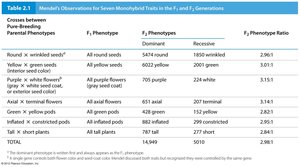
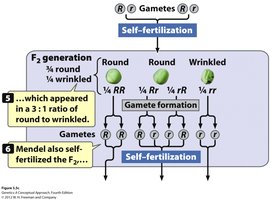
Allowing F1 plants to self-fertilize, Mendel observed the return of the recessive phenotype in the F2 generation. The ratio of dominant to recessive phenotypes was approximately 3:1 for all traits.
F3 Generation and Genotype Ratios
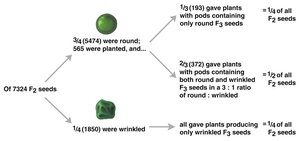
Self-fertilizing F2 plants, Mendel found a 1:2:1 ratio of genotypes in the F3 generation, confirming that not all dominant phenotype plants were genetically identical.
Mendel's Model of Heredity
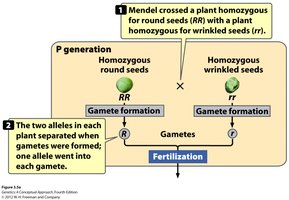
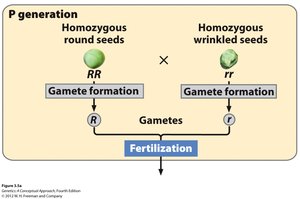
Mendel proposed that each organism has two alleles for each gene (diploid), inherited from each parent. Gametes are haploid, containing one allele, and alleles segregate randomly during gamete formation.
Homozygous: Two identical alleles (AA or aa).
Heterozygous: Two different alleles (Aa).
Mendel's First Law: Law of Segregation
Organisms have two copies of each gene, which segregate randomly into gametes. This explains the 3:1 phenotype ratio and 1:2:1 genotype ratio in monohybrid crosses.
Punnett Square
The Punnett square is a tool to predict genotypes and phenotypes of progeny from genetic crosses. It visualizes the combination of alleles from each parent.
Example: Cross Aa x Aa produces AA, Aa, and aa genotypes.
The Testcross
A testcross determines whether an organism with a dominant phenotype is homozygous or heterozygous by crossing it with a homozygous recessive individual.
SS x ss: All progeny are Ss (dominant phenotype).
Ss x ss: Progeny are 1:1 dominant:recessive.
Mendel's Experiments with Corn
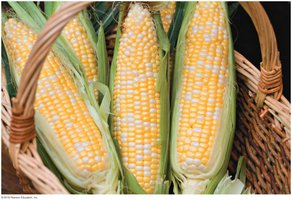
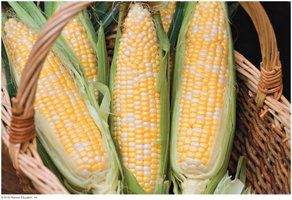
Mendel's principles were applied to corn, showing 3:1 segregation of kernel color in crosses between yellow and white kernels.
Mendel's Second Law: Law of Independent Assortment
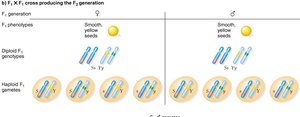
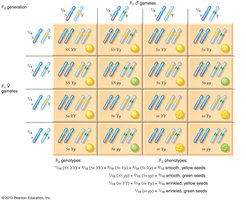
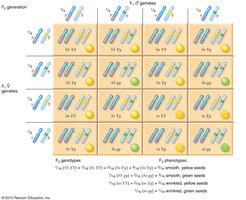
During gamete formation, alleles for different traits segregate independently. This explains the 9:3:3:1 ratio observed in dihybrid crosses.
Dihybrid Cross: Cross involving two traits (e.g., seed shape and color).
F2 Ratio: 9 smooth yellow : 3 smooth green : 3 wrinkled yellow : 1 wrinkled green.
Trihybrid Crosses and Probability
Mendel extended his experiments to three traits, using probability and the branching diagram method to predict outcomes. The chi-square test is used to compare observed and expected results, determining if differences are due to chance.
Trihybrid Cross: Involves three genes, producing 64 possible progeny classes.
Chi-square Test: Statistical method to assess the fit between observed and expected ratios.
Summary Table: Mendel's Seven Monohybrid Traits
The following table summarizes Mendel's observations for seven monohybrid traits in peas:
Trait | Dominant Phenotype | Recessive Phenotype | F2 Phenotype Ratio |
|---|---|---|---|
Seed shape | Round | Wrinkled | 2.96:1 |
Seed color | Yellow | Green | 3.01:1 |
Flower color | Purple | White | 3.15:1 |
Pod shape | Inflated | Constricted | 2.84:1 |
Pod color | Green | Yellow | 3.14:1 |
Flower position | Axial | Terminal | 2.88:1 |
Plant height | Tall | Short | 2.84:1 |
Key Equations
The fundamental equations for Mendelian inheritance are:
Monohybrid Cross Genotype Ratio:
Monohybrid Cross Phenotype Ratio:
Dihybrid Cross Phenotype Ratio:
Probability of independent events:
Chi-square test:
Conclusion
Mendel's laws of segregation and independent assortment form the foundation of classical genetics, explaining how traits are inherited and predicting the outcomes of genetic crosses. These principles are essential for understanding heredity, variation, and the molecular basis of evolution.
