 Back
BackMendelian Inheritance and the Foundations of Transmission Genetics
Study Guide - Smart Notes
 Tailored notes based on your materials, expanded with key definitions, examples, and context.
Mendelian Inheritance: Foundations of Transmission Genetics
Introduction to Inheritance and Mendelian Principles
Inheritance is the process by which traits are passed from parents to offspring. Gregor Mendel's experiments with pea plants established the foundational laws of heredity, explaining how traits can disappear in one generation and reappear in another. These principles form the basis of classical genetics.
Observable Traits: Traits can be shared between parents and offspring, and sometimes skip generations.
Mendelian Principles: Mendel's work led to the formulation of the laws of segregation and independent assortment.


Gregor Mendel and His Experimental Approach
Gregor Mendel chose pea plants for their clear, variable traits and performed controlled crosses to study inheritance. His systematic approach and quantification of results allowed him to deduce the basic laws of heredity.
Controlled Crosses: Mendel used pure-breeding (true-breeding) strains to ensure consistent results.
Traits Studied: Each trait had two distinct forms (e.g., green/yellow pods, round/wrinkled seeds).
Quantification: Mendel counted large numbers of offspring to identify consistent ratios.
Key Terminology in Mendelian Genetics
Alleles: Different forms of a gene that determine specific traits.
Homozygous: Having two identical alleles for a trait (e.g., RR or rr).
Heterozygous: Having two different alleles for a trait (e.g., Rr).
True/Pure Breeding: Organisms that consistently produce offspring with the same trait as the parent.
Tracking Generations in Genetic Crosses
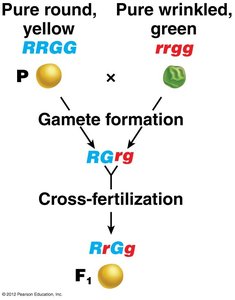
Generations are labeled as P (parental), F1 (first filial), F2 (second filial), and so on. This nomenclature helps track the inheritance of traits through successive generations.
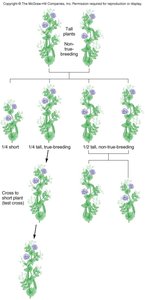
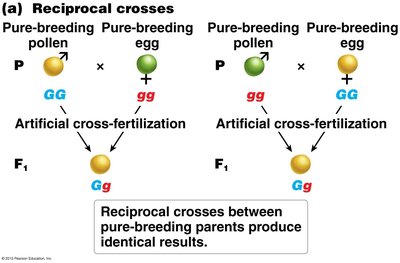
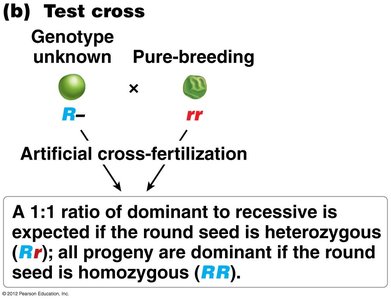
Experimental Crosses: Replicate, Reciprocal, and Test Crosses
Mendel used several types of crosses to analyze inheritance patterns:
Replicate Crosses: Repeating the same cross multiple times to ensure reliability.
Reciprocal Crosses: Switching the sexes of the parents to test if inheritance is sex-dependent.
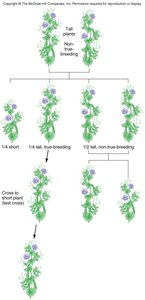
Test Crosses: Crossing an individual with a dominant phenotype to a homozygous recessive to determine genotype.
Dominance and Recessiveness
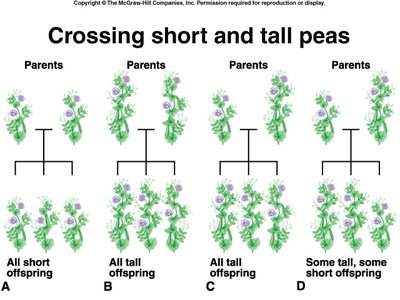
When two true-breeding plants with different traits are crossed, only one trait appears in the F1 generation (dominant), while the other is masked (recessive). The recessive trait can reappear in subsequent generations.
Common Dominant and Recessive Traits in Humans
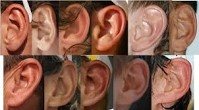
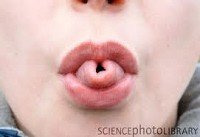
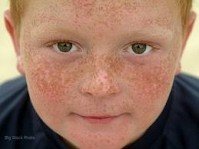
Many human traits follow Mendelian inheritance patterns, such as widow's peak, earlobe attachment, tongue rolling, cleft chin, dimples, handedness, curly hair, and freckles.




Categories of Mendelian Disorders
Mendelian disorders are classified based on the affected system and mode of inheritance:
Neurological: Huntington’s disease (AD), Rett syndrome (X-linked dominant), Spinal muscular atrophy (AR)
Metabolic: Phenylketonuria (PKU, AR), Tay–Sachs disease (AR), Gaucher disease (AR)
Hematological: Sickle cell anemia (AR), Hemophilia A & B (X-linked recessive), Thalassemias (AR)
Musculoskeletal/Connective Tissue: Marfan syndrome (AD), Osteogenesis imperfecta (AD), Duchenne muscular dystrophy (X-linked recessive)
Cardiovascular: Familial hypercholesterolemia (AD)
Key: AD = Autosomal dominant, AR = Autosomal recessive
Monohybrid Crosses and Mendel’s First Law (Law of Segregation)
A monohybrid cross involves individuals heterozygous for a single gene. Mendel observed a 3:1 phenotypic ratio in the F2 generation, with a 1:2:1 genotypic ratio. This led to the law of segregation, which states that alleles separate during gamete formation and unite randomly at fertilization.
Phenotypic Ratio (F2): 3 dominant : 1 recessive
Genotypic Ratio (F2): 1 homozygous dominant : 2 heterozygous : 1 homozygous recessive
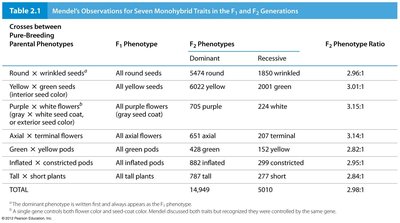
Mendel’s Observations: Quantitative Data
Mendel’s careful quantification of offspring led to the identification of consistent ratios, which are summarized in the table below.
Cross | F1 Phenotype | F2 Phenotypes (Dominant) | F2 Phenotypes (Recessive) | F2 Phenotype Ratio |
|---|---|---|---|---|
Round × wrinkled seeds | All round | 5474 round | 1850 wrinkled | 2.96:1 |
Yellow × green seeds | All yellow | 6022 yellow | 2001 green | 3.01:1 |
Purple × white flowers | All purple | 705 purple | 224 white | 3.15:1 |
Axial × terminal flowers | All axial | 651 axial | 207 terminal | 3.14:1 |
Green × yellow pods | All green | 428 green | 152 yellow | 2.82:1 |
Inflated × constricted pods | All inflated | 882 inflated | 299 constricted | 2.95:1 |
Tall × short plants | All tall | 787 tall | 277 short | 2.84:1 |
Dihybrid and Trihybrid Crosses: Law of Independent Assortment
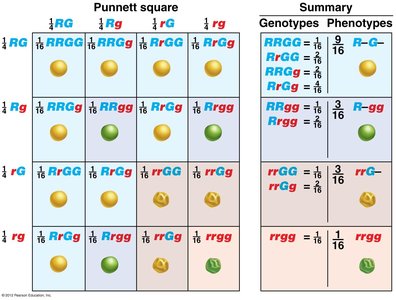
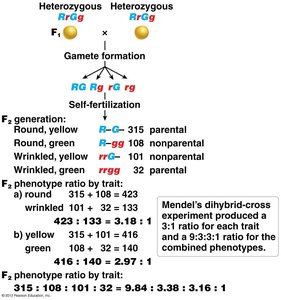
Mendel extended his analysis to crosses involving two or more traits. In dihybrid crosses, he observed a 9:3:3:1 phenotypic ratio in the F2 generation, leading to the law of independent assortment: alleles of different genes assort independently during gamete formation.
Dihybrid Cross: Cross between individuals heterozygous for two genes (e.g., RrGg × RrGg).
Phenotypic Ratio (F2): 9:3:3:1 (for two traits)
Trihybrid Cross: Involves three genes, with ratios calculated as the product of individual monohybrid ratios.
Genetic Problem Solving: Probability in Genetics
Genetic crosses can be analyzed using probability rules. For example, the probability of obtaining a specific genotype from a cross is the product of the probabilities for each gene.
Example: Probability of AaBBCc from AaBbCc × AaBbCc:
Summary Table: Mendelian Ratios
Type of Cross | Genotypic Ratio | Phenotypic Ratio |
|---|---|---|
Monohybrid (Aa × Aa) | 1:2:1 | 3:1 |
Dihybrid (AaBb × AaBb) | 9:3:3:1 (for phenotypes) | 9:3:3:1 |
Trihybrid (AaBbCc × AaBbCc) | 27:9:9:9:3:3:3:1 (for phenotypes) | 27:9:9:9:3:3:3:1 |
Additional info: These notes cover the core concepts of Mendelian genetics, including the laws of segregation and independent assortment, and provide examples and problem-solving strategies relevant to college-level genetics.
