 Back
BackMendelian Inheritance: Dihybrid Crosses, Probability, and Pedigree Analysis
Study Guide - Smart Notes
 Tailored notes based on your materials, expanded with key definitions, examples, and context.
Mendelian Inheritance: Dihybrid Crosses, Probability, and Pedigree Analysis
Dihybrid Crosses and Independent Assortment
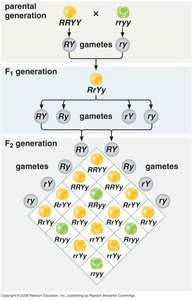
Mendelian genetics explores how traits are inherited from one generation to the next. When considering two traits simultaneously, Mendel's Law of Independent Assortment states that alleles for different traits segregate independently during gamete formation. This principle can be illustrated using dihybrid crosses, which involve individuals heterozygous for two genes.
Dihybrid Cross: A cross between two individuals that are both heterozygous for two traits (e.g., RrYy x RrYy).
Independent Assortment: The alleles of one gene segregate into gametes independently of the alleles of another gene.
Phenotypic Ratio: The classic F2 ratio for a dihybrid cross is 9:3:3:1, representing the four possible phenotype combinations.
Punnett Square: Used to predict the genotypic and phenotypic outcomes of genetic crosses.
Gamete Formation: Each parent produces four types of gametes in equal frequency (e.g., RY, Ry, rY, ry).
Forked-Line Method and Probability in Genetics
As the number of traits increases, Punnett squares become unwieldy. The forked-line (branch) diagram and probability rules provide efficient alternatives for predicting genetic outcomes.
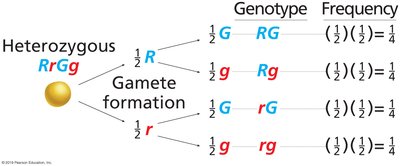
Forked-Line Diagram: A visual tool to determine all possible gamete combinations and their frequencies.
Product Rule: The probability of two independent events both occurring is the product of their individual probabilities.
Sum Rule: The probability of either of two mutually exclusive events occurring is the sum of their individual probabilities.
Conditional Probability: The probability of an event given that another event has already occurred (e.g., probability an F2 yellow seed is heterozygous).
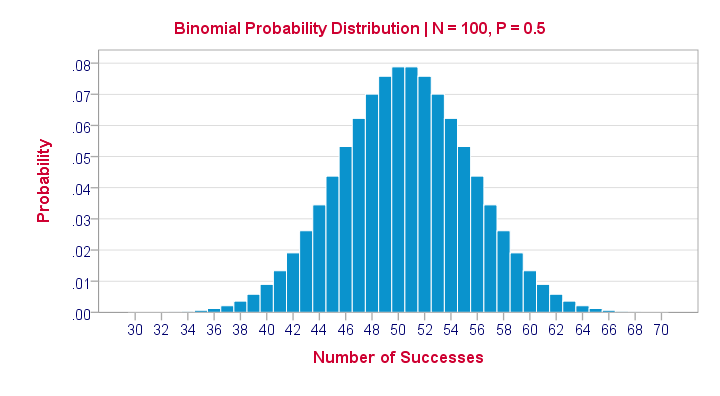
Binomial Probability: Used to predict the probability of a specific combination of outcomes in a series of events (e.g., number of yellow vs. green seeds in a pod).
Application of Probability Rules in Genetics
Probability theory is essential for predicting genetic outcomes. The product and sum rules are used before a cross, while conditional probability is used after a cross when additional information is available.
Example (Product Rule): Probability of getting homozygous recessive offspring (aabb) from AaBb x AaBb is .
Example (Sum Rule): Probability of getting a heterozygote (Aa) from Aa x Aa is (for Aa from each parent).
Example (Conditional Probability): In Gg x Gg, probability a yellow-seeded F2 is heterozygous (Gg) is .
Binomial Expansion: For n events, gives the probability distribution of outcomes.
Chi-Square Analysis and Statistical Significance
Chi-square (χ²) analysis is used to compare observed and expected genetic ratios, determining if deviations are due to chance or indicate a significant difference.
Chi-Square Formula: , where O = observed, E = expected.
Degrees of Freedom (df): Number of outcome classes minus one ().
p-value: Probability that the observed deviation is due to chance. A p-value < 0.05 is considered statistically significant.
Application: Used to test hypotheses such as independent assortment of genes.
Pedigree Analysis and Autosomal Inheritance
Pedigree analysis uses symbolic representations of family trees to interpret inheritance patterns in diploid organisms. It helps distinguish between autosomal dominant and recessive traits.
Autosomal Dominant: Trait appears in every generation; affected offspring have at least one affected parent; both sexes equally affected.
Autosomal Recessive: Trait can skip generations; affected offspring can be born to unaffected parents; both sexes equally affected.
Pedigree Symbols: Squares represent males, circles represent females, shaded symbols indicate affected individuals.
Summary Table: Key Probability Rules in Genetics
Rule | Application | Formula |
|---|---|---|
Product Rule | Probability of independent events both occurring | |
Sum Rule | Probability of either of two mutually exclusive events | |
Conditional Probability | Probability of A given B has occurred | |
Binomial Probability | Probability of X successes in n trials | |
Chi-Square Test | Statistical test for observed vs. expected ratios |
Key Takeaways
Mendel's laws of segregation and independent assortment form the foundation of classical genetics.
Dihybrid crosses reveal the independent inheritance of traits and produce predictable phenotypic ratios.
Probability theory and statistical analysis are essential tools for predicting and evaluating genetic outcomes.
Pedigree analysis helps determine the mode of inheritance for traits in families.
