 Back
BackMendel’s Second Law: Independent Assortment and Probability in Genetics
Study Guide - Smart Notes
 Tailored notes based on your materials, expanded with key definitions, examples, and context.
Mendel’s Second Law: Independent Assortment
Introduction to Mendelian Genetics
Mendel’s experiments with pea plants established foundational principles of heredity. His work with single-gene traits led to the discovery of predictable inheritance patterns, but the inheritance of multiple traits required further investigation. Mendel’s Second Law, the Law of Independent Assortment, explains how genes located on different chromosomes are inherited independently of one another.
Single-Gene Inheritance and Phenotypic Ratios
Monohybrid Crosses: Involve one gene with two alleles. F1 generation shows only the dominant phenotype; F2 generation segregates in a 3:1 dominant to recessive ratio.
Examples of Traits Studied by Mendel: Seed shape (round vs. wrinkled), seed color (yellow vs. green), flower color (purple vs. white), pod shape (inflated vs. pinched), pod color (green vs. yellow), flower position (axial vs. terminal), and stem length (long vs. short).
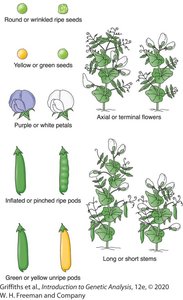
Dihybrid Crosses and the Discovery of Independent Assortment
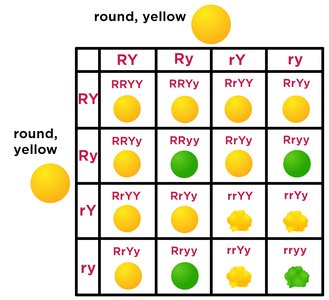
When Mendel crossed plants differing in two traits (dihybrid crosses), he observed new phenotypic combinations in the F2 generation, not present in the parental generation. The F2 phenotypic ratio was consistently 9:3:3:1, indicating independent inheritance of the two traits.
Parental Generation (P): True-breeding plants for two traits are crossed.
F1 Generation: All individuals display the dominant phenotype for both traits.
F2 Generation: Four phenotypes appear in a 9:3:3:1 ratio.
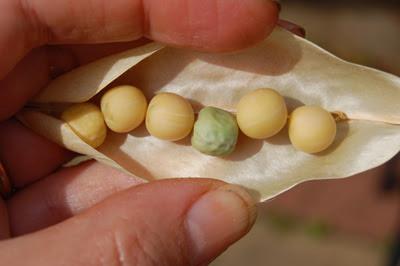
Explanation of the 9:3:3:1 Ratio
Independent Assortment: Genes on different chromosomes segregate independently during gamete formation.
Probability and Product Rule: The probability of two independent events occurring together is the product of their individual probabilities.
Calculation Example: Probability of yellow (3/4) and smooth (3/4) seeds in F2 = 3/4 × 3/4 = 9/16.
Probability Trees and Complex Crosses
As the number of genes increases, Punnett squares become impractical. Probability trees and the product rule allow for efficient calculation of genotype and phenotype probabilities for multiple genes.
Probability Tree: Each branch represents an event; multiply probabilities along branches to find combined probabilities.
Generalization: For n genes, the number of possible genotypes is 3n (for two-allele genes), and phenotypes is 2n (for simple dominant/recessive traits).
Punnett Squares for Multiple Genes
Punnett squares can be used for two or three genes, but probability methods are preferred for larger numbers. For example, a dihybrid cross (Y/y R/r × Y/y R/r) can be broken down into two monohybrid crosses, and the product rule applied to combine results.
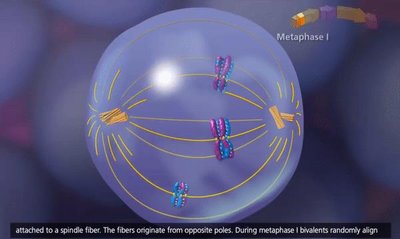
Meiosis and the Mechanism of Independent Assortment
During meiosis, homologous chromosomes align independently at the metaphase plate (Metaphase I), leading to random assortment of maternal and paternal chromosomes into gametes. This underlies Mendel’s Second Law.
Metaphase I: Tetrads align independently, resulting in 2n possible chromosome combinations (where n is the number of chromosome pairs).
Example: In humans (n = 23), there are 223 = 8,388,608 possible gamete combinations due to independent assortment alone.
Other Types of Inheritance
Organelle Inheritance
Some genes are located in organelles such as mitochondria and chloroplasts, which are usually inherited uniparentally (often maternally). This is due to the cytoplasmic contribution of the egg cell to the zygote.
Heteroplasmy: Presence of more than one type of organelle genome within a cell or individual.
Polygenic Inheritance and Quantitative Traits
Continuous Variation and Quantitative Trait Loci (QTLs)
Many traits, such as height or skin color, show continuous variation and are controlled by multiple genes (polygenic inheritance). Each gene contributes additively to the phenotype, resulting in a bell-shaped distribution in the population.
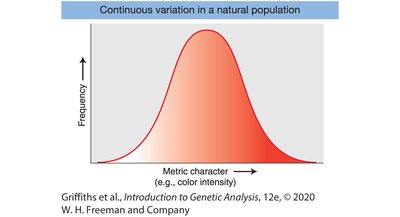
Quantitative Trait Loci (QTLs): Genes that contribute to quantitative traits. The phenotype depends on the number of contributing alleles present.
Additive Effects: Each allele adds a certain amount to the phenotype (e.g., each dominant allele adds 10 units, each recessive adds 2 units).
Polygenic Inheritance Example
Consider a plant with two pigment-producing genes (A and B), each with a dominant allele (producing 10 units of pigment) and a recessive allele (producing 1 unit). The total pigment is the sum of all allele contributions.
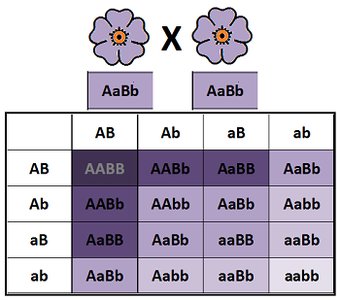
Calculation: Add the contributions of each allele to determine the phenotype.
Practice Problem: If three QTLs control height in Ewoks, and each H allele adds 10 cm while each h allele adds 2 cm, the phenotype is the sum of all allele contributions.
Summary Table: Mendelian vs. Polygenic Inheritance
Feature | Mendelian (Single-Gene) | Polygenic (Multiple Genes) |
|---|---|---|
Number of Genes | One | Two or more |
Phenotypic Classes | Discrete (e.g., round/wrinkled) | Continuous (e.g., height, color intensity) |
Inheritance Pattern | Simple ratios (3:1, 9:3:3:1) | Bell-shaped distribution |
Genetic Calculation | Punnett squares, probability | Sum of allele effects, probability |
Additional info: The notes above integrate foundational concepts from Chapters 2, 3, and 19 of a typical genetics curriculum, including Mendel’s laws, probability in genetics, meiosis, and polygenic inheritance. Practice problems and probability trees are recommended for mastery.
