 Back
BackCh 4 Modification of Mendelian Ratios: Extensions and Exceptions to Classical Genetics
Study Guide - Smart Notes
 Tailored notes based on your materials, expanded with key definitions, examples, and context.
Modification of Mendelian Ratios
Introduction to Modified Ratios
Mendelian genetics is based on the principles that genes are present on homologous chromosomes and segregate independently during gamete formation. However, the classic Mendelian ratios (3:1 for monohybrid and 9:3:3:1 for dihybrid crosses) are often modified when gene expression does not follow simple dominant/recessive patterns or when multiple genes influence a single trait. These modifications arise due to various genetic and environmental factors.
Alleles and Mutations
Allelic Variation and Mutation Types
Alleles: Alternative forms of the same gene found within a population. The wild-type allele is most common and often, but not always, dominant.
Mutations: Changes in DNA sequence that create new alleles. Types include:
Loss-of-function mutation: Reduces or eliminates gene product function. Complete loss results in a null allele.
Gain-of-function mutation: Enhances or changes the function of the gene product, often by altering gene regulation.
Neutral mutation: Does not affect phenotype.
Genetic Nomenclature
Symbolizing Alleles
Recessive alleles: Lowercase, italicized (e.g., d for dwarf).
Dominant alleles: Uppercase (e.g., D for tall).
Organism-specific conventions exist (e.g., e for ebony in Drosophila melanogaster).
No dominance: Uppercase italic letters with superscripts denote alternative alleles.
Extensions of Dominance Relationships
Incomplete Dominance
Incomplete dominance occurs when neither allele is completely dominant, resulting in an intermediate phenotype in heterozygotes. For example, crossing red and white snapdragons yields pink offspring, with phenotypic and genotypic ratios both 1:2:1.
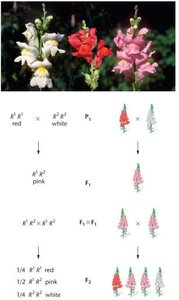
Example in Humans: Tay–Sachs disease shows incomplete dominance at the biochemical level, where heterozygotes have intermediate enzyme activity.
Codominance
Codominance is the joint expression of both alleles in a heterozygote, with no dominance or recessiveness. An example is the MN blood group in humans, where both M and N antigens are expressed if both alleles are present.
Multiple Alleles
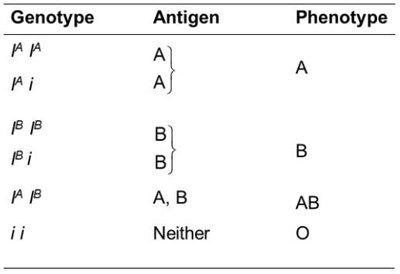
More than two alleles can exist for a gene in a population, though any individual carries only two. The ABO blood group system in humans is a classic example, with three alleles (IA, IB, and i).
Genotype | Antigen | Phenotype |
|---|---|---|
IAIA | A | A |
IAi | A | A |
IBIB | B | B |
IBi | B | B |
IAIB | A, B | AB |
ii | Neither | O |
Gene Interactions and Epistasis
Gene Interaction and Epigenesis
Many phenotypic traits are influenced by multiple genes. Epigenesis describes the process by which complex traits arise through the interaction of several genes, as seen in organ development or hereditary deafness.
Epistasis
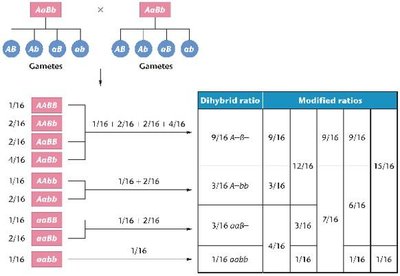
Epistasis occurs when one gene masks or modifies the expression of another gene. This leads to modified dihybrid ratios, deviating from the classic 9:3:3:1 ratio.
Recessive epistasis: A recessive genotype at one locus masks expression at another (e.g., coat color in mice).
Dominant epistasis: A dominant allele at one locus masks alleles at a second locus (e.g., fruit color in squash).
Complementary gene interaction: Both dominant alleles are required for a phenotype (e.g., flower color in sweet peas).
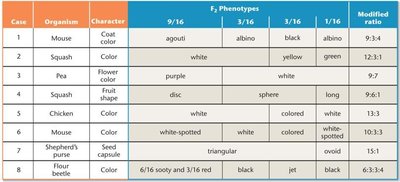
Case | Organism | Character | 9/16 | 3/16 | 3/16 | 1/16 | Modified ratio |
|---|---|---|---|---|---|---|---|
1 | Mouse | Coat color | agouti | albino | black | albino | 9:3:4 |
2 | Squash | Color | white | yellow | green | 12:3:1 | |
3 | Pea | Flower color | purple | white | 9:7 | ||
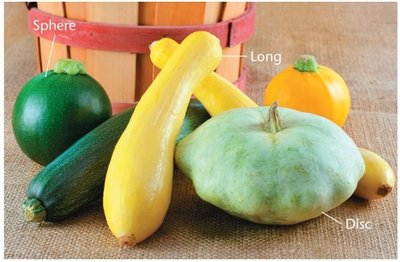
4 | Squash | Fruit shape | disc | sphere | sphere | long | 9:6:1 |
5 | Chicken | Color | white | colored | white | colored | 13:3 |
6 | Mouse | Color | white-spotted | white | colored | white-spotted | 10:3:3 |
7 | Shepherd's purse | Seed capsule | triangular | ovoid | 15:1 | ||
8 | Flour beetle | Color | 6/16 sooty and 3/16 red | black | jet | black | 6:3:3:4 |
Novel Phenotypes
When two gene pairs influence a trait equally, novel phenotypes can arise, as seen in the fruit shape of summer squash (disc, sphere, long) with a 9:6:1 ratio.
Complementation Analysis
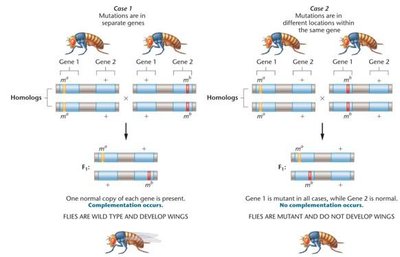
Complementation analysis determines if two mutations causing similar phenotypes are in the same gene or different genes. If two mutants produce wild-type offspring, the mutations are in different genes (complementation occurs).
X-Linkage and Sex-Influenced Inheritance
X-Linked Inheritance
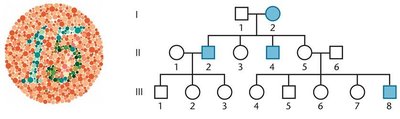
Genes located on the X chromosome exhibit unique inheritance patterns, as males (XY) are hemizygous for X-linked genes. Reciprocal crosses yield different results, as demonstrated by Morgan's studies in Drosophila.
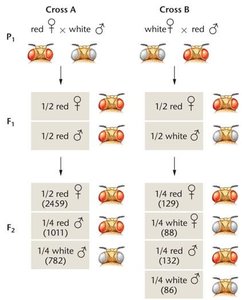
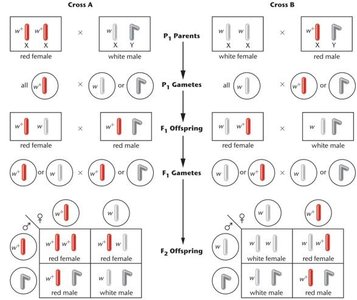
Crisscross inheritance: X-linked traits pass from mother to son.
Human example: Red-green color blindness is X-linked recessive.
Phenotypic Expression and Environmental Effects
Penetrance and Expressivity
Penetrance: Proportion of individuals with a genotype that show the expected phenotype.
Expressivity: Degree to which a phenotype is expressed among individuals with the same genotype.
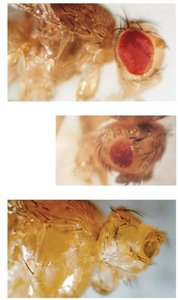
Example: The eyeless mutation in Drosophila shows variable expressivity, from normal eyes to complete absence.
Position Effect
The physical location of a gene on a chromosome can affect its expression, especially if moved to heterochromatin regions by translocation or inversion.
Conditional Mutations
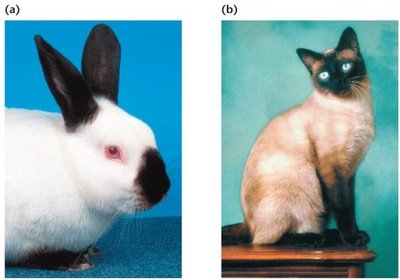
Some mutations express phenotypes only under certain environmental conditions, such as temperature-sensitive mutations. For example, Himalayan rabbits and Siamese cats have darker fur in cooler body regions due to temperature-sensitive pigment production.
Onset of Genetic Expression
Timing of Trait Manifestation
Genetic traits may become apparent at different life stages. Some disorders, such as Tay–Sachs disease, Lesch–Nyhan disease, Duchenne muscular dystrophy, and Huntington disease, manifest at specific developmental periods.
Extranuclear Inheritance
Organelle Heredity and Maternal Effect
Some inheritance patterns deviate from Mendelian rules due to extranuclear genes in mitochondria and chloroplasts, or due to maternal effect genes.
Organelle heredity: Traits determined by genes in mitochondria or chloroplasts, usually inherited maternally.
Maternal effect: Offspring phenotype is determined by the mother's genotype, not the offspring's own genotype.
Examples of Organelle Heredity
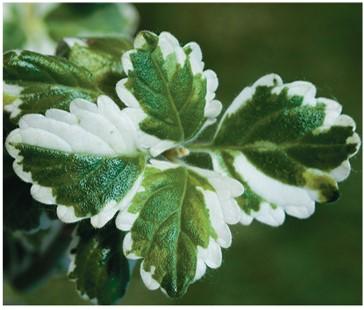
Chloroplast inheritance: Variegation in Mirabilis jalapa (four-o'clock plant) is determined by the ovule's chloroplasts.
Mitochondrial inheritance: Mutations in mitochondrial DNA can cause diseases, such as petite colonies in yeast (Saccharomyces cerevisiae).
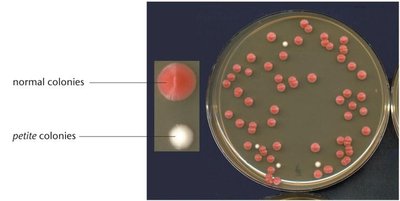
Maternal Effect in Development
Maternal-effect genes, such as bicoid in Drosophila, are crucial for early embryonic patterning. The phenotype of the offspring is determined by the genotype of the mother, as her gene products are deposited in the egg and direct early development.
Additional info: This summary covers the main concepts and examples from the provided materials, expanding on definitions, mechanisms, and applications relevant to the modification of Mendelian ratios and exceptions to classical inheritance patterns.
