 Back
Molecular Biology of Transcription and RNA Processing: Study Notes CH8
Study Guide - Smart Notes
 Tailored notes based on your materials, expanded with key definitions, examples, and context.
Chapter 8: Molecular Biology of Transcription and RNA Processing
8.1 RNA Transcripts Carry the Messages of Genes
Transcription is the process by which genetic information encoded in DNA is transferred to RNA, enabling protein synthesis. RNA molecules are chemically similar to DNA but play distinct roles in cellular function, particularly in the flow of genetic information from the nucleus to the cytoplasm in eukaryotes.
Transcription: Synthesis of a single-stranded RNA molecule from a DNA template by RNA polymerase.
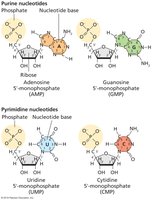
RNA Structure: RNA ribonucleotides consist of a ribose sugar, a nucleotide base (adenine, guanine, cytosine, or uracil), and phosphate groups. Uracil replaces thymine found in DNA, and ribose replaces deoxyribose.
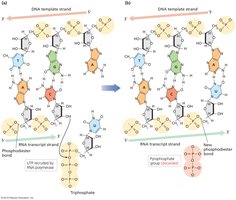
Base Pairing: RNA is synthesized using complementary base pairing: A with U, C with G.
Phosphodiester Bonds: RNA strands are assembled by forming phosphodiester bonds between adjacent nucleotides.
RNA Polymerase: Catalyzes the addition of ribonucleotides to the 3' end of the growing RNA strand, eliminating two phosphates in the process.
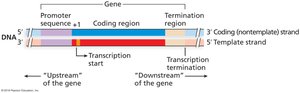
Gene Structure: Genes contain promoter (upstream), coding region, and termination region (downstream) segments, each with distinct functions in transcription.
Categories of RNA
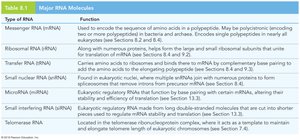
RNA molecules are classified based on their function in the cell. Messenger RNA (mRNA) is translated into protein, while functional RNAs (rRNA, tRNA, snRNA, miRNA, siRNA, telomerase RNA) perform various roles in gene expression and regulation.
mRNA: Short-lived intermediary between DNA and protein; undergoes translation.
rRNA: Combines with proteins to form ribosomes.
tRNA: Binds amino acids and deposits them during protein synthesis.
snRNA: Involved in pre-mRNA splicing.
miRNA/siRNA: Regulatory RNAs involved in gene silencing.
Telomerase RNA: Maintains telomere length.
Type of RNA | Function |
|---|---|
Messenger RNA (mRNA) | Encodes amino acid sequence; undergoes translation |
Ribosomal RNA (rRNA) | Forms ribosomes with proteins |
Transfer RNA (tRNA) | Transfers amino acids during translation |
Small nuclear RNA (snRNA) | Splicing of pre-mRNA |
MicroRNA (miRNA) | Regulates gene expression |
Small interfering RNA (siRNA) | Gene silencing |
Telomerase RNA | Maintains telomeres |
8.2 Bacterial Transcription Is a Four-Stage Process
Bacterial transcription involves four stages: promoter recognition, transcription initiation, chain elongation, and chain termination. The polymerase uses the template strand to assemble a complementary, antiparallel RNA strand.
Template Strand: Used by RNA polymerase for RNA synthesis.
Coding Strand: Complementary to the template strand; not used for transcription.
8.3 Eukaryotic Transcription Is More Diversified and Complex than Bacterial Transcription
Eukaryotic transcription is more complex due to the presence of multiple RNA polymerases, chromatin structure, and posttranscriptional processing. Eukaryotes have three RNA polymerases, each transcribing different types of genes.
RNA Polymerase I: Transcribes rRNA genes.
RNA Polymerase II: Transcribes protein-coding genes and most snRNA genes.
RNA Polymerase III: Transcribes tRNA genes, one snRNA gene, and one rRNA gene.
Chromatin: DNA-protein complex affecting gene regulation.
Introns and Exons: Eukaryotic genes contain introns (non-coding) and exons (coding); introns are removed during RNA processing.
Eukaryotic Promoter Elements
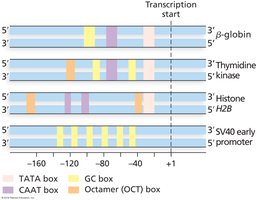
Promoters are DNA sequences that control the initiation of transcription. Eukaryotic promoters often contain consensus sequences such as the TATA box, CAAT box, and GC-rich box, which are recognized by transcription factors.
TATA Box: Most common, located at -25 position; consensus sequence 5'-TATAAA-3'.
CAAT Box: Often found near -80 position.
GC-rich Box: Located at -90 or further upstream; consensus 5'-GGGCGG-3'.
Variability: Promoters vary in type, number, and location of consensus elements.

Pol II Promoter Recognition
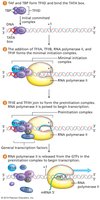
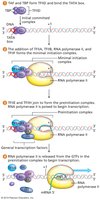
RNA polymerase II recognizes promoter consensus sequences with the help of transcription factors (TFs). The preinitiation complex (PIC) assembles at the TATA box, directing RNA pol II to the +1 position for mRNA synthesis.
TFIID: Multisubunit protein containing TATA-binding protein (TBP) and TBP-associated factors (TAF).
General Transcription Factors: Components of the PIC.
Other Regulatory Sequences and Chromatin-Based Regulation
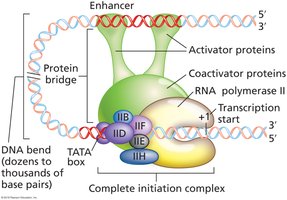
Enhancer and silencer sequences regulate gene expression by increasing or repressing transcription. Chromatin modification and remodeling are epigenetic processes that affect transcription factor accessibility.
Enhancer Sequences: Bind activator proteins and coactivators, forming a protein bridge that bends DNA and increases transcription efficiency.
Silencer Sequences: Bind proteins that repress transcription by shielding DNA from activation.
Chromatin Modification: Alters chromatin state, affecting gene accessibility.
8.4 Posttranscriptional Processing Modifies RNA Molecules
Eukaryotic transcripts undergo posttranscriptional modifications to become mature mRNAs. These modifications include 5' capping, 3' polyadenylation, and intron splicing, which are tightly coupled and essential for mRNA stability and function.
Pre-mRNA: Initial transcript; undergoes processing to become mature mRNA.
5' Capping: Addition and methylation of guanine at the 5' end; protects mRNA and facilitates transport, splicing, and translation.
Polyadenylation: Addition of a poly(A) tail at the 3' end; enhances stability and translation.
Intron Splicing: Removal of introns by the spliceosome; exons are ligated to form mature mRNA.
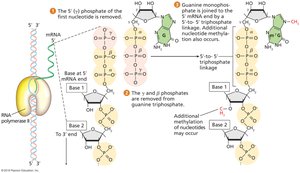
Functions of the 5' Cap and Polyadenylation
5' Cap: Protects mRNA from degradation, facilitates nuclear export, splicing, and translation.
Poly(A) Tail: Protects mRNA, facilitates export, and enhances translation.
Introns and Splicing
Introns are non-coding segments removed from pre-mRNA. Splicing is performed by the spliceosome, which ensures precise removal to prevent errors in protein synthesis. Some introns are self-splicing or removed by enzymatic processes.
Exons: Coding segments retained in mature mRNA.
Spliceosome: snRNA-protein complex responsible for intron removal.
Lariat Structure: Formed during splicing when the 5' intron end binds to branch point adenine.
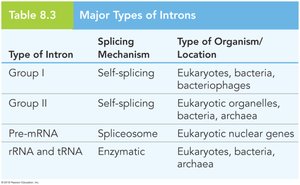
Type of Intron | Splicing Mechanism | Type of Organism/Location |
|---|---|---|
Group I | Self-splicing | Eukaryotes, bacteria, bacteriophages |
Group II | Self-splicing | Eukaryotic organelles, bacteria, archaea |
Pre-mRNA | Spliceosome | Eukaryotic nuclear genes |
rRNA and tRNA | Enzymatic | Eukaryotes, bacteria, archaea |
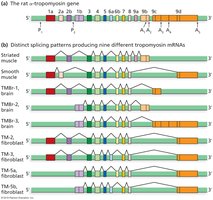
Alternative Patterns of RNA Transcription and Splicing
Alternative splicing, promoters, and polyadenylation allow a single gene to produce multiple protein products, increasing proteomic diversity. This is common in humans and less frequent in other organisms.
Alternative Splicing: Different combinations of exons are joined to produce distinct mRNAs.
Alternative Promoters: Multiple transcription start sites.
Alternative Polyadenylation: Multiple poly(A) signals produce different mRNAs.
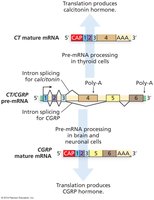
Self-Splicing Introns
Some RNA molecules contain introns that catalyze their own removal. Group I and Group II self-splicing introns are found in various organisms and organelles.
Ribosomal and Transfer RNA Processing
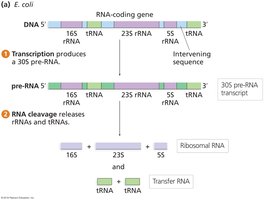
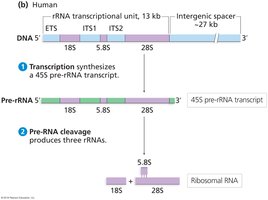
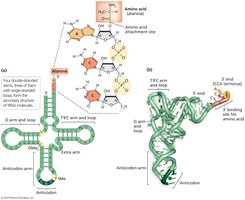
rRNAs are transcribed as large precursors and cleaved into smaller molecules. tRNAs are individually transcribed and processed, with each eukaryotic genome containing all possible tRNA genes.
RNA Editing
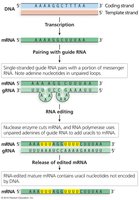
RNA editing involves posttranscriptional changes to the nucleotide sequence of some mRNAs, such as the addition or deletion of uracils, often guided by a complementary guide RNA (gRNA).
Summary Table: Major Types of Introns
Type of Intron | Splicing Mechanism | Type of Organism/Location |
|---|---|---|
Group I | Self-splicing | Eukaryotes, bacteria, bacteriophages |
Group II | Self-splicing | Eukaryotic organelles, bacteria, archaea |
Pre-mRNA | Spliceosome | Eukaryotic nuclear genes |
rRNA and tRNA | Enzymatic | Eukaryotes, bacteria, archaea |
Additional info: The notes expand on brief points with academic context, definitions, and examples to ensure completeness and clarity for Genetics college students.
