 Back
BackMutations and DNA Repair: Mechanisms, Types, and Biological Impact
Study Guide - Smart Notes
 Tailored notes based on your materials, expanded with key definitions, examples, and context.
Mutations and DNA Repair
Introduction to Mutations
Mutations are permanent alterations in the DNA sequence or chromosome structure that generate new alleles, providing the raw material for evolution and genetic diversity. They can occur spontaneously or be induced by external factors, and their effects range from benign to deleterious, depending on their nature and location within the genome.
Somatic mutations: Occur in non-reproductive cells; not heritable.
Germ-line mutations: Occur in gametes; heritable and contribute to evolution and inherited diseases.
Mutations may affect coding regions (exons) or noncoding regions (introns, promoters, enhancers, etc.).
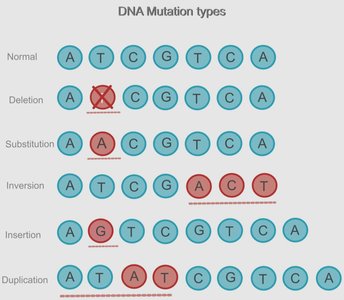
Classification of Gene Mutations
Gene mutations are classified by the molecular changes they introduce and their effects on protein function.
Point mutations (base substitutions): Change of one base pair to another.
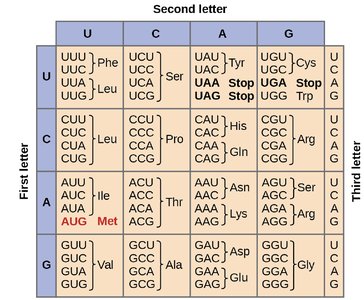
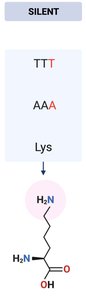
Silent (synonymous) mutation: Alters a codon but does not change the encoded amino acid.
Missense mutation: Changes a codon to encode a different amino acid.
Nonsense mutation: Converts a codon into a stop codon, leading to premature termination of translation.
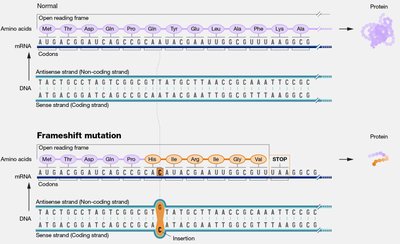
Frameshift mutation: Insertion or deletion of nucleotides that shifts the reading frame, altering downstream amino acid sequence.
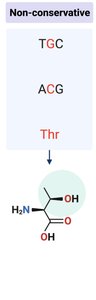
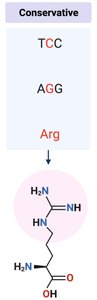
Conservative vs. Non-conservative Missense Mutations
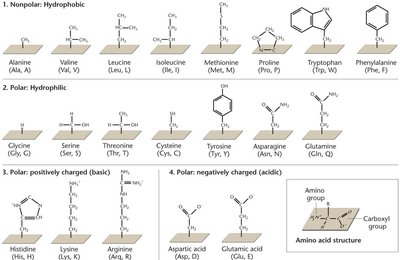
Conservative mutation: New amino acid has similar properties to the original; protein function often preserved.
Non-conservative mutation: New amino acid has different properties; may disrupt protein structure or function.
Frameshift Mutations
Frameshift mutations result from insertions or deletions that are not multiples of three nucleotides, causing a shift in the reading frame and often leading to nonfunctional proteins.
Wobble Hypothesis and Synonymous Mutations
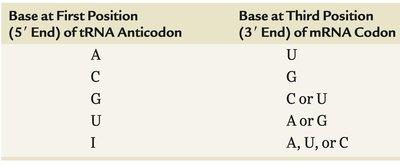
The genetic code is degenerate, meaning multiple codons can encode the same amino acid. The third base of the codon (wobble position) often tolerates variation without altering the amino acid, leading to synonymous (silent) mutations.
Wobble pairing allows one tRNA to recognize multiple codons.
Most synonymous mutations occur at the third codon position.
Types of Base Substitutions
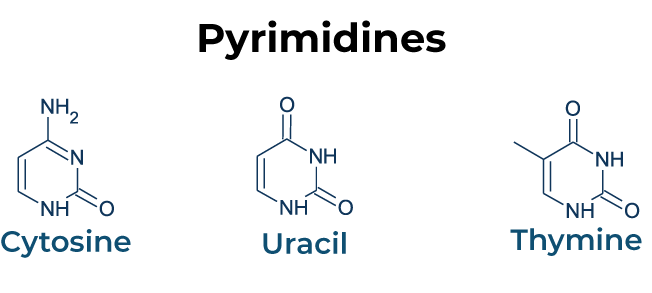
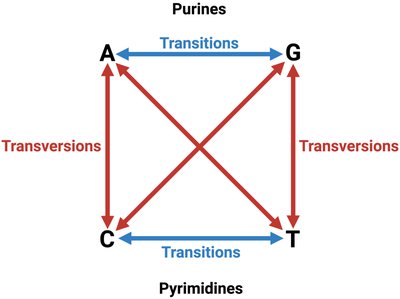
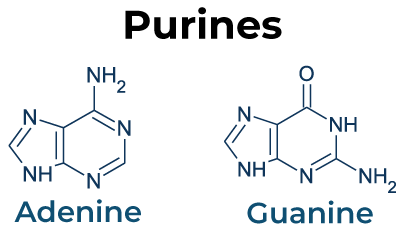
Transitions: Purine-to-purine (A ↔ G) or pyrimidine-to-pyrimidine (C ↔ T) substitutions.
Transversions: Purine-to-pyrimidine or vice versa (A or G ↔ C or T).
Mutation Classification by Location and Phenotype
Autosomal mutations: Affect genes on autosomes (chromosomes 1–22).
X- and Y-linked mutations: Affect genes on sex chromosomes.
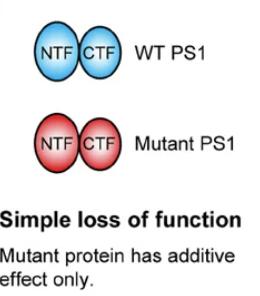
Loss-of-function mutation: Decreased or abolished gene function.
Null mutation: Complete loss of gene function; may be lethal.
Dominant mutation: Phenotype appears in heterozygotes (e.g., Huntington’s disease).
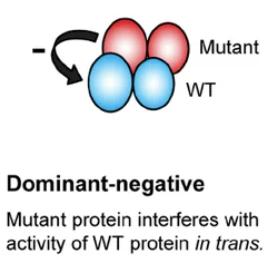
Dominant negative mutation: Mutant protein interferes with normal protein function.
Haploinsufficiency: One functional allele is insufficient for normal function (e.g., Marfan syndrome).
Molecular Causes of Mutations
DNA replication errors: Mismatches during replication can lead to mutations if not corrected by proofreading or mismatch repair.
Spontaneous chemical changes: Depurination (loss of purine base) and deamination (removal of amino group) can alter base pairing.
Mutagens: Physical (UV, X-rays), chemical (base analogs, intercalating agents), or biological agents that increase mutation rates.
Mutation Rates and Genome Size
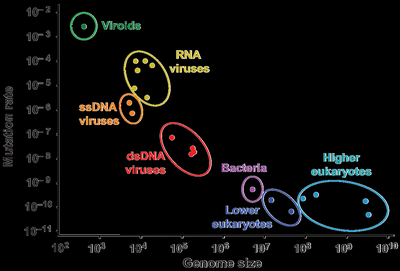
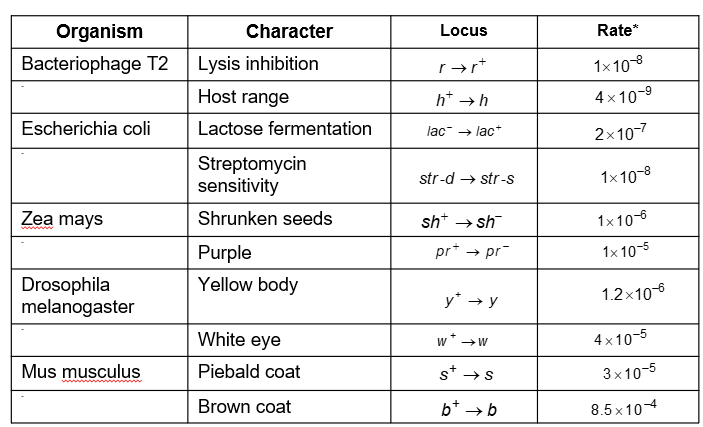
Mutation rates vary among organisms and are influenced by genome size and the fidelity of DNA replication and repair mechanisms.
Viruses (especially RNA viruses) have high mutation rates due to error-prone replication enzymes.
Bacteria and eukaryotes have lower mutation rates due to efficient proofreading and repair systems.
Per base mutation rate decreases with genome size, but total mutations per genome increase in larger genomes.
DNA Repair Mechanisms
Cells possess multiple mechanisms to correct DNA errors and maintain genomic integrity:
Proofreading: DNA polymerase removes mismatched bases during replication using 3′ → 5′ exonuclease activity.
Mismatch repair: Corrects errors missed by proofreading after replication is complete.
Direct repair: Reverses specific base modifications (e.g., photoreactivation of thymine dimers).
Excision repair: Removes damaged bases or nucleotides and fills the gap with new DNA.
Induced Mutations and Experimental Mutagenesis
Mutations can be experimentally induced using chemicals, radiation, or biological systems for research and biotechnology applications.
Base analogs: Mimic normal bases, causing mispairing during replication.
Deaminating agents: Change base identity (e.g., cytosine to uracil).
Alkylating agents: Add alkyl groups to bases, altering pairing properties.
Intercalating agents: Insert between bases, causing insertions or deletions (frameshifts).
UV radiation: Forms thymine dimers, distorting DNA structure.
Ionizing radiation: Causes DNA breaks and chromosomal rearrangements.
Site-directed mutagenesis: Introduces specific mutations at chosen sites for gene editing.
Distribution of Fitness Effects (DFE) of Mutations
The DFE describes how new mutations affect an organism's fitness, influencing evolutionary processes, disease development, and population viability. Most mutations are neutral or deleterious; only a small fraction are beneficial.
Summary Table: Types of Point Mutations and Their Effects
Mutation Type | DNA Change | Protein Effect | Example |
|---|---|---|---|
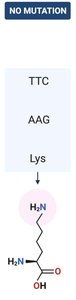
No Mutation | TTC → AAG | Lysine (Lys) | Normal protein |
Silent | TTT → AAA | Lysine (Lys) | No change in protein |
Nonsense | ATC → UAG | STOP codon | Premature termination |
Missense (Conservative) | TCC → AGG | Arginine (Arg) | Similar amino acid |
Missense (Non-conservative) | TGC → ACG | Threonine (Thr) | Different amino acid |
