 Back
BackPatterns of Evolution and Phylogenetic Analysis in Genetics
Study Guide - Smart Notes
 Tailored notes based on your materials, expanded with key definitions, examples, and context.
Patterns of Evolution
Divergent Evolution
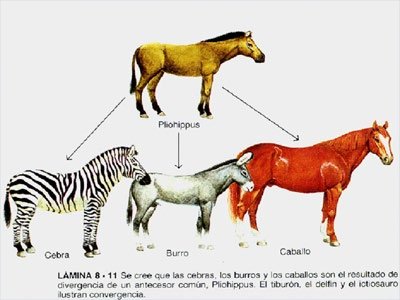
Divergent evolution occurs when two or more species originate from a common ancestor and accumulate differences, leading to the formation of new species. This process can result from either allopatric (geographic separation) or sympatric (within the same area) speciation.
Key Point 1: Divergent evolution explains how related species become increasingly different over time due to adaptation to different environments or ecological niches.
Key Point 2: This pattern is often revealed by homologous structures—traits inherited from a common ancestor but modified for different functions.
Example: The evolution of zebras, donkeys, and horses from a common ancestor demonstrates divergent evolution.
Convergent Evolution
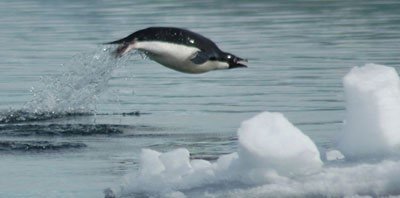
Convergent evolution describes the process by which unrelated species independently evolve similar traits as a result of adapting to similar environments or ecological roles.
Key Point 1: The species involved are not closely related but develop analogous structures—features with similar functions but different evolutionary origins.
Key Point 2: Convergent evolution highlights the power of natural selection in shaping similar adaptations in response to similar selective pressures.
Example: The wings of birds, bats, and insects are analogous structures that evolved independently for flight.
Parallel Evolution
Parallel evolution occurs when two related species or lineages evolve similar traits independently after their divergence from a common ancestor. This typically happens when both species face similar environmental challenges.
Key Point 1: Parallel evolution is distinguished from convergent evolution by the closer evolutionary relationship of the species involved.
Key Point 2: It often results in similar adaptations in closely related groups living in similar habitats.
Example: Placental and marsupial mammals have independently evolved similar forms and ecological roles in different continents.

Coevolution
Coevolution refers to the reciprocal evolutionary changes that occur between pairs or groups of species in response to interactions with each other. This process is common in predator-prey, host-parasite, and mutualistic relationships.
Key Point 1: Adaptations in one species drive the evolution of adaptations in another species.
Key Point 2: Coevolution can lead to highly specialized relationships, such as between flowering plants and their pollinators.
Example: The evolutionary arms race between predators and prey, such as owls and mice.

Speciation and Mechanisms
Sympatric Speciation
Sympatric speciation is the process by which new species arise from a single ancestral species while inhabiting the same geographic region. This contrasts with allopatric speciation, where geographic barriers lead to species divergence.
Key Point 1: Sympatric speciation can occur through mechanisms such as polyploidy, sexual selection, and ecological niche differentiation.
Key Point 2: Genetic changes, such as mutations or chromosomal rearrangements, can lead to reproductive isolation even without physical separation.
Example: Hybridization between bird species resulting in unique color patterns in offspring, which are then incorporated into the population through gene flow.
Phylogeny and Phylogenetic Trees
Phylogeny: Evolutionary Relationships
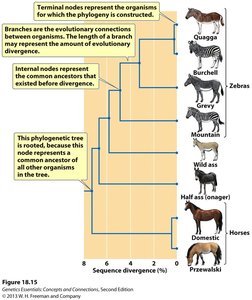
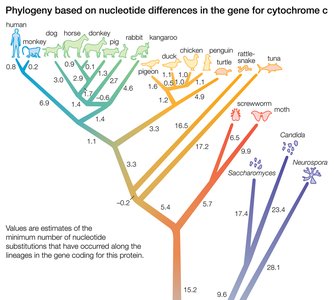
Phylogeny is the study of the evolutionary relationships among groups of organisms. Phylogenetic trees (cladograms) are graphical representations that depict these relationships based on shared characteristics and genetic data.
Key Point 1: Nodes represent common ancestors, with terminal nodes indicating current species and internal nodes indicating ancestral species.
Key Point 2: Branches represent evolutionary lineages, and clades are groups of organisms descended from a common ancestor.
Key Point 3: Taxa (singular: taxon) are the groups or categories of organisms at the tips of the branches.
Methods for Constructing Phylogenetic Trees
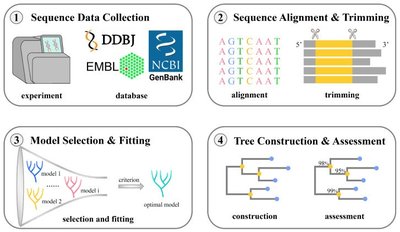
Several approaches are used to infer phylogenetic relationships:
Distance Approach: Based on the overall degree of similarity between organisms, often using genetic or phenotypic data. Requires a distance metric, such as the number of amino acid changes between sequences.
Parsimony Approach: Seeks the tree with the minimum number of evolutionary changes (mutations) required to explain the observed data.
Maximum Likelihood and Bayesian Methods: Use statistical models to estimate the probability of observed data given different tree structures. Maximum likelihood finds the single best tree, while Bayesian methods provide a set of probable trees to assess uncertainty.
Homologous Sequence Alignment
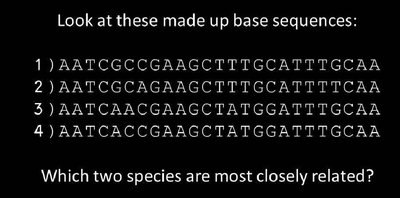
Homologous sequence alignment is a critical step in phylogenetic analysis, allowing researchers to compare DNA, RNA, or protein sequences to identify similarities and differences that inform evolutionary relationships.
Key Point 1: Base substitutions and insertions/deletions (indels) are identified and used to infer evolutionary events.
Key Point 2: Sequence alignment helps distinguish between homologous (shared ancestry) and analogous (convergent) traits.
Avoiding Misinterpretations in Phylogenetic Trees
It is important to interpret phylogenetic trees correctly:
Key Point 1: The proximity of branch tips does not necessarily indicate close relatedness; the number of nodes between taxa and their most recent common ancestor is more informative.
Key Point 2: Phylogenetic trees can be rooted or unrooted, affecting the interpretation of evolutionary relationships.
Molecular Evolution and the Molecular Clock
Rates of Molecular Evolution
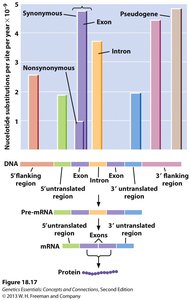
The rate of molecular evolution is typically measured as the rate of nucleotide substitution per site per year. Different types of substitutions and genomic regions evolve at different rates:
Synonymous Substitutions: Do not change the amino acid sequence and usually occur at higher rates due to lack of selective pressure.
Nonsynonymous Substitutions: Change the amino acid sequence and are often subject to natural selection, resulting in lower rates.
Genomic Regions: Coding regions (exons) have lower substitution rates, while non-coding regions (introns, pseudogenes) evolve more rapidly.
The Molecular Clock
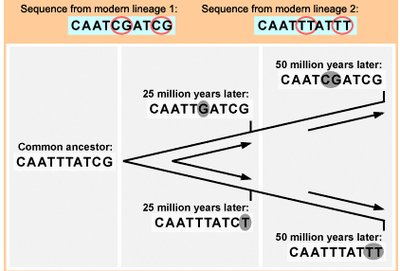
The molecular clock hypothesis posits that genetic mutations accumulate at a relatively constant rate over time, allowing scientists to estimate the timing of evolutionary events.
Key Point 1: The molecular clock is calibrated using fossil records or known divergence times.
Key Point 2: It is particularly useful for dating evolutionary splits when the fossil record is incomplete.
Equation:
Genome Evolution
Gene Duplication and Multigene Families
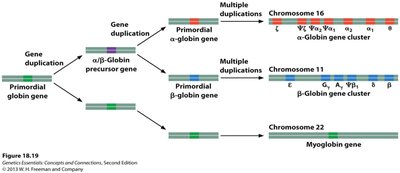
Gene duplication is a major mechanism for generating new genetic material. Duplicated genes can diverge and acquire new functions, leading to the formation of multigene families—sets of genes with similar sequences but different functions.
Key Point 1: One copy of a duplicated gene may accumulate mutations and become a pseudogene (non-functional), while another may evolve a novel function.
Key Point 2: The human globin gene family is a classic example, with multiple genes for oxygen transport arising from successive duplications.
Whole-Genome Duplication (Polyploidy)
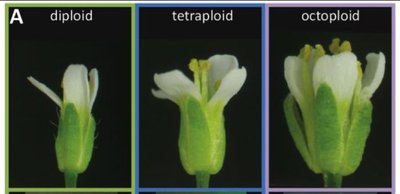
Whole-genome duplication, or polyploidy, involves the duplication of an organism's entire set of chromosomes. This process is common in plants and can lead to rapid speciation and increased genetic diversity.
Key Point 1: Polyploidy can result in diploid, tetraploid, or octoploid organisms, each with multiple sets of chromosomes.
Key Point 2: Polyploidy is less frequent in animals but plays a significant role in plant evolution.
Horizontal Gene Transfer
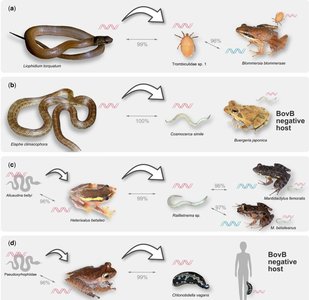
Horizontal gene transfer (HGT) is the movement of genetic material between organisms other than by vertical transmission (parent to offspring). HGT is especially common among bacteria and can occur between bacteria and eukaryotes.
Key Point 1: HGT can obscure traditional phylogenetic relationships, as genes may be acquired from unrelated species.
Key Point 2: HGT is often mediated by vectors such as viruses or parasites.
Summary Table: Patterns and Mechanisms of Evolution
Pattern/Mechanism | Description | Example |
|---|---|---|
Divergent Evolution | Species diverge from a common ancestor | Horse, zebra, donkey |
Convergent Evolution | Unrelated species evolve similar traits | Wings in bats and birds |
Parallel Evolution | Related species evolve similar traits independently | Placental and marsupial mammals |
Coevolution | Species evolve in response to each other | Predator-prey relationships |
Gene Duplication | New genes arise from duplication events | Globin gene family |
Whole-Genome Duplication | Entire genome is duplicated | Polyploid plants |
Horizontal Gene Transfer | Genes transferred between species | Bacterial antibiotic resistance |
Conclusion
Evolutionary genetics encompasses a variety of mechanisms and patterns, including divergent, convergent, parallel, and coevolution, as well as processes such as gene duplication, polyploidy, and horizontal gene transfer. Phylogenetic analysis, using methods like distance, parsimony, and likelihood approaches, allows scientists to reconstruct evolutionary relationships and understand the genetic basis of biodiversity.
