 Back
BackPatterns of Inheritance: Pedigrees and Human Genetic Disorders
Study Guide - Smart Notes
 Tailored notes based on your materials, expanded with key definitions, examples, and context.
Patterns of Inheritance
Introduction to Human Pedigrees
Pedigrees, or family trees, are essential tools in genetics for tracking the inheritance of traits and disorders through generations. They help determine whether a disorder is genetic and elucidate its mode of inheritance. Standardized symbols are used to represent individuals, their biological sex, affected status, and relationships.
Purpose: To analyze inheritance patterns and predict the probability of offspring inheriting specific traits or diseases.
Symbols: Squares represent males, circles represent females, shaded symbols indicate affected individuals, and horizontal lines denote mating pairs.
Complexity: Modern pedigrees may include step-children, half-siblings, adoption, and assisted reproductive technologies, requiring clear rules for interpretation.
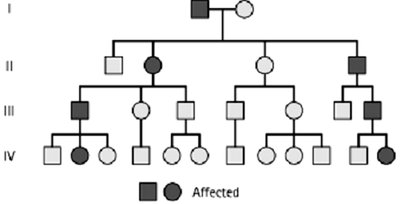
Autosomal Recessive Inheritance
Definition and Expression
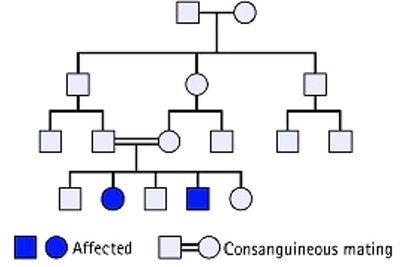
An autosomal recessive trait is expressed only when an individual inherits two copies of the mutant allele (homozygous state). Carriers (heterozygotes) do not show the phenotype but can pass the allele to offspring.
Genotype: Only individuals with two recessive alleles (e.g., dd) are affected.
Carriers: Heterozygotes (Dd) are unaffected but can transmit the allele.
Punnett Square: Used to predict offspring ratios; two carrier parents have a 25% chance of producing an affected child.
Characteristics and Population Factors
Affected individuals often appear in a single generation (horizontal transmission).
Males and females are affected equally.
Increased incidence with consanguinity (inbreeding), genetic isolation, or assortative mating.
Examples of Autosomal Recessive Diseases
Cystic Fibrosis: Carrier frequency 1/22; disease frequency 1/2000.
Oculocutaneous Albinism: Carrier frequency 1/70; disease frequency 1/20,000.
Phenylketonuria: Carrier frequency 1/50; disease frequency 1/10,000.
Tay Sachs Disease: Especially prevalent in Ashkenazi Jews (carrier frequency 1/30).
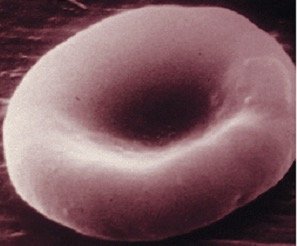
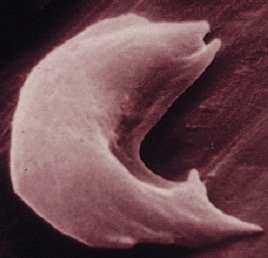
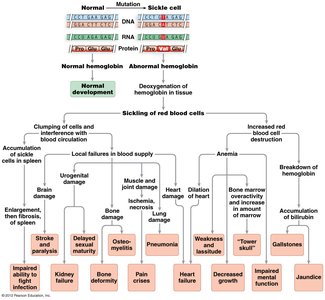
Sickle Cell Disease: Mutation in the beta-globin gene; homozygous individuals are affected, heterozygotes have a milder phenotype (sickle cell trait).
Mechanisms and Pathways
Often due to loss-of-function mutations in enzymes (inborn errors of metabolism).
Can cause accumulation of toxic substrates (e.g., phenylalanine in PKU) or deficiency of essential products (e.g., melanin in albinism).
Autosomal Dominant Inheritance
Definition and Expression
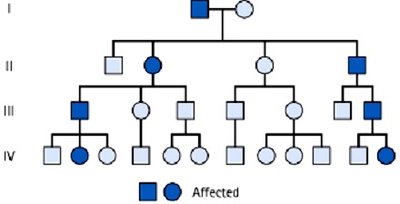
An autosomal dominant trait is expressed in individuals with at least one mutant allele (heterozygous or homozygous dominant). Affected individuals typically appear in every generation (vertical transmission).
Genotype: Both DD and Dd individuals are affected.
Transmission: Each affected parent has a 50% chance of passing the trait to offspring, regardless of sex.
Unaffected individuals: Do not carry the allele and cannot pass it on.
Mechanisms of Dominant Mutations
Haploinsufficiency: One normal allele is insufficient for normal function.
Gain-of-function (Neomorphic): Mutant allele produces increased or new activity.
Dominant Negative (Antimorphic): Mutant protein interferes with normal protein function (e.g., in multimeric proteins like collagen).
Examples of Autosomal Dominant Diseases
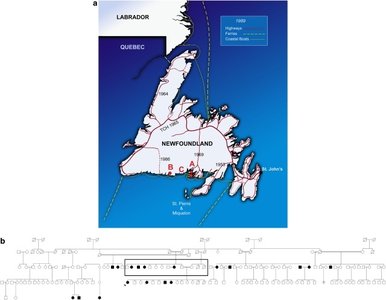
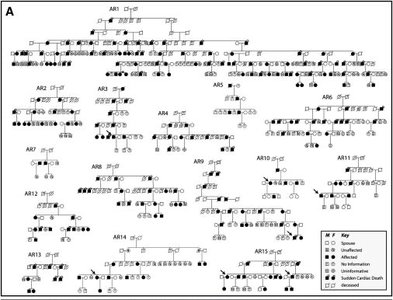
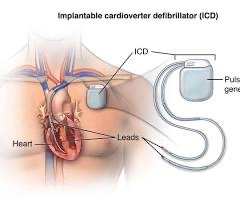
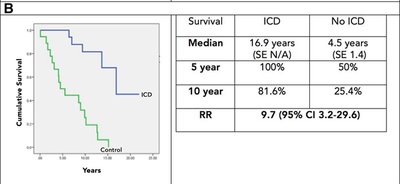
Arrhythmogenic Right Ventricular Cardiomyopathy (ARVC/ACM): Caused by mutations in the TMEM43 gene; identified in Newfoundland families. Early identification and treatment (e.g., ICD implantation) significantly improve survival.
Sex-Linked Inheritance
Sex Chromosomes and Biological Sex Determination
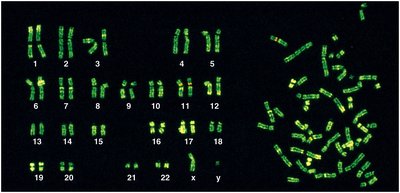
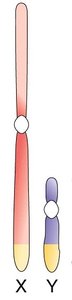
Sex-linked traits are associated with genes located on the sex chromosomes (X or Y). In humans, females are XX and males are XY. Males are hemizygous for X-linked genes, meaning they have only one copy.
X-Linked Recessive Inheritance
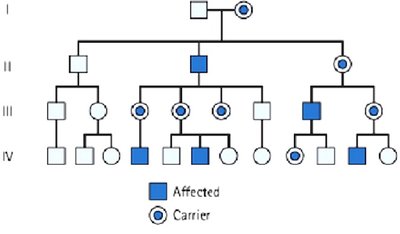
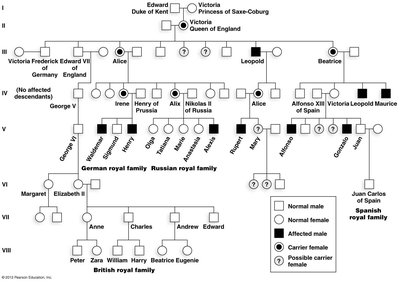
Males are more frequently affected because they have only one X chromosome.
Carrier females (heterozygotes) can pass the trait to 50% of their sons (affected) and 50% of their daughters (carriers).
No male-to-male transmission.
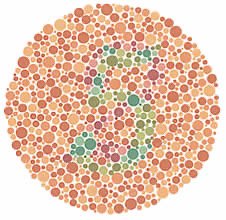
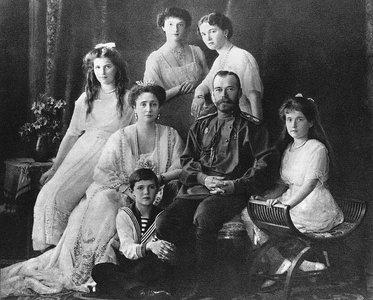
Examples: Red-green color blindness, hemophilia, Duchenne muscular dystrophy.

X-Linked Dominant Inheritance
Affected males pass the trait to all daughters but no sons.
Affected females pass the trait to 50% of sons and daughters.
Females are often less severely affected than males.
Examples: Incontinentia pigmenti, Charcot-Marie-Tooth disease.
Y-Linked Inheritance
Only males are affected and the trait is passed from father to son.
Genes on the Y chromosome are primarily involved in male sex determination and spermatogenesis (e.g., SRY gene).
Mutations often result in sterility and are not passed on.
Summary Table: Patterns of Inheritance
Pattern | Sex Ratio | Transmission | Generational Appearance | Key Features |
|---|---|---|---|---|
Autosomal Dominant | Equal | Parent to offspring (vertical) | Every generation | 50% risk if one parent affected |
Autosomal Recessive | Equal | Often siblings (horizontal) | May skip generations | 25% risk if both parents are carriers |
X-Linked Recessive | More males | Carrier mother to sons | May skip generations | No male-to-male transmission |
X-Linked Dominant | More females | Affected father to all daughters | Every generation | No male-to-male transmission |
Y-Linked | Males only | Father to son | Every generation (if not lethal) | Male infertility if mutated |
Key Concepts and Equations
Mendelian Segregation: Each parent contributes one allele for each gene, leading to predictable ratios in offspring.
Punnett Square: Visual tool for predicting genotype and phenotype ratios.
For two heterozygous parents (Dd x Dd):
Genotypic ratio: 1 DD : 2 Dd : 1 dd Phenotypic ratio (if D is dominant): 3 dominant : 1 recessive
