 Back
BackPedigree Analysis and Sex-Linked Inheritance: Mendelian and Chromosomal Genetics CH3 NEW SEM
Study Guide - Smart Notes
 Tailored notes based on your materials, expanded with key definitions, examples, and context.
Autosomal Inheritance and Pedigree Analysis
Assigning Genotypes in Autosomal Recessive Pedigrees
Pedigree analysis is a fundamental tool in genetics for determining the inheritance pattern of traits and predicting the probability of offspring inheriting specific genotypes or phenotypes. In autosomal recessive inheritance, affected individuals must inherit two copies of the recessive allele (dd), while carriers have one dominant and one recessive allele (Dd).
Genotype Assignment: Use uppercase (D) for the dominant allele and lowercase (d) for the recessive allele. Assign genotypes based on the presence or absence of the trait in the pedigree.
Carrier Probability: Unaffected individuals with affected siblings are likely carriers (Dd).
Conditional Probability: When additional information is known (e.g., individuals are unaffected), probabilities must be adjusted accordingly.
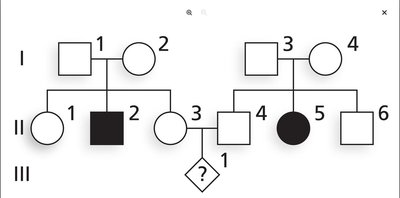
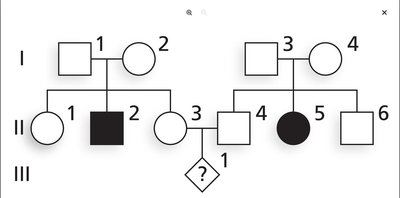
Example: In the provided pedigree, II-2 and II-5 are affected (dd), so their parents must be carriers (Dd). II-3 and II-4 are unaffected siblings of affected individuals, so each has a 2/3 chance of being a carrier (Dd) and a 1/3 chance of being homozygous dominant (DD).
Calculating Offspring Risk for Autosomal Recessive Disorders
To determine the probability that a child will inherit an autosomal recessive disorder, multiply the probabilities that both parents are carriers by the probability that two carriers will have an affected child.
Probability both parents are carriers: (2/3 for mother) × (2/3 for father) = 4/9
Probability two carriers have an affected child: 1/4
Total probability: (4/9) × (1/4) = 1/9
Formula:
Example: If both parents are unaffected siblings of affected individuals, the chance their child will have the disorder is 1/9.
Probability Theory in Mendelian Genetics
Conditional Probability and Mendelian Ratios
Conditional probability is used when additional information modifies the expected Mendelian ratios. For example, knowing an individual is unaffected excludes the homozygous recessive genotype, altering the probability distribution among possible genotypes.
Without phenotype information: Probability of being heterozygous (Dd) is 1/2.
With phenotype information (unaffected): Probability of being Dd is 2/3, DD is 1/3.
Punnett Square for Two Carriers (Dd × Dd):
Genotypic ratio: 1 DD : 2 Dd : 1 dd
Sex Determination and Sex-Linked Inheritance
Chromosomal Basis of Sex Determination
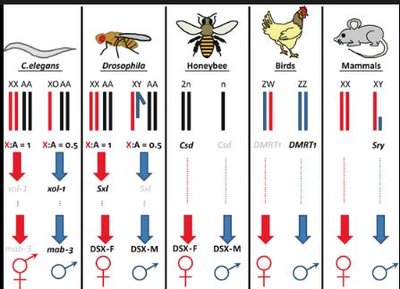
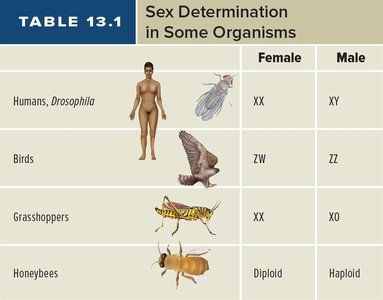
Sex determination systems vary among species and are based on the presence or absence of specific sex chromosomes. In humans and Drosophila, sex is determined by the combination of X and Y chromosomes.
Humans: XX = female, XY = male
Drosophila: XX = female, XY = male (but the ratio of X chromosomes to autosomes is also important)
Birds: ZW = female, ZZ = male
Grasshoppers: XX = female, XO = male
Honeybees: Diploid = female, Haploid = male
X-Linked Inheritance Patterns
X-linked traits are inherited through genes located on the X chromosome. Males are hemizygous for X-linked genes, meaning they have only one copy, so recessive alleles are always expressed in males.
X-linked recessive: More common in males; affected males inherit the allele from their mothers.
X-linked dominant: Affected males pass the trait to all daughters but no sons; affected females can pass the trait to both sons and daughters.
Y-linked: Only males are affected; passed from father to son.
Classic Experiments: Morgan's Drosophila Crosses
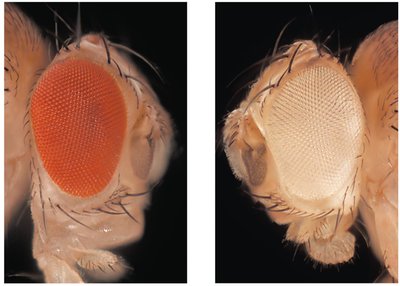
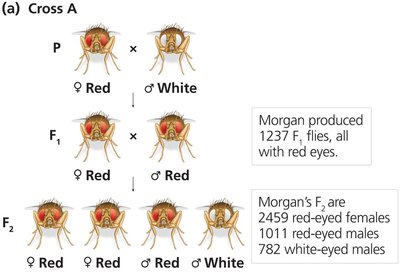
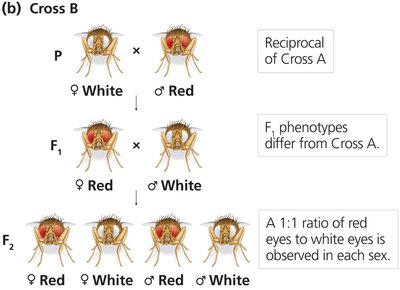
Thomas Hunt Morgan's experiments with Drosophila melanogaster (fruit flies) demonstrated X-linked inheritance. The white-eyed mutation was found to be X-linked and recessive.
Cross A: Red-eyed female × white-eyed male → F1 all red-eyed; F2 shows white eyes only in males.
Cross B (reciprocal): White-eyed female × red-eyed male → F1 red-eyed females, white-eyed males; F2 shows a 1:1 ratio of red to white eyes in both sexes.
Random X-Chromosome Inactivation and Mosaicism
X-Inactivation in Mammals
In female mammals, one of the two X chromosomes in each somatic cell is randomly inactivated early in development, forming a Barr body. This process ensures dosage compensation between males and females.
Barr body: The inactivated X chromosome, visible in the nucleus.
Mosaicism: Females are mosaics for X-linked gene expression, with some cells expressing the maternal X and others the paternal X.
Example: Calico and tortoiseshell cats display mosaic coat color patterns due to X-inactivation.
Summary Table: Sex Determination Systems
Organism | Female | Male |
|---|---|---|
Humans, Drosophila | XX | XY |
Birds | ZW | ZZ |
Grasshoppers | XX | XO |
Honeybees | Diploid | Haploid |
Key Terms and Concepts
Autosomal recessive: Trait expressed only when two recessive alleles are present.
Carrier: Individual with one dominant and one recessive allele; does not express the trait but can pass it on.
Hemizygous: Having only one allele for a gene, as in males for X-linked genes.
Barr body: Inactivated X chromosome in female somatic cells.
Mosaicism: Presence of two or more populations of cells with different genotypes in one individual.
