 Back
BackPopulation and Evolutionary Genetics: Mechanisms, Hardy–Weinberg Law, and Applications
Study Guide - Smart Notes
 Tailored notes based on your materials, expanded with key definitions, examples, and context.
Population and Evolutionary Genetics
Introduction to Population Genetics
Population genetics studies the distribution and change of allele frequencies under the influence of evolutionary processes. It provides the foundation for understanding both microevolution (changes within populations) and macroevolution (the emergence of new species).
Population: A group of individuals of the same species living in a defined area, capable of interbreeding.
Gene pool: The complete set of alleles present in a population.
Heterozygosity: The presence of different alleles at a gene locus within individuals of a population, contributing to genetic variation.
Mechanisms of Microevolution
Forces Affecting Allele Frequencies
Microevolutionary mechanisms alter gene frequencies in populations, driving evolutionary change. The main mechanisms include:
Natural Selection: Differential survival and reproduction of individuals due to differences in phenotype. Traits that enhance survival and reproduction become more common.
Mutation: The only process that creates new alleles, introducing novel genetic variation into the gene pool.
Genetic Drift: Random changes in allele frequencies, especially significant in small populations. Includes the founder effect and genetic bottleneck.
Gene Flow (Migration): Movement of individuals (and their alleles) between populations, altering allele frequencies.
Non-random Mating: Mating that is not random with respect to genotype or phenotype, affecting genotype frequencies.
Hardy–Weinberg Law
Principles and Assumptions
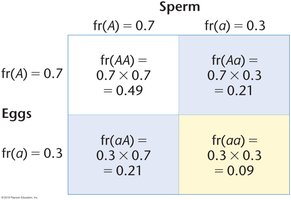
The Hardy–Weinberg law provides a mathematical model to study genetic variation in populations. It predicts how gene frequencies will be inherited from generation to generation under ideal conditions.
Assumptions: No selection, no mutation, no migration, infinitely large population, and random mating.
Consequences: Allele and genotype frequencies remain constant from generation to generation in the absence of evolutionary forces.
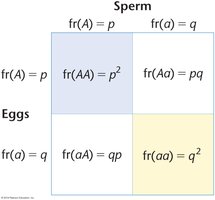
The Hardy–Weinberg equation for two alleles (A and a):
Where = frequency of allele A, = frequency of allele a,
Genotype frequencies: (AA), (Aa), (aa)
Application to Human Populations
The Hardy–Weinberg law is used to study genetic traits in humans, such as disease resistance and blood types. It allows estimation of allele and genotype frequencies from observed data.
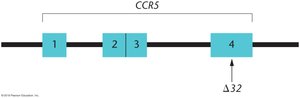
Example: The CCR5 gene and resistance to HIV-1 infection.
The CCR5 gene encodes a protein that acts as a receptor for HIV-1. A 32-bp deletion (Δ32) in exon 4 confers resistance to HIV-1 infection.
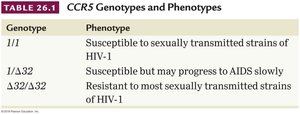
CCR5 Genotypes and Phenotypes
Genotype | Phenotype |
|---|---|
1/1 | Susceptible to sexually transmitted strains of HIV-1 |
1/Δ32 | Susceptible but may progress to AIDS slowly |
Δ32/Δ32 | Resistant to most sexually transmitted strains of HIV-1 |
Experimental Detection of CCR5 Genotypes
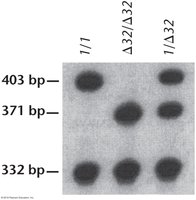
Researchers use PCR and gel electrophoresis to distinguish between CCR5 genotypes based on fragment sizes:
1/1: 332-bp and 403-bp fragments
Δ32/Δ32: 332-bp and 371-bp fragments
1/Δ32: 332, 403, and 371-bp fragments
Calculating Allele Frequencies
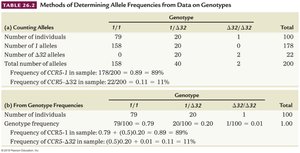
Allele frequencies can be determined by two main methods:
Counting alleles: Directly count the number of each allele in the population.
From genotype frequencies: Use observed genotype frequencies to calculate allele frequencies.
Genotype | Number of Individuals | Genotype Frequency |
|---|---|---|
1/1 | 79 | 0.79 |
1/Δ32 | 20 | 0.20 |
Δ32/Δ32 | 1 | 0.01 |
Hardy–Weinberg with Multiple Alleles
For loci with more than two alleles, the Hardy–Weinberg equation is extended:
Allele frequencies:
Genotype frequencies:
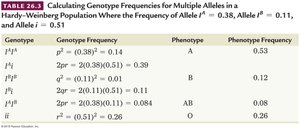
Example: ABO blood group system with three alleles (IA, IB, i):
Genotype | Genotype Frequency | Phenotype | Phenotype Frequency |
|---|---|---|---|
IAIA | (0.38)2 = 0.14 | A | 0.53 |
IBIB | (0.11)2 = 0.01 | B | 0.12 |
ii | (0.51)2 = 0.26 | O | 0.26 |
IAi | 2(0.38)(0.51) = 0.39 | A | 0.53 |
IBi | 2(0.11)(0.51) = 0.11 | B | 0.12 |
IAIB | 2(0.38)(0.11) = 0.08 | AB | 0.08 |
Estimating Heterozygote Frequencies and Disease Incidence
The Hardy–Weinberg law is useful for estimating carrier frequencies of recessive diseases. For example, cystic fibrosis (CF) is an autosomal recessive disorder with an incidence of 1 in 2,600 among people of northern European ancestry.
Incidence of CF (q2) = 0.0004
Recessive allele frequency:
Dominant allele frequency:
Heterozygote frequency: (4%)

Macroevolution, Speciation, and Phylogeny
Speciation and Evolutionary Relationships
Macroevolution involves genetic changes that lead to reproductive isolation and the formation of new species. Speciation is driven by natural selection, genetic drift, or both, resulting in genetic divergence between populations.
Species: Groups of interbreeding organisms reproductively isolated from others.
Speciation: The process by which new species arise due to genetic divergence.
Phylogeny: The evolutionary history of a group, reconstructed from genetic differences.
Phylogenetic tree components: Root (common ancestor), branches (lineages), nodes (splitting points), tips (living/extinct species).
