 Back
BackPopulation Genetic Screening for Autosomal Dominant Diseases: Insights from the Healthy Nevada Project
Study Guide - Smart Notes
 Tailored notes based on your materials, expanded with key definitions, examples, and context.
Genetic Screening and Autosomal Dominant Diseases
CDC Tier 1 (CDCT1) Genetic Conditions
CDC Tier 1 genetic conditions are a group of inherited autosomal dominant disorders with high clinical actionability and significant public health impact. The three main CDCT1 conditions are:
Hereditary Breast and Ovarian Cancer (HBOC) – primarily associated with BRCA1 and BRCA2 genes
Lynch Syndrome (LS) – associated with mismatch repair genes: MLH1, MSH2, MSH6, and PMS2
Familial Hypercholesterolemia (FH) – associated with APOB, LDLR, and PCSK9 genes
These conditions are relatively prevalent but often underdiagnosed using traditional family history-based screening.
Population Genetic Screening
Population genetic screening involves testing large, unselected groups for pathogenic or likely pathogenic (P/LP) variants in genes associated with disease. The Healthy Nevada Project (HNP) evaluated 26,906 participants for P/LP variants in the nine genes linked to HBOC, LS, and FH.
Carrier Rate: 1.33% of participants carried a P/LP variant in one of the nine genes.
Disease Manifestation: 21.9% of carriers had clinically relevant disease, with 70% diagnosed before age 65.
Under-ascertainment: 90% of carriers were not previously identified by routine clinical care or family history.
Genetic Basis and Clinical Impact of CDCT1 Conditions
Genetic Variants and Disease Risk
Pathogenic variants in the genes listed above confer a significantly increased risk for their respective diseases:
HBOC: Increased risk of breast and ovarian cancer
LS: Increased risk of colorectal and other cancers
FH: Increased risk of hyperlipidemia and atherosclerotic cardiovascular disease (ASCVD)
Odds ratios (OR) for disease in carriers compared to non-carriers were substantial, e.g., OR = 9.9 for breast/ovarian cancer in HBOC carriers, OR = 39.4 for colon cancer in LS carriers, and OR = 3.4 for hyperlipidemia in FH carriers.
Penetrance and Age of Onset
Penetrance: Not all carriers develop disease, but risk is significantly elevated.
Age of Onset: Median age at first diagnosis for carriers was 60.5 years; 83.3% of disease presented after age 40, and 70% before age 65.
Clinical Guidelines and Family History
Current guidelines for genetic testing (e.g., NCCN for HBOC/LS, JACC for FH) rely heavily on family history and clinical suspicion.
Only 25.2% of carriers reported a family history of relevant disease, and less than 20% had documentation of inherited risk in medical records.
Many at-risk individuals fall outside current testing guidelines and would not be identified without population screening.
Genetic Testing and Variant Interpretation
Sequencing and Variant Classification
Sequencing: Clinical Exome+ sequencing was used to identify variants.
Annotation: Variants were annotated using tools such as Ensembl Variant Effect Predictor, gnomAD, and ClinVar.
Classification: Variants were classified as pathogenic or likely pathogenic (P/LP) according to ACMG guidelines.
Return of Results and Clinical Follow-up
Participants were notified of secondary findings by clinicians and provided with supporting documentation for follow-up care.
Family history surveys and electronic health record (EHR) analysis were used to assess disease manifestation and risk factors.
Clinical Outcomes and Statistical Analysis
Comparison of Carriers and Non-Carriers
Statistical analyses (e.g., Fisher’s exact test, Cox regression, Kaplan–Meier survival analysis) demonstrated significantly increased disease incidence and earlier onset in carriers of P/LP variants.
HBOC: Carriers had a much higher risk of breast/ovarian cancer compared to non-carriers.
LS: Carriers had a markedly increased risk of colorectal and other cancers.
FH: Carriers had earlier onset of hyperlipidemia and earlier intervention with lipid-lowering medications.
Gene-Specific Effects
Some differences in disease-free survival (DFS) were observed between different genes within the same condition (e.g., MSH6 vs. PMS2 for LS), but not all differences reached statistical significance.
Tables and Figures
Table: Characteristics of Individuals with HBOC, LS, and FH
The following table summarizes the main demographic and clinical features of carriers in the studied cohort:
Condition | Gene(s) | Number of Carriers | Carriers with Medical Records | Median Age (years) | Patients with Clinically Relevant Disease | Within Guidelines for Testing |
|---|---|---|---|---|---|---|
HBOC | BRCA1/BRCA2 | 178 | 135 | 46 | 28 | 44 |
LS | MLH1/MSH2/MSH6/PMS2 | 80 | 66 | 52 | 19 | 15 |
FH | APOB/LDLR/PCSK9 | 102 | 73 | 47 | 13 | 10 |
Additional info: Table entries are summarized from the main text and Table 1 of the source. "Within Guidelines" refers to individuals who would qualify for genetic testing under current clinical guidelines.
Figure: Disease-Free Survival for Hyperlipidemia and Treatment in FH Carriers
Carriers of P/LP variants in FH genes show earlier onset of hyperlipidemia and earlier initiation of lipid-lowering therapy compared to non-carriers.
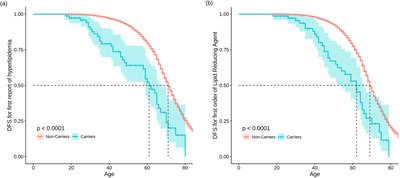
Figure: Gene-Specific Disease-Free Survival Comparisons
Comparisons of disease-free survival between different genes within the same condition (e.g., BRCA1 vs. BRCA2 for HBOC, MSH6 vs. PMS2 for LS, APOB vs. LDLR for FH) reveal gene-specific differences in disease risk and onset.
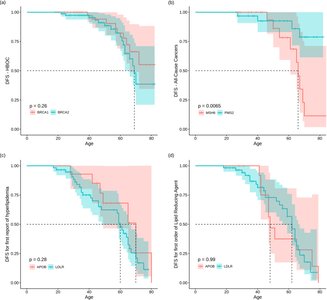
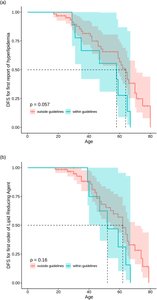
Figure: Impact of Clinical Guidelines on FH Outcomes
For FH, being within or outside current clinical guidelines for genetic testing does not significantly alter the risk or timing of hyperlipidemia or treatment, highlighting the limitations of guideline-based screening.
Implications for Public Health and Clinical Practice
Population screening can identify at-risk individuals who would not be detected by current guidelines.
Early identification of carriers enables earlier intervention and may reduce disease morbidity and mortality.
Limitations: Ethical, social, and economic considerations must be addressed before widespread implementation.
Additional info: The study supports the integration of genetic screening into routine healthcare for actionable conditions, but further research is needed to optimize protocols and address potential challenges.
