 Back
BackPopulation Genetics and the Hardy-Weinberg Law
Study Guide - Smart Notes
 Tailored notes based on your materials, expanded with key definitions, examples, and context.
Population Genetics
Genetic Variation in Populations
Genetic variation is a fundamental characteristic of most populations and species. It provides the raw material for evolution and adaptation, as seen in the wide range of phenotypes within a species, such as the size difference between a Chihuahua and a Great Dane. This variation is maintained and studied within the field of population genetics.
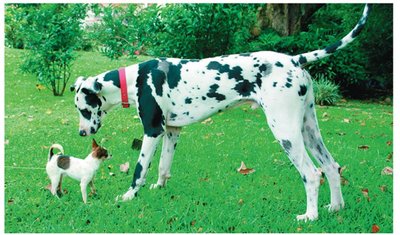
Population: A group of individuals belonging to the same species, living in the same geographic area, and capable of interbreeding.
Gene Pool: The total genetic information carried by all members of a population.
Heterozygosity: Most populations contain a high degree of heterozygosity, meaning many individuals carry different alleles at a given locus.
Example: The diversity in dog breeds is a result of genetic variation within the species Canis lupus familiaris.
Key Terms in Population Genetics
Population Genetics: The study of the genetic composition of populations and how it changes over time and space.
Gene Frequency (Allele Frequency): The relative abundance or rarity of a particular gene (allele) in a population, ranging from 0 to 1.
Hardy-Weinberg Law
Principles and Equilibrium
The Hardy-Weinberg Law provides a mathematical model to study genetic variation in populations under ideal conditions. It predicts how gene and genotype frequencies will remain constant from generation to generation in the absence of evolutionary influences.
Allele Frequencies: For a gene with two alleles, A and a:
Frequency of allele A = p
Frequency of allele a = q
p + q = 1
Genotype Frequencies: In the next generation, the expected frequencies are:
p2: Frequency of homozygous dominant individuals (AA)
2pq: Frequency of heterozygous individuals (Aa)
q2: Frequency of homozygous recessive individuals (aa)
Example: In the ABO blood group system, multiple alleles (IA, IB, IO) can be analyzed using similar principles.
Assumptions of Hardy-Weinberg Equilibrium
No selection (all genotypes have equal fitness)
Random mating
No migration (no gene flow in or out of the population)
No mutation
No genetic drift (population is infinitely large)
Calculating Allele and Genotype Frequencies
Allele Frequencies:
Alternatively,
Genotype Frequencies:
Factors Modifying Gene Frequency
Selection: Artificial or natural selection can change allele frequencies by favoring certain genotypes.
Natural Selection: Individuals with higher viability reproduce more successfully, altering gene frequencies over time.
Testing for Hardy-Weinberg Equilibrium
Chi-Square Analysis
The chi-square (χ2) test is used to determine if observed genotype frequencies deviate significantly from those expected under Hardy-Weinberg equilibrium.
Formula:
If is less than the critical value at 0.05 significance with 1 degree of freedom (3.841), accept the null hypothesis (no significant difference; population is in equilibrium).
If is greater, reject the null hypothesis (significant difference; population is not in equilibrium).
Example Calculation:
Observed: AA = 21, Aa = 53, aa = 26; N = 100
Genotypic Frequencies: AA = 0.21, Aa = 0.53, aa = 0.26
Allele Frequencies: A = 0.48, a = 0.52
Expected (using Hardy-Weinberg): AA = 23, Aa = 50, aa = 27
Chi-square value: 0.39 (which is less than 3.841, so accept H0)
Historical Context
Population genetics was developed by naturalists and agricultural breeders to understand how genetic variation is maintained and how it changes under different evolutionary forces.
