 Back
BackPosttranscriptional Regulation in Eukaryotes: Mechanisms and Biological Implications
Study Guide - Smart Notes
 Tailored notes based on your materials, expanded with key definitions, examples, and context.
Posttranscriptional Regulation in Eukaryotes
Introduction to Posttranscriptional Regulation
Posttranscriptional regulation encompasses all mechanisms that control gene expression after transcription has occurred but before translation into protein. These processes are essential for generating protein diversity, fine-tuning gene expression, and responding to cellular signals. Major mechanisms include alternative splicing, mRNA stability and degradation, noncoding RNAs, mRNA localization, and posttranslational modifications.
Alternative splicing – Generates multiple mRNA isoforms from a single gene.
mRNA stability and degradation – Determines the lifespan of mRNA molecules.
Noncoding RNAs – Regulate gene expression through RNA interference and other mechanisms.
mRNA localization and translation initiation – Control where and when proteins are synthesized.
Posttranslational modifications – Regulate protein activity after translation.
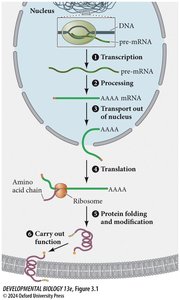
Regulation of Alternative Splicing
Alternative Splicing Creates Diversity in Gene Isoforms
Alternative splicing is a process by which different combinations of exons are joined together to produce multiple mRNA variants (isoforms) from a single pre-mRNA transcript. This mechanism greatly expands the proteome, allowing a limited number of genes to encode a vast array of proteins with distinct functions.
Isoforms – Protein variants produced from the same gene via alternative splicing.
At least two-thirds of human protein-coding genes undergo alternative splicing, resulting in over 290,000 protein isoforms from about 22,000 genes.
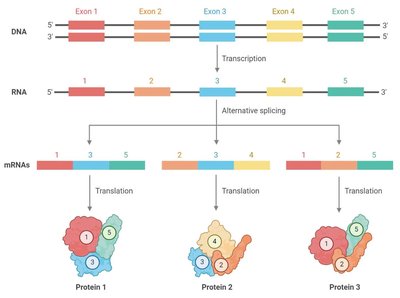
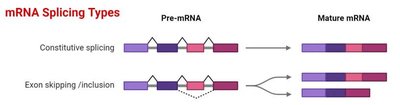
Types of Alternative Splicing
Constitutive splicing – All exons are included in the mature mRNA ("normal" splicing).
Exon skipping (cassette exons) – Specific exons may be included or excluded from the final mRNA. This is the most common form, accounting for 30–40% of events.
Alternative splice sites – Use of different 5' or 3' splice sites within an exon, resulting in inclusion of different exon segments.
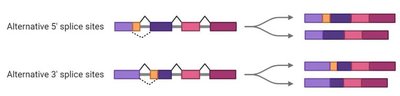
Intron retention – Introns are retained in the mature mRNA, which can lead to novel protein isoforms or mRNA degradation.
Mutually exclusive exons – Only one of two (or more) exons is included in the mature mRNA, allowing for domain swapping in proteins.
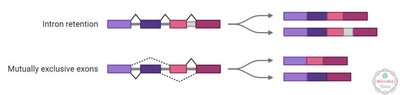
Regulation of Alternative Splicing
Alternative splicing is regulated by cis-acting sequence elements and trans-acting protein factors:
Splicing enhancers (ESE/ISE) – Sequences that promote splicing, bound by SR proteins.
Splicing silencers (ESS/ISS) – Sequences that inhibit splicing, bound by hnRNPs.
Spliceosome components (U1, U2 snRNPs) – Catalyze the splicing reaction.
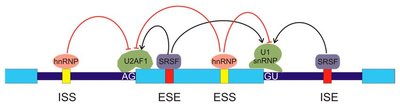
Example: A mutation in an intronic splice enhancer (ISE) can lead to exon skipping or intron retention, potentially resulting in nonfunctional proteins due to frameshifts or premature stop codons.
Biological Significance and Examples of Alternative Splicing
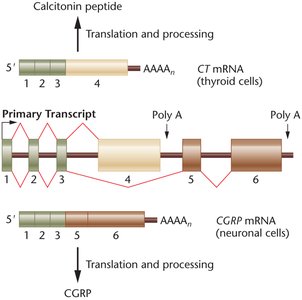
Calcitonin gene – Alternative splicing and polyadenylation produce different hormones in thyroid versus neuronal cells.
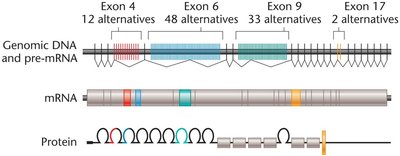
Dscam gene in Drosophila – Can generate 38,016 different protein isoforms, crucial for neuronal identity during development.
Clinical Relevance: Spinal Muscular Atrophy (SMA)
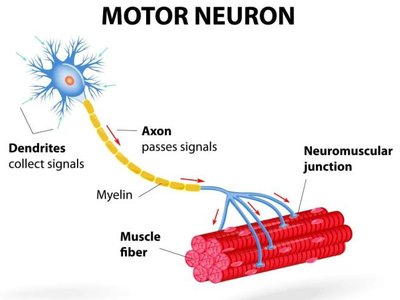
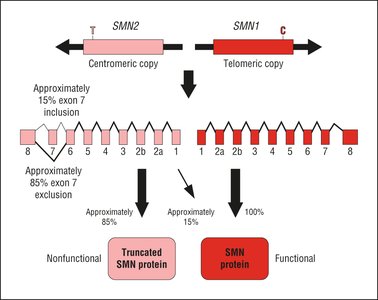
Spinal Muscular Atrophy is a neurodegenerative disease caused by defective splicing of the SMN2 gene, leading to loss of motor neurons and muscle atrophy. The disease is autosomal recessive and is a leading genetic cause of infant mortality.
SMN2 gene – A single nucleotide change disrupts a splice enhancer, causing exon 7 exclusion in most transcripts and resulting in nonfunctional protein.
SMN1 gene – Normally produces functional SMN protein; loss of SMN1 function leads to SMA.


Therapeutic Approaches: Spinraza (Nusinersen)
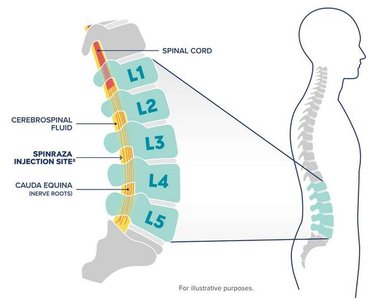
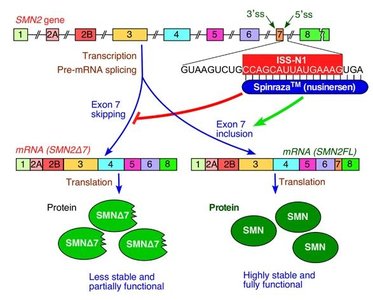
Spinraza is an antisense oligonucleotide therapy that modulates SMN2 splicing by blocking an intronic splicing silencer (ISS-N1), increasing exon 7 inclusion and production of functional SMN protein.
Administered via intrathecal injection into the spinal cord.
Significantly improves outcomes for SMA patients but is costly.
Gene Expression Regulation by mRNA Stability and Degradation
mRNA Decay Pathways
The steady-state level of mRNA in a cell is determined by the balance between transcription and degradation. mRNA decay is a key regulatory step in gene expression.
Deadenylation-dependent decay – Shortening of the poly-A tail by exoribonucleases destabilizes mRNA.
Decapping – Removal of the 5' cap structure makes mRNA susceptible to degradation.
Endonucleolytic cleavage – Internal cleavage of mRNA leads to rapid degradation.
Regulation of mRNA Stability
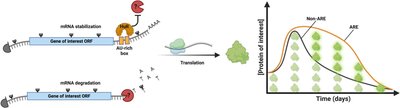
Adenosine–uridine rich elements (AREs) – Cis-acting sequences in the 3' UTR that regulate mRNA stability.
Trans-acting proteins – Bind to AREs to stabilize or destabilize mRNA (e.g., HuR stabilizes mRNA).
Noncoding RNAs in Posttranscriptional Regulation
Types and Functions of Noncoding RNAs (ncRNAs)
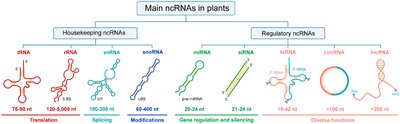
Noncoding RNAs do not encode proteins but play crucial roles in gene regulation, including RNA interference (RNAi), splicing, and chromatin modification.
siRNA (small interfering RNA) – Derived from double-stranded RNA, induces mRNA degradation.
miRNA (microRNA) – Endogenously encoded, regulates gene expression by translational repression or mRNA cleavage.
Mechanism of RNA Interference (RNAi)
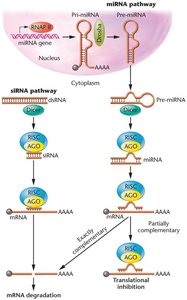
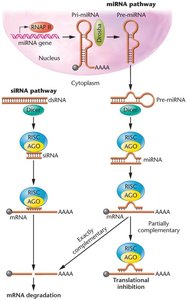
Double-stranded RNA is processed by Dicer into siRNAs or miRNAs.
siRNAs/miRNAs are loaded onto the RISC (RNA-induced silencing complex).
RISC uses the guide strand to target complementary mRNA for cleavage or translational inhibition.
mRNA Localization and Translational Control
Cytoplasmic Polyadenylation and Translational Activation
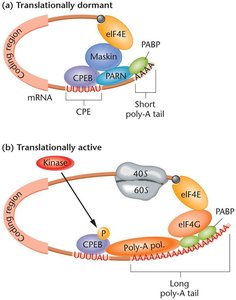
Some mRNAs are stored in a translationally dormant state and activated only in response to specific signals. The cytoplasmic polyadenylation element (CPE) in the 3' UTR is recognized by CPEB, which recruits proteins to repress or activate translation.
Phosphorylation of CPEB by kinases triggers poly-A tail elongation and translation initiation.
mRNA Localization and Localized Translation
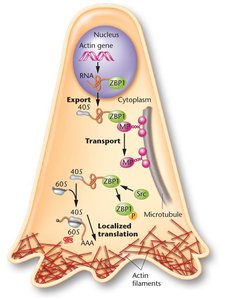
mRNA localization ensures that proteins are synthesized at the correct cellular location. The 3' UTR zip code sequence binds ZBP1, which transports mRNA to specific sites and blocks translation until localization is achieved.
Posttranslational Modifications Regulate Protein Activity
Phosphorylation
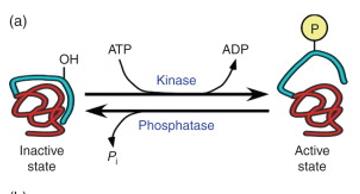
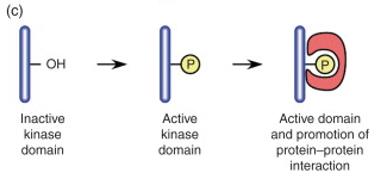
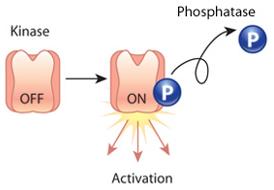
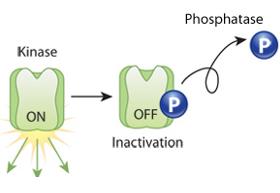
Phosphorylation is the most common posttranslational modification, regulating protein function by adding phosphate groups to serine, threonine, or tyrosine residues. Kinases catalyze phosphorylation, while phosphatases remove phosphates. This modification can activate or inactivate proteins, alter their interactions, or change their cellular localization.
Kinases – Enzymes that add phosphate groups using ATP.
Phosphatases – Enzymes that remove phosphate groups.
Ubiquitin-Mediated Protein Degradation
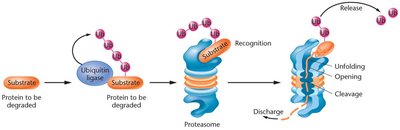
Ubiquitination targets proteins for degradation by the proteasome. Ubiquitin ligases attach ubiquitin molecules to lysine residues on substrate proteins, marking them for recognition and breakdown by the proteasome into small peptides.
Integrated Regulation Example: TNFα mRNA Stability
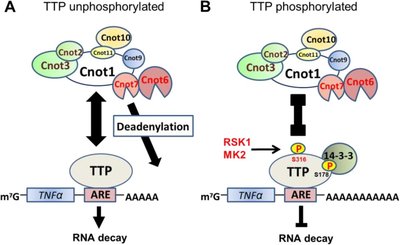
The stability of TNFα mRNA is regulated by the binding of TTP to AREs in the 3' UTR. When TTP is unphosphorylated, it recruits the Cnot deadenylase complex, promoting mRNA decay. Phosphorylation of TTP prevents this interaction, stabilizing the mRNA and increasing protein production. This is a classic example of posttranscriptional regulation modulated by posttranslational modification.
Summary Table: Major Mechanisms of Posttranscriptional Regulation
Mechanism | Description | Key Players | Biological Outcome |
|---|---|---|---|
Alternative Splicing | Generation of multiple mRNA isoforms from one gene | SR proteins, hnRNPs, spliceosome | Protein diversity |
mRNA Stability/Degradation | Regulation of mRNA half-life | AREs, HuR, TTP, deadenylases | Control of protein levels |
Noncoding RNAs | Gene silencing via RNAi | siRNA, miRNA, RISC, Dicer | Translational repression or mRNA cleavage |
mRNA Localization | Transport and local translation of mRNA | Zip code, ZBP1 | Spatial control of protein synthesis |
Posttranslational Modification | Regulation of protein activity after translation | Kinases, phosphatases, ubiquitin ligases | Protein activation/inactivation, degradation |
