 Back
BackChap 18
Study Guide - Smart Notes
 Tailored notes based on your materials, expanded with key definitions, examples, and context.
Posttranscriptional Regulation in Eukaryotes
Overview of Gene Expression Regulation
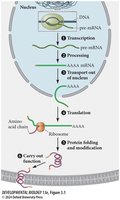
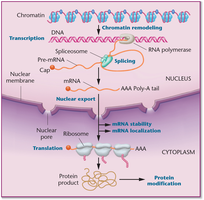
Gene expression in eukaryotes is regulated at multiple levels, including chromatin remodeling, transcription, post-transcriptional, and post-translational modifications. Posttranscriptional regulation offers numerous opportunities to control gene expression after mRNA synthesis, affecting the diversity and function of proteins produced.
Chromatin remodeling and histone modification: Alters DNA accessibility for transcription.
Transcriptional regulation: Controls initiation and elongation of mRNA synthesis.
Post-transcriptional regulation: Includes splicing, mRNA stability, microRNAs, and more.
Post-translational regulation: Modifies proteins after translation, e.g., phosphorylation.
Regulation of Alternative Splicing
Alternative Splicing and Isoform Diversity
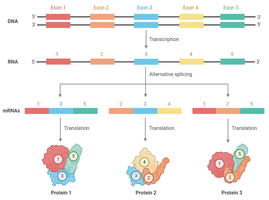
Alternative splicing is a process by which different combinations of exons are joined together from a single pre-mRNA, resulting in multiple mRNA variants (spliceforms) and thus diverse protein isoforms. This mechanism greatly expands the proteome without increasing the number of genes.
Isoforms: Proteins with similar or different functions produced from the same gene.
Pre-mRNA: The initial transcript containing both exons and introns.
Alternative splicing: Generates different mRNAs from the same gene, leading to protein diversity.
Types of Alternative Splicing
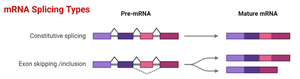
Constitutive splicing: All exons are included in the mature mRNA.
Exon skipping (Cassette exons): Exons may be included or excluded, the most common form (30-40% of events).
Alternative splice sites: Use of different 5' or 3' splice sites within an exon.
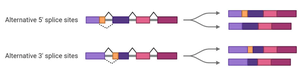
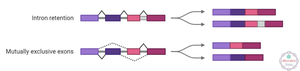
Intron retention: Introns are retained in mature mRNA, potentially leading to non-functional proteins or mRNA degradation.
Mutually exclusive exons: Only one of several possible exons is included, allowing domain swapping in proteins.
Regulation of Splicing
Alternative splicing is regulated by cis-acting sequences and trans-acting factors:
Splicing enhancers (ESE, ISE): Promote inclusion of exons.
Splicing silencers (ESS, ISS): Promote exclusion of exons.
SR proteins: Bind enhancers and recruit spliceosome components.
hnRNPs: Bind silencers and inhibit splicing.
U1 and U2 snRNPs: Core spliceosome machinery catalyzing splicing reactions.
Biological and Medical Relevance of Alternative Splicing
Alternative splicing is essential for generating protein diversity. For example, the Dscam gene in Drosophila can produce 38,016 different protein isoforms, crucial for nervous system development.
Human proteome: At least two-thirds of protein-coding genes undergo alternative splicing, resulting in over 290,000 protein isoforms from ~22,000 genes.
Spinal Muscular Atrophy (SMA) and Splicing Defects
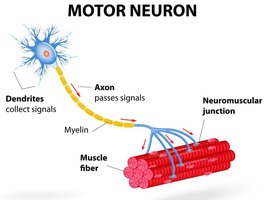
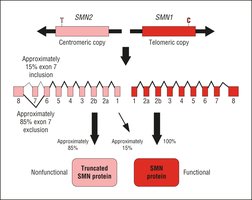
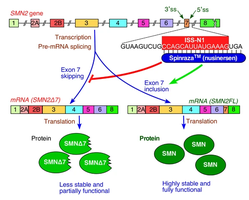
SMA is a neurodegenerative disease caused by defective splicing of the SMN2 gene, leading to loss of motor neurons and muscle weakness. The SMN2 gene has a mutation in a splice enhancer site, causing exclusion of exon 7 and production of non-functional protein.
SMN2 copy number: Modifies disease severity; more copies can lessen symptoms.
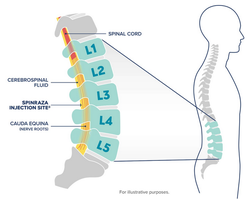
Therapies: Spinraza (nusinersen) is an antisense oligonucleotide that blocks the ISS-N1 site, promoting exon 7 inclusion and increasing functional SMN protein.


Regulation of mRNA Stability and Degradation
mRNA Decay Pathways
The steady-state level of mRNA in a cell is determined by the balance between transcription and degradation. Several pathways regulate mRNA stability:
Deadenylation-dependent decay: Exoribonucleases shorten the poly-A tail, destabilizing mRNA.
Decapping: Removal of the 5' cap makes mRNA susceptible to degradation.
Endonucleolytic cleavage: Internal cuts in mRNA lead to rapid degradation.
Regulation by Adenosine–Uridine Rich Elements (AREs)
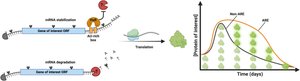
AREs are cis-acting sequence elements in the 3' untranslated region of mRNAs that regulate stability. Trans-acting proteins, such as HuR, bind to AREs to stabilize mRNA and promote translation.
Noncoding RNAs in Posttranscriptional Regulation
Noncoding RNAs (ncRNAs)
Noncoding RNAs do not encode proteins but play critical roles in gene regulation, including posttranscriptional control.
RNA interference (RNAi): Sequence-specific silencing of gene expression by short RNAs.
siRNAs: Double-stranded RNAs cleaved by Dicer, incorporated into RISC, and guide mRNA cleavage.
microRNAs (miRNAs): Endogenous ncRNAs that regulate gene expression by blocking translation or promoting mRNA degradation.
Therapeutic applications include drugs like Inclisiran, which uses RNAi to lower LDL cholesterol.
Posttranslational Modifications Regulate Protein Activity
Protein Modification by Phosphorylation
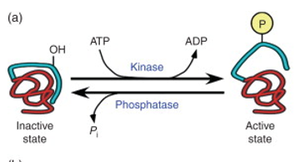
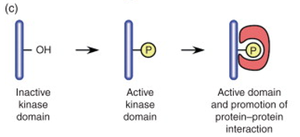
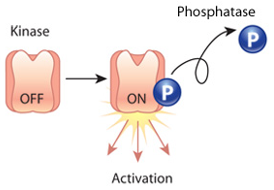
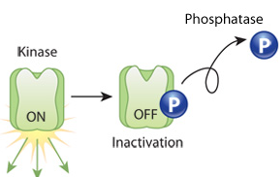
Phosphorylation is the most common posttranslational modification, regulating protein activity, localization, and interactions. Kinases add phosphate groups to serine, threonine, or tyrosine residues, while phosphatases remove them.
Conformational changes: Phosphorylation often induces structural changes, altering protein function.
Regulation: Can activate or inactivate proteins, depending on context.
Ubiquitin-Mediated Protein Degradation
Ubiquitination targets proteins for degradation by the proteasome, a multi-subunit complex with protease activity. Proteins are covalently modified with ubiquitin, recognized by the proteasome, and broken down into small peptides.
Summary Table: Types of Alternative Splicing
Type | Description | Effect |
|---|---|---|
Constitutive Splicing | All exons included | "Normal" protein |
Exon Skipping | Exons may be skipped | Protein diversity |
Alternative Splice Site | Different 5' or 3' sites used | Protein diversity |
Intron Retention | Introns retained in mRNA | Non-functional or degraded mRNA |
Mutually Exclusive Exons | Only one of several exons included | Domain swapping in proteins |
Key Equations
mRNA Steady-State Level:
Protein Diversity from Alternative Splicing:
Conclusion
Posttranscriptional regulation is a critical aspect of gene expression in eukaryotes, contributing to protein diversity, cellular function, and disease mechanisms. Understanding these processes is essential for genetics students, especially in the context of human health and therapeutic interventions.
