 Back
BackProbability Rules and Binomial Distribution in Transmission Genetics
Study Guide - Smart Notes
 Tailored notes based on your materials, expanded with key definitions, examples, and context.
Probability in Transmission Genetics
Introduction to Probability
Probability is a fundamental concept in genetics, used to predict the likelihood of genetic events such as inheritance patterns. Understanding probability rules is essential for solving problems in transmission genetics, including Mendelian ratios and genetic crosses.
Probability of an Event: The frequency of a specific event among all possible events. For example, the probability of getting heads in a single coin toss is 1/2.
Sum of Probabilities: The probabilities of all possible outcomes must add up to 1.
Example: Tossing a coin: Probability of heads = 1/2; Probability of tails = 1/2.
Additive Rule of Probability
The additive rule applies when two events are mutually exclusive (cannot happen at the same time). The probability that either event occurs is the sum of their individual probabilities.
Formula:
Example: Probability of rolling an even number on a die (2, 4, or 6):
Independent Events and the Multiplicative Rule
Two events are independent if the occurrence of one does not affect the probability of the other. The probability that both independent events occur is the product of their individual probabilities.
Formula:
Example: Probability of getting heads three times in a row:
Conditional Probability
Conditional probability is the probability of an event (A) occurring given that another event (B) has already occurred. This is useful in genetics when additional information is known about an outcome.
Formula:
Example: If a family has two children and one is known to be a boy, the probability that both are boys is .
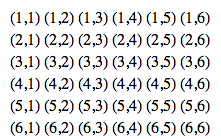
Example: Probability that both dice show 2 given their sum is 4: .
Binomial Distribution in Genetics
Introduction to the Binomial Distribution
The binomial distribution is used to calculate the probability of obtaining a specific number of successes in a fixed number of independent trials, where each trial has two possible outcomes (success or failure). This is commonly applied in genetics to predict the distribution of genotypes or phenotypes in offspring.
Formula:
Where:
n: Number of trials
X: Number of successes
p: Probability of success
q: Probability of failure ()
Example: Coin Toss
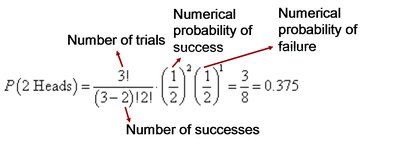
Find the probability of getting exactly two heads in three coin tosses.
There are three ways to get two heads: HHT, HTH, THH.
Probability:
Using the formula:
Example: Multiple-Choice Questions
If a student randomly guesses on five multiple-choice questions (each with five choices), the probability of getting exactly three correct is calculated using the binomial formula.
n = 5 (number of questions)
X = 3 (number of correct answers)
p = 1/5 (probability of guessing correctly)
q = 4/5 (probability of guessing incorrectly)
Formula:
Applications in Genetics
Probability and binomial distribution are essential for predicting the outcomes of genetic crosses, such as the likelihood of inheriting certain traits or the expected ratios of genotypes and phenotypes in offspring.
Example: Predicting the probability of a child inheriting a recessive genetic disorder when both parents are carriers.
