 Back
BackRegulation of Gene Expression in Bacteria: The lac and trp Operons
Study Guide - Smart Notes
 Tailored notes based on your materials, expanded with key definitions, examples, and context.
Regulation of Gene Expression in Bacteria
Overview of Gene Regulation
Gene expression in bacteria is tightly regulated to ensure that proteins are produced only when needed, optimizing energy and resource use. This regulation allows bacteria to adapt rapidly to environmental changes by altering the synthesis of enzymes and other proteins.
Inducible enzymes: Produced only in the presence of specific substrates (e.g., enzymes for lactose metabolism in E. coli).
Constitutive enzymes: Continuously produced regardless of environmental conditions.
Repressible systems: Gene expression is inhibited by the abundance of a specific molecule (e.g., tryptophan synthesis enzymes).
Positive and Negative Control of Transcription
Transcriptional regulation in bacteria can occur via two main mechanisms:
Negative control: Transcription occurs unless it is shut off by a regulatory molecule (repressor).
Positive control: Transcription occurs only when a regulatory molecule (activator) stimulates RNA production.
The Operon Model
Structure and Function of Operons
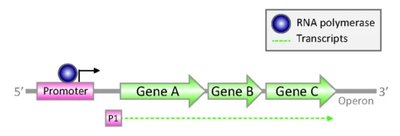
An operon is a cluster of genes with related functions that are transcribed together under the control of a single regulatory region. This arrangement allows for coordinated regulation of genes involved in a common pathway.
Genes are contiguous on the bacterial chromosome.
Regulatory region (promoter and operator) is located upstream (5') of the gene cluster.
Lactose Metabolism and the lac Operon
Inducible System: The lac Operon
The lac operon in E. coli is a classic example of an inducible gene system. It enables the bacterium to metabolize lactose only when it is present in the environment.
lacZ: Encodes β-galactosidase, which converts lactose into glucose and galactose.
lacY: Encodes permease, which facilitates lactose entry into the cell.
lacA: Encodes transacetylase, which removes toxic by-products of lactose digestion.

Polycistronic mRNA and Coordinated Regulation
All three structural genes of the lac operon are transcribed as a single unit, resulting in a polycistronic mRNA. This allows for simultaneous translation of all gene products, ensuring coordinated regulation.

Regulatory Regions and Factors
Gene expression in the lac operon is controlled by interactions between cis-acting sites (DNA sequences on the same molecule) and trans-acting factors (diffusible gene products, such as proteins).
Operator (O): Cis-acting site where the repressor binds.
Promoter (P): Cis-acting site where RNA polymerase binds to initiate transcription.
lacI gene: Encodes the repressor protein (trans-acting factor).
Negative Control: The lac Repressor
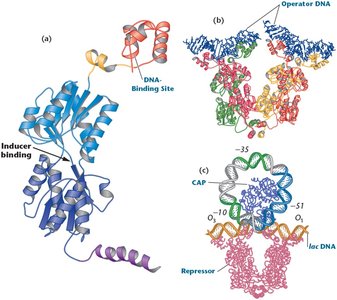
The lacI gene produces an allosteric repressor protein that binds to the operator, blocking RNA polymerase and repressing transcription in the absence of lactose. When lactose is present, it binds to the repressor, causing a conformational change that prevents the repressor from binding the operator, thus allowing transcription.
Mutations Affecting the lac Operon
Constitutive mutations (lacI-, lacOC): Lead to continuous expression of structural genes, regardless of lactose presence.
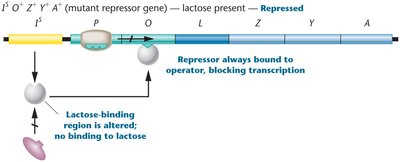
lacIS mutation: Produces a superrepressor that cannot bind lactose, resulting in permanent repression.
Catabolite Repression and Positive Control
When both glucose and lactose are present, E. coli preferentially uses glucose. The presence of glucose inhibits the lac operon via catabolite repression. The catabolite activator protein (CAP) must bind to cAMP to activate transcription. High glucose inhibits adenyl cyclase, reducing cAMP levels and preventing CAP binding, thus repressing the lac operon.
cAMP-CAP complex: Required for maximal transcription of the lac operon.
Glucose present: Low cAMP, CAP does not bind, lac operon off.
Glucose absent: High cAMP, CAP binds, lac operon on (if lactose is present).
The trp Operon: Repressible System
Regulation of Tryptophan Synthesis
The trp operon in E. coli is a repressible system that controls the synthesis of tryptophan. When tryptophan is abundant, it acts as a corepressor, binding to the trp repressor and enabling it to bind the operator, thus blocking transcription.
trpR gene: Encodes the repressor protein (inactive without tryptophan).
trpP: Promoter region for RNA polymerase binding.
trpO: Operator region for repressor binding.
Five structural genes: Encode enzymes for tryptophan biosynthesis.
Attenuation: Fine-Tuning trp Operon Expression
Attenuation is a regulatory mechanism that causes premature termination of transcription when tryptophan is abundant. The leader sequence of the trp mRNA can form alternative stem-loop structures (antiterminator or terminator) depending on tryptophan availability.
Low tryptophan: Ribosome stalls, antiterminator forms, transcription proceeds.
High tryptophan: Ribosome does not stall, terminator forms, transcription stops.
RNA as Regulators: Riboswitches and sRNAs
RNA molecules can regulate gene expression through mechanisms such as riboswitches and small noncoding RNAs (sRNAs).
Riboswitches: mRNA regions that bind small ligands, causing conformational changes that affect transcription or translation.
sRNAs: Bind to mRNA, masking the ribosome binding site (RBS) and blocking or enabling translation.
Summary Table: Comparison of lac and trp Operons
Feature | lac Operon | trp Operon |
|---|---|---|
Type of Regulation | Inducible | Repressible |
Regulatory Molecule | Lactose (inducer) | Tryptophan (corepressor) |
Default State | Off (repressed) | On (expressed) |
Regulatory Protein | Repressor (lacI) | Repressor (trpR) |
Additional Regulation | Catabolite repression (CAP-cAMP) | Attenuation |
Key Points
Gene expression in bacteria is regulated at the transcriptional level by both negative and positive control mechanisms.
The lac operon is an inducible system regulated by lactose and glucose availability.
The trp operon is a repressible system regulated by tryptophan levels and attenuation.
RNA molecules, such as riboswitches and sRNAs, provide additional layers of gene regulation.
