 Back
BackRegulation of Gene Expression in Bacteria and Bacteriophage: The lac Operon Paradigm
Study Guide - Smart Notes
 Tailored notes based on your materials, expanded with key definitions, examples, and context.
Regulation of Gene Expression in Bacteria and Bacteriophage
Transcriptional Control and DNA–Protein Interactions
Gene expression in bacteria is primarily regulated at the transcriptional level, involving specific interactions between DNA-binding proteins and regulatory DNA sequences. This regulation ensures that genes are expressed only when needed, optimizing cellular resources and responses to environmental changes.
Constitutive transcription: Genes that are continuously expressed to perform routine cellular functions.
Regulated transcription: Genes expressed only in response to specific environmental signals.
Regulation can affect both the initiation and the amount of transcription.
Most gene regulation in bacteria is transcriptional, but post-transcriptional mechanisms (such as mRNA degradation and translation inhibition) also play roles.
Mechanisms for Regulating Bacterial Gene Expression
Type | Mechanism | Example |
|---|---|---|
Transcriptional Regulation | Inducible transcription | lac operon |
Transcriptional Regulation | Repressible transcription | trp operon |
Transcriptional Regulation | Attenuation | trp operon, riboswitches |
Posttranscriptional Regulation | mRNA destruction | riboswitches |
Posttranscriptional Regulation | Translation blockage | antisense RNA, riboswitches |
Negative and Positive Control of Transcription
Transcriptional regulation can be classified as negative or positive control, depending on the role of regulatory proteins.
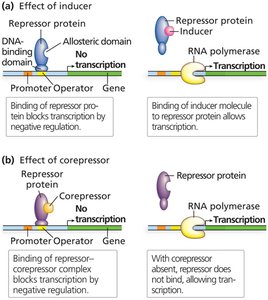
Negative control: A repressor protein binds to a regulatory DNA sequence (operator), blocking transcription.
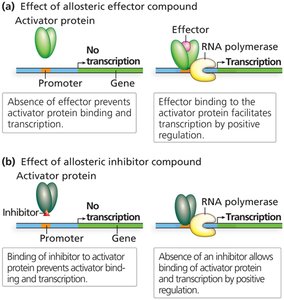
Positive control: An activator protein binds to a regulatory DNA sequence, facilitating RNA polymerase binding and initiating transcription.
Repressor Proteins and Allostery
Repressor proteins are regulatory proteins that exert negative control. They typically have two functional domains:
DNA-binding domain: Binds to operator or other regulatory DNA sequences.
Allosteric domain: Binds small molecules (inducers or corepressors), causing conformational changes that affect DNA binding (allostery).
Allostery can either inactivate or activate the DNA-binding domain, depending on the regulatory system.
Activator Proteins and Positive Control
Activator proteins facilitate transcription by binding to activator binding sites near promoters. Their activity is often regulated by allosteric effectors or inhibitors.
Binding of an effector can activate the DNA-binding domain, promoting transcription.
Binding of an inhibitor can inactivate the DNA-binding domain, preventing transcription.
Structural Features of DNA-Binding Proteins
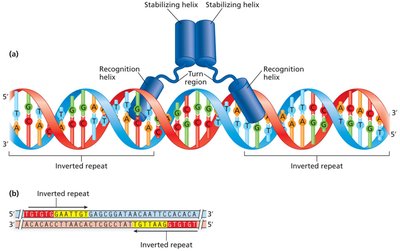
DNA-binding proteins recognize specific DNA sequences through motifs such as the helix-turn-helix (HTH) structure. These motifs allow proteins to interact with inverted or direct repeats in regulatory DNA regions.
Regulatory proteins may function as homodimers or heterodimers, contacting repeated DNA sequences.
The HTH motif consists of two α-helices separated by a turn, with one helix recognizing the DNA sequence and the other stabilizing the interaction.
The lac Operon: An Inducible Operon System
Overview of the lac Operon
The lac operon of Escherichia coli is a classic example of an inducible operon system, coordinating the expression of genes required for lactose metabolism. Operons are clusters of genes under the control of a shared regulatory region, allowing coordinated expression.
The lac operon encodes three structural genes: lacZ (β-galactosidase), lacY (permease), and lacA (transacetylase).
Expression is regulated by the presence or absence of lactose and glucose.
Lactose Metabolism and Induction
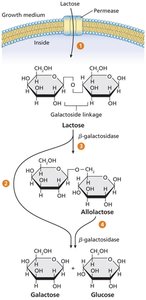
Lactose is a disaccharide composed of glucose and galactose. Its utilization is controlled by the lac operon, which is induced only when lactose is present and glucose is absent.
Permease allows lactose to enter the cell.
β-galactosidase cleaves lactose into glucose and galactose, and also converts some lactose into allolactose, the inducer molecule.
Allolactose binds to the lac repressor, inactivating it and allowing transcription.
lac Operon Structure and Regulatory Regions
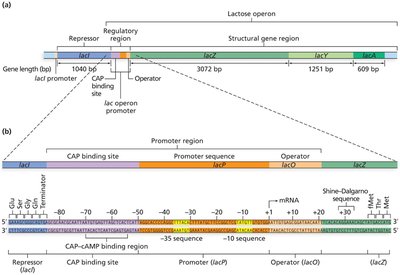
The lac operon consists of a multipart regulatory region and three structural genes. The regulatory region includes:
Promoter (lacP): Binds RNA polymerase.
Operator (lacO): Binds the lac repressor protein.
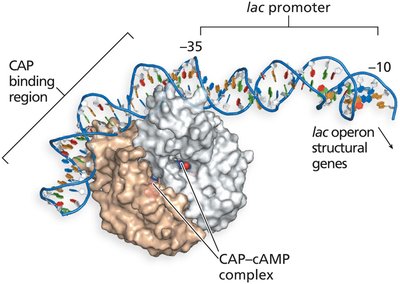
CAP binding site: Binds the catabolite activator protein (CAP)–cAMP complex for positive control.
Regulation of the lac Operon
The lac operon is subject to both negative and positive control:
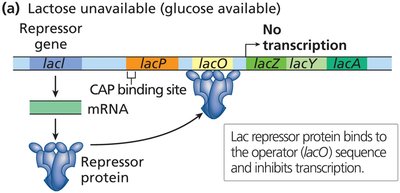
Negative control: In the absence of lactose, the lac repressor binds to the operator, blocking transcription.
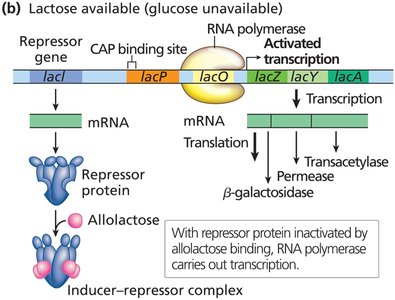
Induction: When lactose is present (and glucose is absent), allolactose binds the repressor, preventing it from binding the operator and allowing transcription.
Positive control: The CAP–cAMP complex binds to the CAP site, enhancing RNA polymerase binding and increasing transcription when glucose is absent.
Levels of lac Operon Transcription
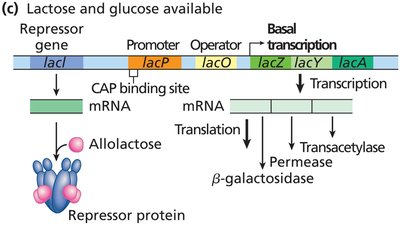
Even in the absence of lactose, the repressor occasionally releases from the operator, allowing low-level (basal) transcription.
Basal transcription produces small amounts of permease and β-galactosidase, enabling the cell to respond quickly if lactose becomes available.
Mutational Analysis of the lac Operon
Genetic Dissection of the lac Operon
Mutational analysis by Jacob, Monod, and colleagues identified the functions of each gene and regulatory region in the lac operon. Complementation analysis in partial diploids (merodiploids) was used to assign mutations to specific genes.
Key Genes, Regulatory Sequences, and Mutants
Gene/Sequence | Product/Type | Function | Important Mutants |
|---|---|---|---|
lacI | Repressor protein | Binds operator and allolactose | I−: Cannot bind operator IS: Super-repressor, cannot bind allolactose |
lacZ | β-galactosidase | Cleaves lactose | Z−: No β-galactosidase |
lacY | Permease | Lactose transport | Y−: No permease |
lacA | Transacetylase | Protects against by-products | A−: No transacetylase |
lacO | Operator | Binds repressor | OC: Fails to bind repressor, constitutive transcription |
lacP | Promoter | Binds RNA polymerase | P−: Fails to bind RNA polymerase |
Complementation Analysis
Complementation analysis in partial diploids demonstrated that wild-type alleles of lacZ and lacY can complement mutant alleles, restoring function. This analysis helped define the cis- and trans-acting elements of the operon.
Regulatory Mutations and Their Effects
lacI−: Repressor cannot bind operator; results in constitutive transcription.
lacIS: Super-repressor cannot bind allolactose; operon is never induced.
lacOC: Operator cannot bind repressor; results in constitutive transcription.
lacP−: Promoter cannot bind RNA polymerase; no transcription occurs.
Summary Table: Effects of Key Mutations
Genotype | β-Galactosidase (Lactose) | β-Galactosidase (No Lactose) | Permease (Lactose) | Permease (No Lactose) | Description |
|---|---|---|---|---|---|
I+ P+ O+ Z+ Y+ | + | − | + | − | Wild-type (lac+) |
I+ P+ O+ Z− Y+ | − | − | + | − | No β-galactosidase |
I+ P+ O+ Z+ Y− | + | − | − | − | No permease |
I− P+ O+ Z+ Y+ | + | + | + | + | Constitutive transcription (lacI−) |
I+ P+ OC Z+ Y+ | + | + | + | + | Constitutive transcription (lacOC) |
IS P+ O+ Z+ Y+ | − | − | − | − | Non-inducible (lacIS) |
I+ P− O+ Z+ Y+ | − | − | − | − | No transcription (lacP−) |
Conclusion
The lac operon serves as a model for understanding gene regulation in prokaryotes, illustrating the interplay of negative and positive control, the role of allostery, and the power of genetic analysis in dissecting regulatory mechanisms.
