 Back
BackRegulation of Gene Expression in Bacteria: The lac Operon, trp Operon, Catabolite Repression, and CRISPR Systems
Study Guide - Smart Notes
 Tailored notes based on your materials, expanded with key definitions, examples, and context.
Regulation of Gene Expression in Bacteria
Overview of Regulatory Systems
Gene expression in bacteria is tightly regulated to ensure that proteins are produced only when needed. This regulation is achieved through the interaction of cis-acting elements (such as promoters, operators, and enhancers) and trans-acting factors (such as repressors and activators). Bacterial genes can be organized into operons, which are clusters of genes under the control of a single regulatory region, allowing coordinated expression of genes with related functions.
Constitutive genes: Expressed continuously, regardless of environmental conditions.
Inducible systems: Genes are normally off but can be turned on (induced) in response to specific signals.
Repressible systems: Genes are normally on but can be turned off (repressed) when not needed.
Positive control: Expression is activated by an activator protein.
Negative control: Expression is inhibited by a repressor protein.
Lac Operon: Regulation of Lactose Metabolism
Structure and Function of the lac Operon
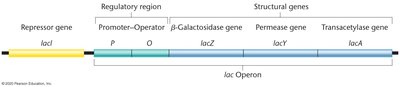
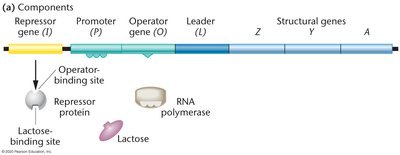
The lac operon in Escherichia coli is a classic example of an inducible, negatively controlled gene system. It enables the bacterium to metabolize lactose only when it is present and glucose is absent. The operon consists of three structural genes (lacZ, lacY, lacA), a promoter, an operator, and a regulatory gene (lacI).
lacZ: Encodes β-galactosidase, which hydrolyzes lactose into glucose and galactose.
lacY: Encodes permease, which facilitates lactose entry into the cell.
lacA: Encodes transacetylase, with a less clearly defined role in lactose metabolism.
lacI: Encodes the repressor protein that binds to the operator to inhibit transcription.
Mechanism of lac Operon Regulation
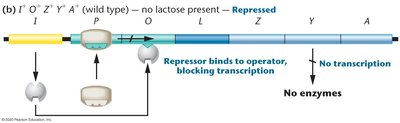
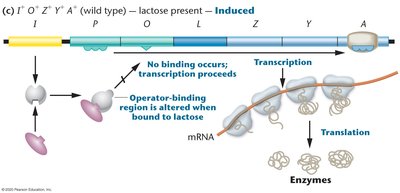
In the absence of lactose, the LacI repressor binds to the operator, blocking RNA polymerase and preventing transcription. When lactose is present, it acts as an inducer by binding to the repressor, causing a conformational change that prevents the repressor from binding the operator. This allows transcription of the operon's genes.
Summary Table: lac Operon Mutants and β-galactosidase Activity
Genotype | +Lactose | -Lactose |
|---|---|---|
I+ O+ Z+ | + | - |
I+ O+ Z- | - | - |
I- O+ Z+ | + | + |
I+ Oc Z+ | + | + |
Is O+ Z+ | - | - |
Additional info: I- = nonfunctional repressor; Oc = operator constitutive (cannot bind repressor); Is = superrepressor (cannot bind inducer).
Catabolite Repression: Glucose Effect
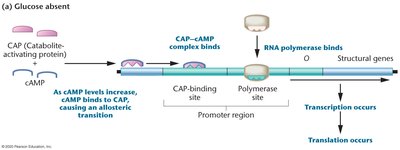
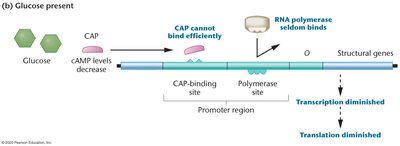
Catabolite repression ensures that the lac operon is only expressed when glucose is absent. In the absence of glucose, cyclic AMP (cAMP) levels rise, allowing cAMP to bind to the catabolite activator protein (CAP). The CAP-cAMP complex binds to the promoter, enhancing RNA polymerase binding and transcription. When glucose is present, cAMP levels drop, CAP cannot bind, and transcription is diminished—even if lactose is present.
trp Operon: Regulation of Tryptophan Biosynthesis
Structure and Function of the trp Operon
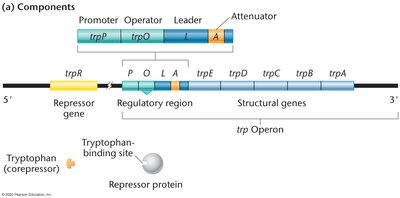
The trp operon is a repressible, negatively controlled system that regulates the biosynthesis of tryptophan. It contains five structural genes (trpE, trpD, trpC, trpB, trpA), a promoter, an operator, and a regulatory gene (trpR).
trpR: Encodes the repressor protein.
Operator: Binding site for the repressor-tryptophan complex.
Structural genes: Encode enzymes for tryptophan biosynthesis.
Mechanism of trp Operon Regulation
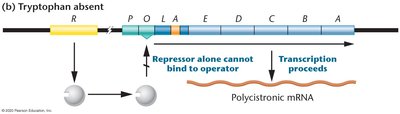
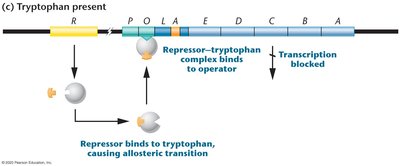
When tryptophan is absent, the repressor cannot bind the operator, and transcription proceeds. When tryptophan is present, it acts as a co-repressor, binding to the repressor and enabling it to bind the operator, blocking transcription.
Attenuation in the trp Operon
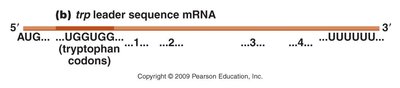
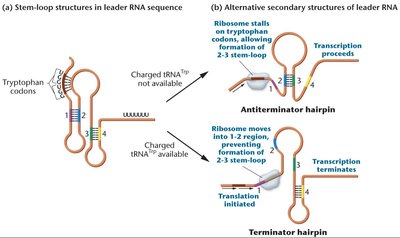
Attenuation is a secondary regulatory mechanism in the trp operon. It relies on the coupling of transcription and translation in bacteria. The leader sequence of the trp operon mRNA can form alternative stem-loop structures, depending on the availability of charged tRNATrp. When tryptophan is scarce, the ribosome stalls, allowing the formation of an antiterminator hairpin and continued transcription. When tryptophan is abundant, a terminator hairpin forms, causing premature termination of transcription.
CRISPR (Cas) System: Bacterial Adaptive Immunity
Structure and Function of CRISPR Loci
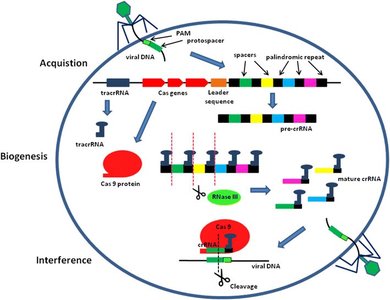
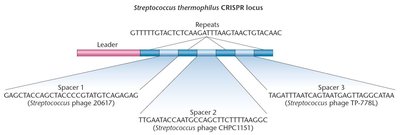
The CRISPR (Clustered Regularly Interspaced Short Palindromic Repeats) system provides bacteria with adaptive immunity against bacteriophages. CRISPR loci consist of repeated DNA sequences interspaced with unique spacers derived from phage genomes. Associated Cas (CRISPR-associated) genes encode proteins involved in the acquisition, processing, and interference stages of immunity.
Acquisition: Integration of new spacer sequences from invading phages into the CRISPR locus.
Expression: Transcription of the CRISPR array and processing into small CRISPR RNAs (crRNAs).
Interference: crRNAs guide Cas proteins to recognize and cleave complementary phage DNA.
Application and Experimental Evidence
Experiments in Streptococcus thermophilus demonstrated that bacteria surviving phage infection acquire new spacers in their CRISPR loci, conferring resistance to the same phage. Removal of these spacers abolishes resistance, confirming the adaptive nature of the system.
Additional info: The CRISPR-Cas system has been adapted as a powerful tool for genome editing in a wide range of organisms.
