 Back
Regulation of Gene Expression in Bacteria: The lac and trp Operons
Study Guide - Smart Notes
 Tailored notes based on your materials, expanded with key definitions, examples, and context.
Regulation of Gene Expression in Bacteria
Overview of Prokaryotic Gene Regulation
Gene expression in bacteria, such as Escherichia coli, is tightly regulated to respond efficiently to environmental changes. Bacteria utilize sophisticated mechanisms to turn transcription of specific genes on or off, depending on metabolic needs. These regulatory systems control processes including replication, recombination, DNA repair, and cell division.
Inducible enzymes: Produced only when specific substrates are present, allowing adaptation to environmental changes.
Constitutive enzymes: Continuously produced regardless of environmental conditions.
Repressible systems: Gene expression is inhibited by the presence of a specific molecule, often the end product of a pathway.
Positive and negative control: Negative control involves gene expression unless shut off by a regulator, while positive control requires a regulator to stimulate transcription.
Lactose Metabolism and the lac Operon
Lactose Metabolism in E. coli
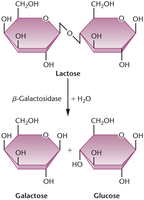
Lactose is a disaccharide composed of galactose and glucose. In E. coli, the enzymes responsible for lactose metabolism are inducible, meaning their expression increases in the presence of lactose. Lactose acts as an inducer, triggering the transcription of genes required for its breakdown.
Inducible system: Enzyme concentration increases when lactose is available.
Regulatory regions: Genes are organized in clusters with regulatory regions upstream, which are cis-acting (on the same DNA strand).
Trans-acting elements: Molecules that bind to cis-acting sites to regulate gene expression.

lacZ and β-Galactosidase
The lacZ gene encodes β-galactosidase, an enzyme that hydrolyzes lactose into glucose and galactose, enabling these monosaccharides to enter glycolysis as energy sources.
Function: Converts lactose to glucose and galactose.
lacY and lacA Genes
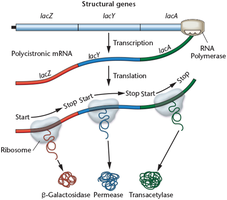
The lacY gene encodes permease, which facilitates lactose entry into the cell. The lacA gene encodes transacetylase, which may help remove toxic by-products of lactose metabolism.
lacY: Permease for lactose transport.
lacA: Transacetylase for detoxification.
Polycistronic mRNA and Structural Genes
The three structural genes (lacZ, lacY, lacA) are transcribed as a single polycistronic mRNA, which is then translated into three distinct proteins.
Cistron: A nucleotide sequence coding for a single gene.
Regulatory Mutations and the lacI Repressor
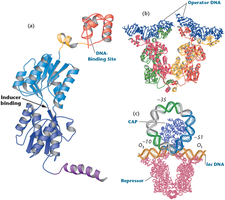
Mutations in regulatory regions can lead to constitutive expression, where enzymes are produced regardless of lactose presence. The lacI gene encodes a repressor protein that regulates transcription by binding to the operator region. This repressor is allosteric, meaning it changes shape and activity upon binding to an inducer (lactose).
The Operon Model: Negative Control
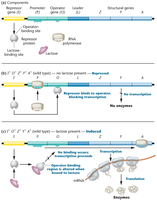
Jacob and Monod proposed the operon model, where the lacI gene produces a repressor that binds to the operator, inhibiting RNA polymerase and repressing transcription. Transcription occurs only when the repressor is not bound to the operator.
Constitutive Mutations: I- and OC
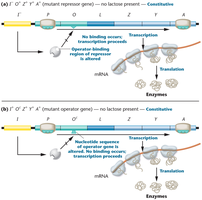
Mutations in the repressor gene (I-) or operator region (OC) result in constitutive expression, where the structural genes are always transcribed, regardless of environmental conditions.
I- mutation: Repressor protein is altered or absent and cannot bind the operator.
OC mutation: Operator DNA sequence is altered and cannot bind the normal repressor.
Super-Repressed Mutant (Is)
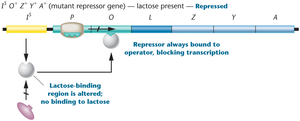
The Is mutation produces a repressor that cannot bind lactose, resulting in permanent repression of the operon even when lactose is present.
Genetic Proof: Merozygotes and Partial Diploids
Genetic experiments with partial diploid (merozygote) bacteria confirmed the operon model. The I gene produces a diffusible product (trans-acting), while the O region must be adjacent to structural genes to regulate transcription.
Positive Control: Catabolite-Activating Protein (CAP)
CAP and Catabolite Repression
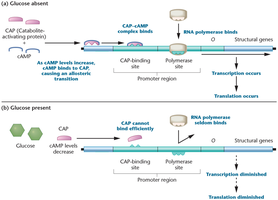
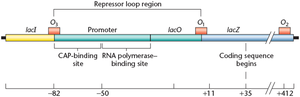
CAP (catabolite-activating protein) exerts positive control over the lac operon. When glucose is present, CAP activity is diminished, reducing operon expression. CAP binds to the CAP-binding site, facilitating RNA polymerase binding and transcription when glucose is absent.
Maximum transcription: Requires repressor to be bound by lactose and CAP to be bound to the CAP-binding site.
Glucose Inhibits CAP Binding
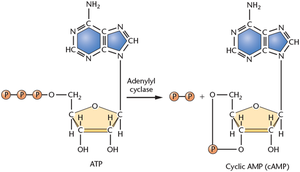
CAP must bind cyclic AMP (cAMP) to activate transcription. Glucose inhibits adenylyl cyclase, reducing cAMP levels and preventing CAP from binding to the promoter.
cAMP: Cyclic adenosine monophosphate, a signaling molecule.
Glucose: Inhibits cAMP production, reducing CAP activity.
Crystal Structure Analysis of Repressor Complexes
Lac Operon Regulatory Regions
Detailed structural analysis reveals three operator sites for repressor binding. In vivo, all three must be bound for maximum repression, forming a repression loop that prevents RNA polymerase access to the promoter.
The Tryptophan (trp) Operon: A Repressible System
trp Operon in E. coli
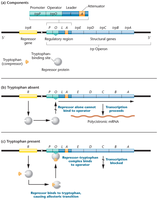
The trp operon is a repressible gene system. When tryptophan is present, enzymes for its biosynthesis are not produced. The operon consists of five contiguous structural genes (trpE, trpD, trpC, trpB, trpA) transcribed as a polycistronic mRNA.
trpP: Promoter, binding site for RNA polymerase.
trpO: Operator, binds repressor.
RNA-Mediated Regulation: Attenuation and Riboswitches
Attenuation Mechanism
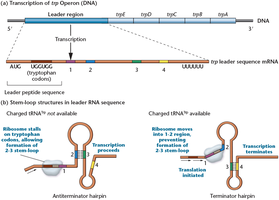
Attenuation is a regulatory mechanism involving the leader sequence and an attenuator. The mRNA can form two different stem-loop structures (hairpins): an antiterminator in the absence of tryptophan and a terminator in its presence. The leader region contains two tryptophan codons, and ribosome stalling or progression determines which hairpin forms.
Antiterminator hairpin: Forms when tryptophan is absent; transcription proceeds.
Terminator hairpin: Forms when tryptophan is present; transcription is terminated.
Riboswitches
Riboswitches are alternative forms of mRNA secondary structure that bind small ligands, causing conformational changes and inducing either antiterminator or terminator structures. Two domains are important: the aptamer (binds ligand) and the expression platform (forms terminator structure).
Small Noncoding RNAs
Bacterial small noncoding RNAs regulate gene expression by binding to mRNAs. They can act as negative regulators by masking the ribosome-binding site, preventing translation, or as positive regulators by preventing secondary structures that would otherwise inhibit translation.
Summary Table: Comparison of lac and trp Operon Regulation
Operon | Type of Regulation | Inducer/Repressor | Key Genes | Regulatory Mechanism |
|---|---|---|---|---|
lac Operon | Inducible | Lactose (Inducer), lacI Repressor | lacZ, lacY, lacA | Negative and positive control (CAP-cAMP) |
trp Operon | Repressible | Tryptophan (Corepressor), trp Repressor | trpE, trpD, trpC, trpB, trpA | Negative control, attenuation |
Additional info: Attenuation and riboswitch mechanisms are common to several amino acid biosynthetic operons, including threonine, histidine, leucine, and phenylalanine.
