 Back
Regulation of Gene Expression in Bacteria: The lac and trp Operons
Study Guide - Smart Notes
 Tailored notes based on your materials, expanded with key definitions, examples, and context.
Regulation of Gene Expression in Bacteria
Overview of Prokaryotic Gene Regulation
Bacteria regulate gene expression to adapt to changing environmental conditions. This regulation ensures that genes are expressed only when their products are needed, conserving energy and resources. Gene regulation in bacteria primarily occurs at the level of transcription and involves both positive and negative control mechanisms.
Inducible enzymes: Produced only in the presence of specific substrates (e.g., enzymes for lactose metabolism).
Constitutive enzymes: Continuously produced regardless of environmental conditions.
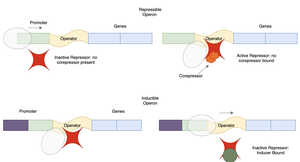
Repressible systems: Gene expression is inhibited by the presence of a specific molecule (corepressor).
Inducible systems: Gene expression is activated by the presence of a specific molecule (inducer).
Positive and Negative Control
Gene expression is regulated by regulatory proteins that respond to environmental signals:
Negative control: A repressor protein inhibits transcription when active.
Positive control: An activator protein stimulates transcription when active.
Both inducible and repressible systems can be regulated by either positive or negative control mechanisms.
Prokaryotic vs. Eukaryotic Regulation
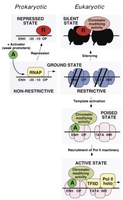
In prokaryotes, the default state of most genes is "on," but repression is common. In contrast, eukaryotic genes are typically "off" by default and require activation for expression.
The lac Operon: An Inducible System
Lactose Metabolism in E. coli
The lac operon in E. coli is a classic example of an inducible gene system. It enables the bacterium to metabolize lactose only when it is present in the environment.
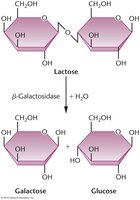
Lactose: A disaccharide composed of glucose and galactose.
β-Galactosidase: Enzyme that hydrolyzes lactose into glucose and galactose.
lac Operon Structure and Function
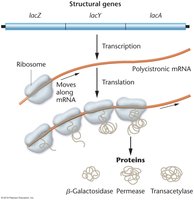
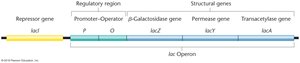
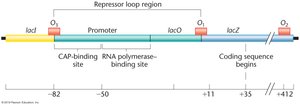
The lac operon consists of three structural genes (lacZ, lacY, lacA) and regulatory regions (promoter, operator). These genes are transcribed as a single polycistronic mRNA.
lacZ: Encodes β-galactosidase.
lacY: Encodes permease, which facilitates lactose entry into the cell.
lacA: Encodes transacetylase, involved in detoxification.
Regulation of the lac Operon
Transcription of the lac operon is controlled by the interaction of the lacI repressor protein and the operator region. In the absence of lactose, the repressor binds to the operator, blocking transcription. When lactose (or its isomer allolactose) is present, it binds to the repressor, causing a conformational change that releases the repressor from the operator, allowing transcription to proceed.
Experimental Evidence and Mutations
Mutations in the lac operon provide insight into its regulation:
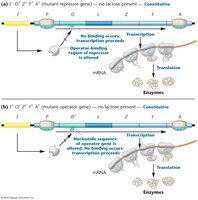
lacI- mutation: Nonfunctional repressor; operon is always on (constitutive expression).
Oc mutation: Operator sequence altered; repressor cannot bind, leading to constitutive expression.
lacIs mutation: Superrepressor; cannot bind inducer, always represses operon.
Dual Control: lac Repressor and Catabolite Activator Protein (CAP)
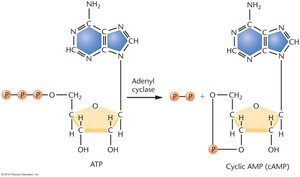
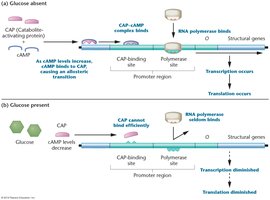
The lac operon is also regulated by the presence of glucose. When glucose is absent, cyclic AMP (cAMP) levels rise, allowing cAMP to bind to CAP. The CAP-cAMP complex binds to the promoter, enhancing RNA polymerase binding and transcription. When glucose is present, cAMP levels drop, CAP does not bind, and transcription is reduced (catabolite repression).
The trp Operon: A Repressible System
Tryptophan Biosynthesis in E. coli
The trp operon is a repressible gene system that controls the synthesis of tryptophan. When tryptophan is abundant, it acts as a corepressor, binding to the trp repressor protein, which then binds to the operator and blocks transcription.
Structural genes: trpE, trpD, trpC, trpB, trpA (encode enzymes for tryptophan biosynthesis).
trpP: Promoter region.
trpO: Operator region.
Attenuation: RNA-Mediated Regulation
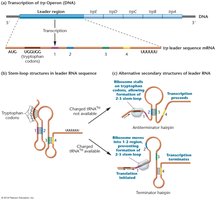
In addition to repression, the trp operon is regulated by attenuation, a mechanism involving the formation of alternative RNA secondary structures in the leader region. When tryptophan is abundant, transcription is terminated prematurely. When tryptophan is scarce, transcription proceeds through the structural genes.
RNA-Based Regulation in Bacteria
Riboswitches
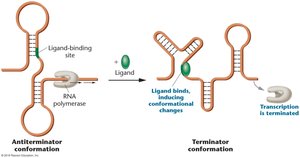
Riboswitches are regulatory segments of mRNA that bind small molecules, causing conformational changes that affect gene expression. They typically consist of an aptamer domain (binds ligand) and an expression platform (alters transcription or translation).
Small Noncoding RNAs (sRNAs)
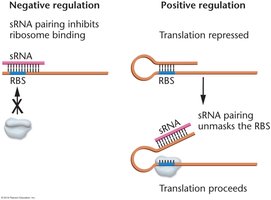
Bacterial sRNAs can regulate gene expression by base-pairing with mRNAs. They can inhibit translation by blocking the ribosome-binding site or activate translation by preventing inhibitory secondary structures.
Summary Table: Comparison of Inducible and Repressible Systems
System Type | Default State | Regulatory Molecule | Effect of Molecule | Example |
|---|---|---|---|---|
Inducible | OFF | Inducer | Turns ON gene expression | lac operon |
Repressible | ON | Corepressor | Turns OFF gene expression | trp operon |
