 Back
BackRegulation of Gene Expression in Bacteria: The lac Operon Model
Study Guide - Smart Notes
 Tailored notes based on your materials, expanded with key definitions, examples, and context.
Regulation of Gene Expression in Bacteria
Introduction to Gene Expression Regulation
Gene expression in bacteria is tightly regulated to ensure that proteins are produced only when needed, conserving energy and resources. The primary level of regulation occurs at the stage of transcription initiation, where the synthesis of RNA from DNA is controlled by various mechanisms.
Constitutive expression: Some genes, known as housekeeping genes, are expressed at all times to maintain basic cellular functions.
Inducible expression: Other genes are expressed only under specific environmental conditions, such as the presence or absence of certain nutrients.
The Central Dogma of Molecular Biology
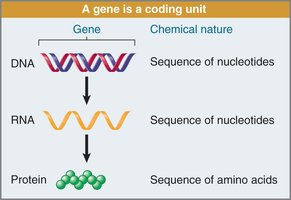
The central dogma describes the flow of genetic information within a biological system: DNA is transcribed into RNA, which is then translated into protein. This process is fundamental to all living organisms.
Mechanisms of Gene Regulation in Prokaryotes
Levels of Regulation
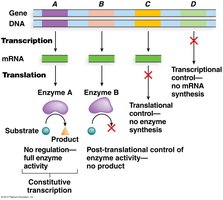
Bacteria regulate gene expression primarily at the transcriptional level, but can also regulate translation and post-translational modifications.
Transcriptional control: Determines whether a gene is transcribed into mRNA.
Translational control: Regulates whether an mRNA is translated into protein.
Post-translational control: Modifies protein activity after translation.
Transcription Initiation and Promoter Recognition
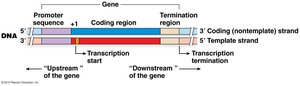
Transcription in bacteria is initiated when RNA polymerase binds to a specific DNA sequence called the promoter. The promoter contains conserved regions, such as the -10 and -35 elements, which are recognized by the sigma factor subunit of RNA polymerase.
Role of Sigma Factor
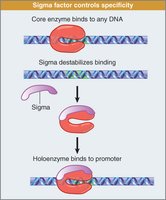
The sigma factor is a protein subunit that guides RNA polymerase to the promoter, ensuring that transcription begins at the correct site.
The Transcription Cycle
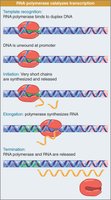
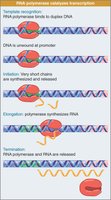
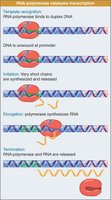
Transcription proceeds through three main stages:
Initiation: RNA polymerase binds to the promoter and begins RNA synthesis.
Elongation: RNA polymerase moves along the DNA, extending the RNA chain in the 5' to 3' direction.
Termination: RNA polymerase releases the completed RNA transcript and detaches from the DNA.
Transcription Factors and Regulation
Transcription Factors: Activators and Repressors
Transcription factors are proteins that bind specific DNA sequences near genes to regulate the rate of transcription initiation. There are two main classes:
Repressors: Decrease or block gene expression by binding to operator sites and preventing RNA polymerase from initiating transcription.
Activators: Increase gene expression by facilitating RNA polymerase binding to the promoter.
Mechanisms of Regulation
Negative regulation: Repressor proteins bind to the operator, blocking transcription.
Positive regulation: Activator proteins bind to DNA and enhance RNA polymerase binding and transcription.
The lac Operon: A Model for Gene Regulation
Structure and Function of the lac Operon
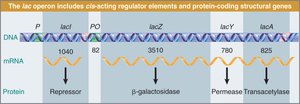
The lac operon in E. coli is a classic example of gene regulation. It consists of three structural genes (lacZ, lacY, lacA) under the control of a single promoter and operator. These genes encode proteins required for the uptake and metabolism of lactose.
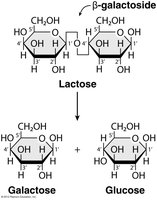
lacZ: Encodes β-galactosidase, which breaks down lactose into glucose and galactose.
lacY: Encodes permease, which transports lactose into the cell.
lacA: Encodes transacetylase, whose function is less well understood.
Lactose Metabolism
β-galactosidase catalyzes the hydrolysis of lactose into glucose and galactose, which can then be used for energy production.
Induction and Repression of the lac Operon
The lac operon is regulated by the presence or absence of lactose and glucose:
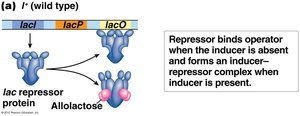
In the absence of lactose, the lac repressor (encoded by lacI) binds to the operator, blocking transcription.
When lactose is present, it is converted to allolactose, which binds to the repressor and inactivates it, allowing transcription to proceed.
Glucose presence inhibits the operon by lowering cAMP levels, preventing CAP-cAMP complex formation and thus positive regulation.
Positive Regulation by CAP-cAMP Complex
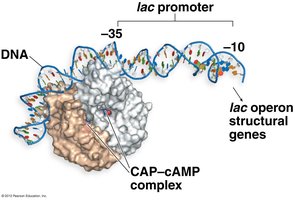
When glucose is absent, cyclic AMP (cAMP) levels rise, allowing cAMP to bind to the catabolite activator protein (CAP). The CAP-cAMP complex binds near the lac promoter, enhancing RNA polymerase binding and increasing transcription.
Summary Table: Transcription Conditions for the lac Operon
Glucose | Lactose | cAMP | Allolactose | lac Operon Transcription | Explanation |
|---|---|---|---|---|---|
Present | Absent | Absent | Absent | Basal | Glucose is present to provide energy. |
Present | Present | Absent | Present | Basal | Glucose is present to provide energy; absence of cAMP prevents positive transcription regulation. |
Absent | Absent | Present | Absent | Basal | CAP-cAMP forms, but no inducer is present to block repressor binding at operator. |
Absent | Present | Present | Present | High | Inducer and CAP-cAMP available to induce and positively regulate transcription. |
Genetic Analysis of the lac Operon
Mutations Affecting lac Operon Regulation
Mutations in the lac operon can affect its regulation:
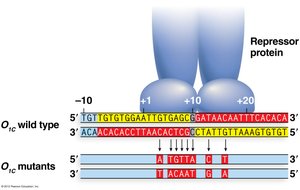
lacOc (operator-constitutive): Mutation in the operator prevents repressor binding, leading to constitutive expression.
lacI- (repressor mutation): Mutation in the repressor gene prevents it from binding the operator, also causing constitutive expression.
lacIS (super-repressor): Mutation prevents the repressor from binding allolactose, so it always binds the operator and blocks transcription, even in the presence of lactose.
Key Lessons from the lac Operon
Gene expression is regulated so that proteins are produced only when needed.
Transcription factors can act as repressors or activators.
Small molecules (inducers or effectors) can modulate the activity of transcription factors through allosteric regulation.
Conclusion
The lac operon provides a foundational model for understanding gene regulation in prokaryotes. It illustrates how cells integrate environmental signals to control gene expression through the interplay of repressors, activators, and small molecule effectors.
