 Back
BackRegulation of Gene Expression in Eukaryotes
Study Guide - Smart Notes
 Tailored notes based on your materials, expanded with key definitions, examples, and context.
Regulation of Gene Expression in Eukaryotes
Introduction to Gene Expression Regulation
Gene expression in eukaryotes is a highly regulated process that ensures proteins are produced at the right time, place, and quantity. Unlike prokaryotes, eukaryotic gene regulation involves multiple layers of control, reflecting the complexity of multicellular organisms.
Constitutive expression: Housekeeping genes are expressed at all times to maintain basic cellular functions.
Regulated expression: Inducible genes are expressed only under specific conditions, allowing cells to respond to environmental or developmental cues.
Evolutionary context: Eukaryotes evolved later than prokaryotes and possess membrane-bound organelles, true chromosomes, and often reproduce sexually.
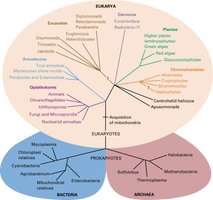
Structural and Functional Differences: Eukaryotes vs. Prokaryotes
Genomic Organization and Complexity
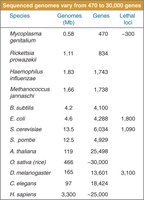
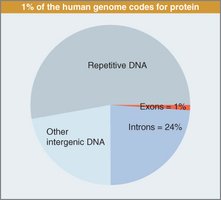
Eukaryotic genomes are larger and more complex than those of prokaryotes. Protein-coding sequences are a minority, and genes are often interrupted by non-coding regions.
Gene density: E. coli has 1 gene per 1,000 bp, while humans have 1 gene per 132,000 bp.
Protein-coding DNA: Only 1-2% of the human genome codes for proteins.
Gene Structure and mRNA Processing
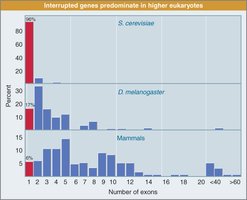
Eukaryotic genes are larger due to the presence of introns and extensive regulatory regions. Primary transcripts undergo several modifications before translation.
Average human protein: ~300 amino acids (900 bp coding DNA).
Average human gene: ~10,000 bp, with most sequence being non-coding.
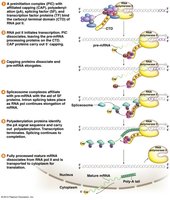
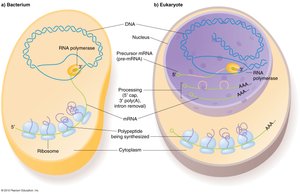
mRNA processing: Includes 5’ capping, 3’ polyadenylation, and splicing out of introns.
Compartmentalization of Transcription and Translation
In eukaryotes, transcription occurs in the nucleus, and translation occurs in the cytoplasm, allowing for additional regulatory steps.
Transcription Initiation in Eukaryotes
Assembly of the Preinitiation Complex
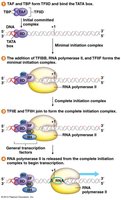
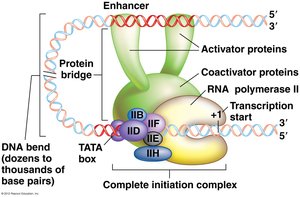
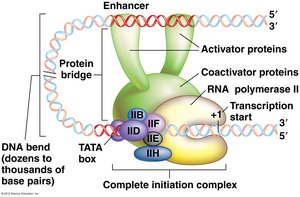
Transcription initiation in eukaryotes requires the assembly of a preinitiation complex (PIC) at the promoter, involving multiple general transcription factors and RNA polymerase II.
TFIID (with TBP): Binds the TATA box first.
Sequential recruitment: TFIIB, TFIIF (with RNA Pol II), TFIIE, and TFIIH join to form the complete PIC.
DNA melting: The DNA strands are separated to allow transcription to begin.
Chromatin Structure and Its Role in Gene Regulation
Nucleosomes and Chromatin Organization
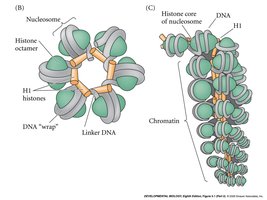
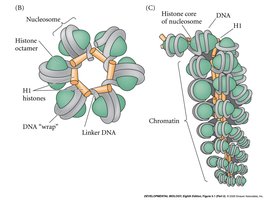
Chromatin consists of DNA wrapped around histone proteins, forming nucleosomes. This packaging generally represses transcription initiation.
Nucleosome: 200 bp of DNA wrapped around a histone octamer (two each of H2A, H2B, H3, H4).
Higher-order structures: Nucleosomes are further packaged into more compact chromatin fibers.
Euchromatin vs. Heterochromatin: Active genes are found in euchromatin (less condensed), while inactive genes are in heterochromatin (more condensed).
Chromatin as a Repressor of Transcription
Chromatin structure is generally repressive, making the default state for many eukaryotic genes 'off.' Regulatory mechanisms are required to make chromatin accessible for transcription.
Mechanisms of Gene Regulation in Eukaryotes
Levels of Regulation
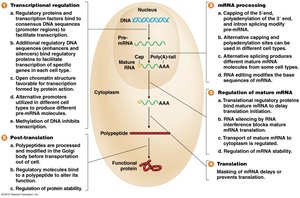
Gene expression can be regulated at multiple levels, but transcription initiation is the most common control point in eukaryotes.
Transcriptional regulation: Involves transcription factors, enhancers, and chromatin remodeling.
Post-transcriptional regulation: Includes mRNA processing, transport, stability, and translation.
Transcription Factors and Enhancers
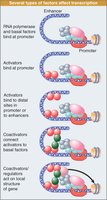
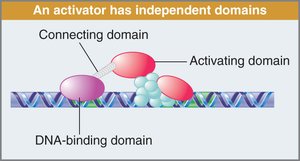
Transcription factors are proteins that bind specific DNA sequences (enhancers) to regulate gene expression. They typically have a DNA-binding domain and a transcription regulation domain.
DNA-binding domain: Recognizes and binds specific DNA sequences near target genes.
Activation domain: Interacts with other proteins to recruit the transcriptional machinery.
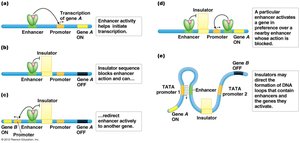
Enhancers: DNA elements that can function at variable distances and orientations relative to the gene they regulate.
Families of Transcription Factors
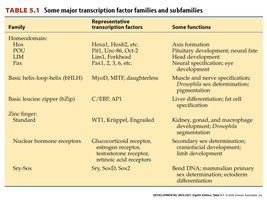
Transcription factors are grouped into families based on their DNA-binding domains. Humans have about 1,000 transcription factor genes, with multiple members in each family.
DNA-Binding Domains
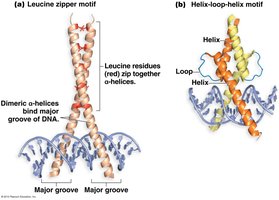
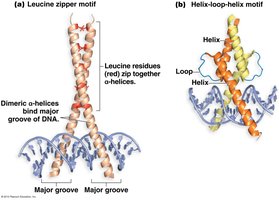
Common DNA-binding motifs include the leucine zipper and helix-loop-helix, which allow transcription factors to bind DNA as monomers, homodimers, or heterodimers.
Enhancer Properties
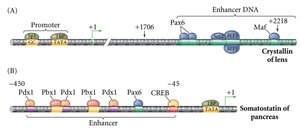
Enhancers can function upstream, downstream, or within introns of the genes they regulate. Their position and orientation are flexible, allowing complex regulation.
Combinatorial Control of Gene Expression
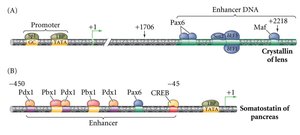
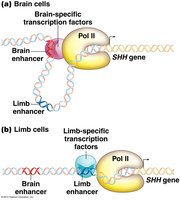
Most eukaryotic genes are regulated by multiple transcription factors, allowing for precise spatial and temporal control of gene expression. Genes with similar regulatory sequences can be co-regulated even if they are not physically linked.
Mechanisms of Transcription Factor Action
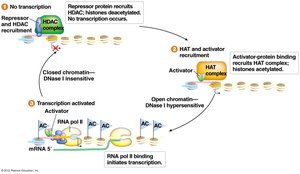
Transcription factors can activate gene expression by recruiting the preinitiation complex and RNA polymerase II or by recruiting enzymes that modify chromatin structure to make DNA more accessible.
Transcriptional Repression in Eukaryotes
Mechanisms of Repression
Eukaryotic transcription repressors can inhibit gene expression by several mechanisms:
Blocking activator binding sites on DNA.
Binding to activator domains and preventing their function (e.g., GAL4/GAL80 system).
Recruiting chromatin-modifying enzymes to make DNA less accessible.
Insulating genes from the effects of nearby enhancers.
Case Study: Regulation of the GAL Genes in Yeast
Model Organism: Saccharomyces cerevisiae
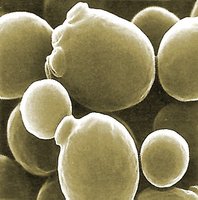
The baker's yeast is a single-celled eukaryote used as a model system for studying gene regulation. It has about 6,300 genes and can grow as haploid or diploid cells.
Induction of GAL Genes
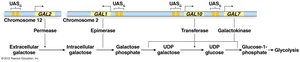
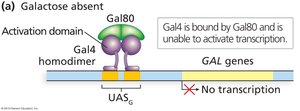
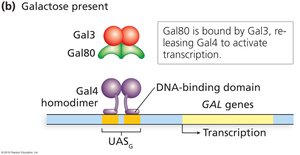
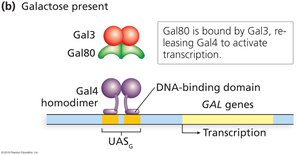
In the presence of galactose, yeast induces the expression of GAL1, GAL2, GAL7, and GAL10, which are required for galactose metabolism. These genes are regulated by the GAL4 activator and GAL80 repressor.
Regulatory Mechanism
UAS (Upstream Activation Sequence): Enhancer element bound by GAL4 homodimer.
GAL4: Transcription activator always bound to UAS.
GAL80: Repressor that binds GAL4 and blocks its activation domain in the absence of galactose.
GAL3: In the presence of galactose, GAL3 binds galactose and interacts with GAL80, releasing GAL4 to activate transcription.
Case Study: Steroid Hormone Regulation of Gene Expression
Steroid Hormones and Their Receptors
Steroid hormones are signaling molecules that can diffuse through cell membranes and bind to intracellular receptors, which then regulate gene expression.
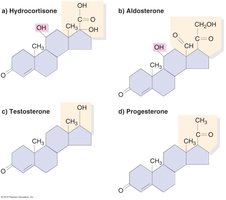
Steroid hormone receptors: Transcription factors with DNA-binding, activation, HSP90 interaction, and ligand-binding domains.
Inactive state: Receptors are held in the cytoplasm by HSP90.
Active state: Hormone binding releases HSP90, allowing the receptor to enter the nucleus and bind specific DNA sequences (hormone response elements).
Hormone Response Elements
Different steroid hormone receptors recognize specific DNA sequences upstream of target genes, such as the estrogen response element (ERE) and glucocorticoid response element (GRE).
ERE: AGGTCANNNTGACCT
GRE: AGAACANNNTGTTCT
All genes with the same response element are activated by the corresponding hormone.
Summary Table: Key Differences in Gene Regulation
Feature | Prokaryotes | Eukaryotes |
|---|---|---|
Gene organization | Operons (linked genes) | Genes scattered, regulated by common factors |
Transcription/Translation | Coupled | Compartmentalized |
Regulatory elements | Operators, repressors | Enhancers, insulators, chromatin structure |
Transcription factors | Fewer types | Many families, combinatorial control |
Chromatin | Absent | Present, major regulatory role |
Additional info: This summary integrates foundational concepts from Ch. 13 (Regulation of Gene Expression in Eukaryotes) and provides context for understanding the complexity and diversity of regulatory mechanisms in eukaryotic cells.
