 Back
BackRegulation of Gene Expression in Eukaryotes: Chromatin, Epigenetics, and Small RNAs
Study Guide - Smart Notes
 Tailored notes based on your materials, expanded with key definitions, examples, and context.
Regulation of Gene Expression in Eukaryotes
Overview of Gene Regulation Mechanisms
Gene expression in eukaryotes is tightly regulated at multiple levels, allowing cells to respond to internal and external signals and to differentiate into specialized cell types. The primary mechanisms include regulation at the level of transcription initiation, chromatin structure modification, and post-transcriptional regulation by small RNAs.
Transcriptional regulation involves controlling the initiation of RNA synthesis from DNA.
Chromatin structure determines the accessibility of DNA to transcription machinery.
Post-transcriptional regulation includes mechanisms such as microRNAs (miRNAs) that affect mRNA stability and translation.
Transcriptional Regulation in Eukaryotes
Transcription Initiation and Chromatin Structure
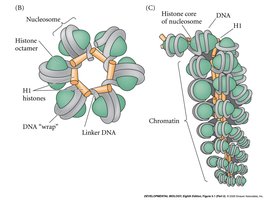
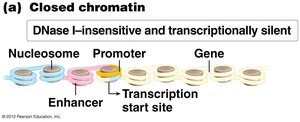
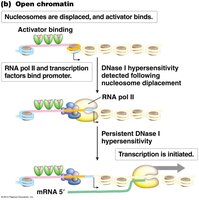
Transcription initiation by RNA polymerase II is influenced by the packaging of DNA into chromatin. Chromatin can exist in a closed (heterochromatin) or open (euchromatin) conformation, affecting gene accessibility.
Closed chromatin: DNA is tightly wrapped around nucleosomes, making promoters inaccessible to transcription factors and RNA polymerase II.
Open chromatin: Nucleosomes are displaced or modified, allowing transcription factors and RNA polymerase II to access DNA and initiate transcription.
Role of Transcription Factors
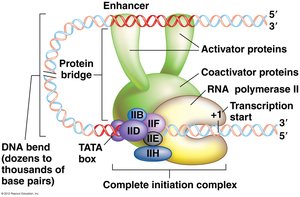
Eukaryotic transcription factors increase the rate of transcription initiation by:
Recruiting the preinitiation complex (PIC) and RNA polymerase II directly to the promoter.
Recruiting enzymes that alter chromatin structure, making transcription initiation easier.
GAL Genes in Yeast and Steroid Hormone Regulation
Specific gene regulatory systems illustrate these principles:
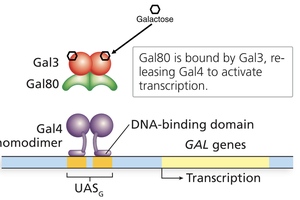
GAL genes in yeast are regulated by the GAL4 activator and GAL80 repressor. In the presence of galactose, GAL3 binds GAL80, releasing GAL4 to activate transcription.
Steroid hormones in mammals activate gene expression by binding to steroid hormone receptors, which function as transcription factors.
Chromatin Remodeling and Histone Modifications
Chromatin Remodeling Complexes
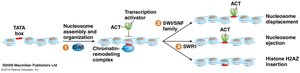
Chromatin remodeling complexes are multi-protein machines that use ATP to reposition or evict nucleosomes, thereby altering DNA accessibility.
The SWI/SNF complex is a well-studied chromatin remodeling complex recruited by transcription activators to open chromatin and increase gene expression.
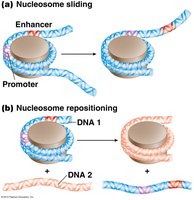
Remodeling can involve nucleosome sliding or repositioning, facilitating access to promoters and enhancers.
Pioneer Transcription Factors
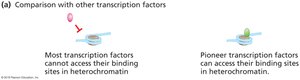
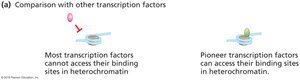
Pioneer transcription factors are unique in their ability to bind DNA sequences even when those sequences are wrapped in nucleosomes. They initiate chromatin opening, allowing other transcription factors to bind and activate gene expression.
Pioneer factors bind first, recruit chromatin remodeling enzymes, and facilitate the formation of an accessible chromatin state.
Histone Modifications
Histone proteins, around which DNA is wrapped, have amino-terminal tails that can be chemically modified. These modifications influence chromatin structure and gene expression.
Acetylation of lysine residues (by histone acetyltransferases, HATs) is associated with open chromatin and active gene expression.
Deacetylation (by histone deacetylases, HDACs) leads to closed chromatin and gene repression.
Methylation of histones can be associated with either activation or repression, depending on the specific residue modified.
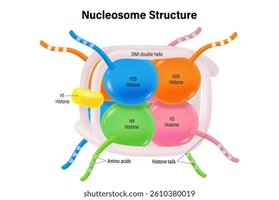
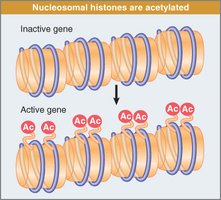
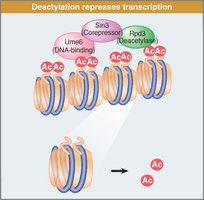
Table: Histone Modifications and Chromatin State
Modification | Enzyme | Effect on Chromatin | Gene Expression |
|---|---|---|---|
Acetylation (Ac) | HAT | Open | Activation |
Deacetylation | HDAC | Closed | Repression |
Methylation (Me) | HMT | Closed or Open (context-dependent) | Repression or Activation |
Demethylation | HDMT | Open | Activation |
Mechanisms of Histone Modification
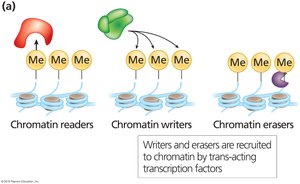
Histone modifications are reversible and dynamically regulated by specific enzymes:
Writers: Add modifications (e.g., HATs, HMTs).
Erasers: Remove modifications (e.g., HDACs, HDMTs).
Readers: Bind modified histones and recruit additional factors, such as chromatin remodeling complexes.
Biophysical Basis of Acetylation Effects
Acetylation neutralizes the positive charge of lysine residues on histones, reducing their affinity for negatively charged DNA. This leads to a more relaxed chromatin structure, facilitating transcription.
Acetylated histones are less positively charged, so DNA binds less tightly.
Reader proteins recognize acetylated or methylated histones and recruit chromatin remodeling complexes.
Epigenetic Regulation of Gene Expression
DNA Methylation
DNA methylation involves the addition of a methyl group to cytosine residues, typically in CpG dinucleotides. This modification is associated with gene repression and is catalyzed by DNA methyltransferases.
Methylated CpGs recruit proteins that bind methylated DNA and recruit HDACs, leading to chromatin condensation and gene silencing.
DNA methylation is a key mechanism for silencing transposable elements and maintaining cell identity.
Epigenetics: Heritable Chromatin Marks
Epigenetic regulation refers to heritable changes in gene expression that do not involve changes to the DNA sequence. These include histone modifications and DNA methylation.
Epigenetic marks can turn genes on or off and can be maintained through cell divisions.
Environmental factors, such as nutrition or stress, can alter epigenetic marks and influence phenotypes across generations.
Examples of Epigenetic Effects
Prenatal exposure to famine (Dutch Hunger Winter) led to persistent changes in DNA methylation and increased risk of metabolic disease in offspring.
Maternal care in mice affects methylation of the glucocorticoid receptor gene, influencing stress responses in offspring.
Exposure to environmental chemicals (e.g., Bisphenol A) can alter epigenetic marks and phenotypes in subsequent generations.
Regulation by Small RNA Molecules
MicroRNAs (miRNAs) and RNA Interference (RNAi)
Small RNA molecules, such as miRNAs, regulate gene expression post-transcriptionally by binding to complementary mRNAs and inhibiting their translation or promoting their degradation.
miRNAs are transcribed as precursor RNAs, processed by Dicer into short double-stranded RNAs (21-25 nt).
One strand is incorporated into the RNA-induced silencing complex (RISC), which targets complementary mRNAs.
Outcomes include mRNA degradation or translational repression, resulting in decreased protein production.
Biological and Experimental Roles of miRNAs
The human genome encodes over 1000 miRNAs, regulating more than 60% of protein-coding genes.
miRNAs play critical roles in development, disease, and cancer.
RNA interference (RNAi) can be harnessed experimentally to knock down gene expression and study gene function.
Summary Table: Key Mechanisms of Eukaryotic Gene Regulation
Mechanism | Level | Key Players | Effect |
|---|---|---|---|
Chromatin Remodeling | Transcriptional | SWI/SNF, remodeling complexes | Opens chromatin, activates genes |
Histone Acetylation | Transcriptional | HATs, HDACs | Acetylation activates, deacetylation represses |
DNA Methylation | Transcriptional/Epigenetic | DNA methyltransferases | Represses gene expression |
miRNAs | Post-transcriptional | Dicer, RISC | Degrades mRNA or blocks translation |
Conclusion
Regulation of gene expression in eukaryotes is a complex, multi-layered process involving chromatin structure, histone and DNA modifications, and small RNA molecules. These mechanisms ensure precise control of gene activity, enabling cellular differentiation, adaptation, and inheritance of gene expression states without altering the underlying DNA sequence.
