 Back
BackRegulation of Gene Expression in Eukaryotes: Mechanisms and Chromatin Dynamics
Study Guide - Smart Notes
 Tailored notes based on your materials, expanded with key definitions, examples, and context.
Regulation of Gene Expression in Eukaryotes
Overview of Gene Regulation Mechanisms
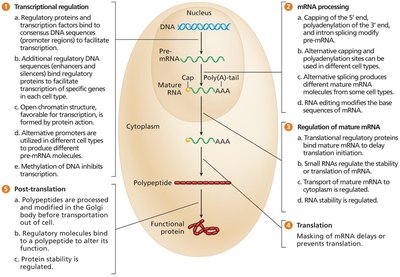
Gene expression in eukaryotes is regulated at multiple levels, including transcription, mRNA processing, translation, and post-translational modifications. The complexity of eukaryotic genomes allows for intricate control, ensuring that genes are expressed in the right cell type, at the right time, and in the correct amount.
Transcriptional regulation: Involves regulatory proteins and DNA sequences that control the initiation and rate of transcription.
Post-transcriptional regulation: Includes mRNA processing, stability, and transport.
Translational regulation: Controls the efficiency and rate at which mRNAs are translated into proteins.
Post-translational regulation: Modifies proteins after synthesis, affecting their function and stability.
Cis-Acting Regulatory Sequences and Trans-Acting Proteins
DNA-Protein Interactions in Eukaryotic Transcription
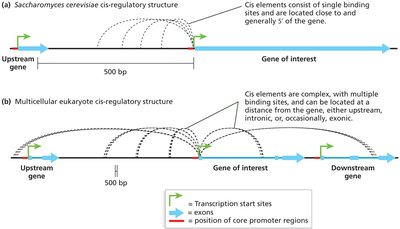
Regulation of transcription in eukaryotes involves cis-acting regulatory sequences (DNA elements on the same chromosome as the gene) and trans-acting regulatory proteins (proteins that can diffuse and act on any chromosome). These interactions are more complex than in prokaryotes, often involving large protein complexes and multiple regulatory elements.
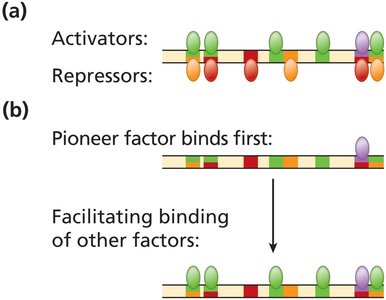
Activator proteins bind to regulatory sequences to stimulate transcription.
Repressor proteins bind to other sequences to hinder transcription.
Transcription factors can regulate many target genes, often as part of large complexes.
Core Promoter, Proximal Elements, Enhancers, and Silencers
The core promoter region (including the TATA box) is adjacent to the transcription start site and binds RNA polymerase II and general transcription factors. Proximal elements are nearby regulatory sequences, while enhancers and silencers can be located far from the gene, even within introns or downstream regions.
Enhanceosomes and DNA Looping
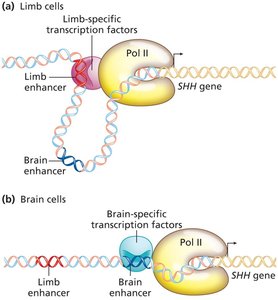
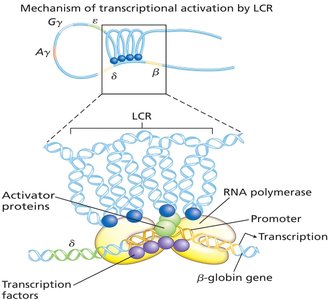
Enhancers and silencers integrate the activities of multiple transcription factors. Enhanceosomes are large protein complexes that bind enhancers, causing DNA to loop so that distant regulatory elements can interact with the core promoter.
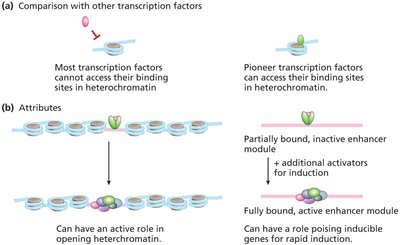
Pioneer factors are the first to bind regulatory DNA, facilitating the binding of additional transcription factors.
Tissue-Specific Regulation: The Sonic Hedgehog (SHH) Gene
The SHH gene is regulated by enhancers located up to 1 million base pairs away. Different combinations of regulatory proteins bind to tissue-specific enhancers, directing expression in the brain or limbs.
Locus Control Regions (LCRs) and the β-Globin Gene Complex
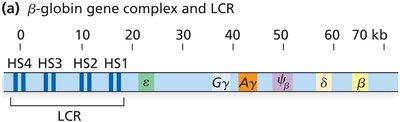
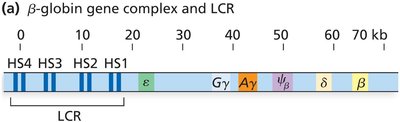
LCRs are specialized enhancers that regulate clusters of related genes. The human β-globin gene complex is controlled by an LCR containing several DNase I hypersensitive sites (HS1–HS4), which bind regulatory proteins and form DNA loops to activate gene expression at different developmental stages.
Mutations in Regulatory Sequences
Mutations or chromosomal rearrangements affecting regulatory sequences, such as LCRs, can lead to diseases like thalassemia, even if the coding regions of the genes are intact.
Conservation of Enhancer Sequences
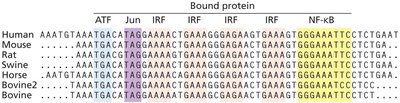
Some enhancer sequences are highly conserved across species, indicating their essential regulatory roles. For example, the β-interferon gene enhancer is conserved among mammals, reflecting evolutionary constraints on gene regulation.
Regulation of the GAL Genes in Yeast
Galactose Utilization Pathway
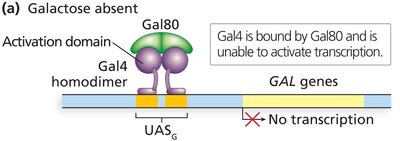
In Saccharomyces cerevisiae, the GAL genes (GAL1, GAL2, GAL7, GAL10) are regulated by upstream activator sequences (UASG) and the Gal4 protein. Gal4 is a transcriptional activator that binds UASG but is inhibited by Gal80 in the absence of galactose.

Transcriptional Activation and Repression
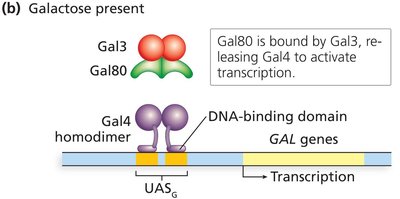
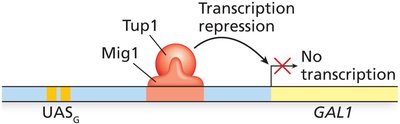
When galactose is present, Gal3 binds Gal80, releasing Gal4 to activate transcription. The Mediator complex (an enhanceosome) facilitates DNA looping and transcription activation. In the presence of glucose, the Mig1-Tup1 repressor complex binds a silencer sequence, blocking transcription of GAL genes.
Insulator Sequences
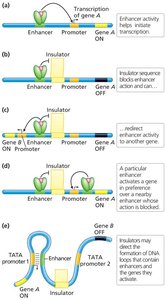
Insulators are cis-acting sequences that block the interaction between enhancers and non-target promoters, ensuring specificity in gene regulation. They can facilitate the formation of DNA loops that isolate regulatory domains.
Chromatin Remodeling and Epigenetic Regulation
Chromatin States: Euchromatin and Heterochromatin
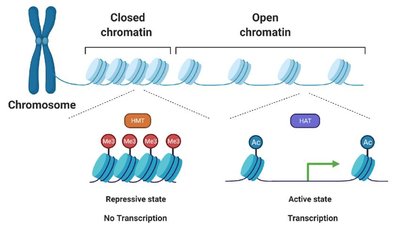
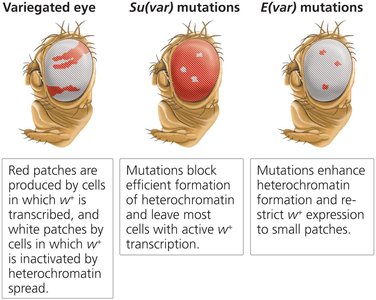
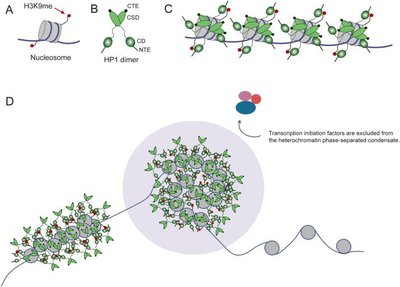
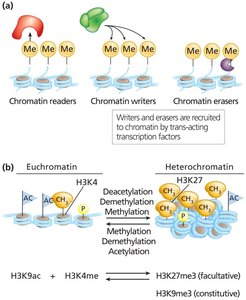
Chromatin structure plays a critical role in gene expression. Constitutive heterochromatin is always condensed and transcriptionally inactive, while facultative heterochromatin can switch between active and inactive states. Position effect variegation (PEV) occurs when euchromatin is placed near heterochromatin, leading to gene silencing.
Epigenetic Modifications
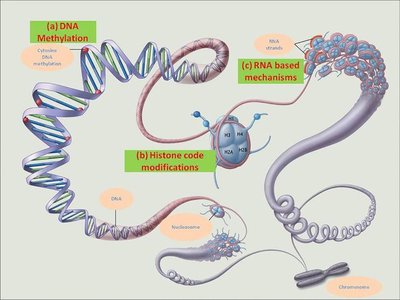
Epigenetic modifications, such as methylation, acetylation, and phosphorylation of histone proteins, alter chromatin structure and gene expression without changing the DNA sequence. These modifications are reversible, heritable, and directly associated with gene transcription.
Chromatin Remodeling Complexes
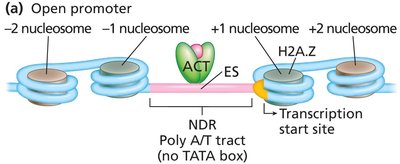
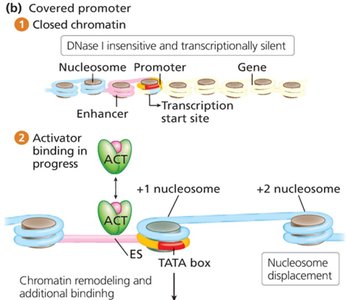
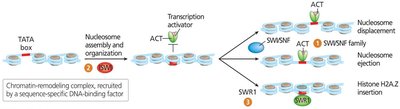
Chromatin remodelers (e.g., SWI/SNF, ISWI, SWR1) reposition or remove nucleosomes to expose or cover regulatory DNA sequences. Chromatin modifiers add or remove chemical groups from histones, affecting chromatin accessibility.
Histone Acetylation and Methylation
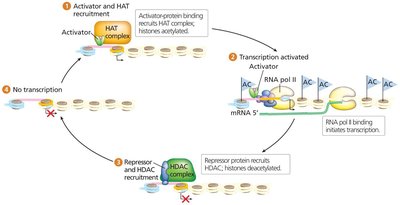
Histone acetyltransferases (HATs) add acetyl groups to histones, neutralizing positive charges and relaxing chromatin for transcription. Histone deacetylases (HDACs) remove acetyl groups, leading to chromatin condensation. Histone methyltransferases (HMTs) add methyl groups, often leading to gene silencing, while demethylases remove them.
Pioneer Factors and Chromatin Opening
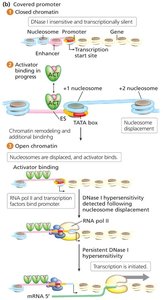
Pioneer factors are transcription factors that can bind to condensed chromatin and initiate chromatin opening, allowing other factors to bind and activate gene expression.
Epigenetic Heritability and Position Effect Variegation
Epigenetic marks are often heritable through cell divisions, maintaining gene expression patterns in daughter cells. Position effect variegation in Drosophila demonstrates heritable gene silencing due to heterochromatin spreading.
Long Noncoding RNAs and X-Chromosome Inactivation
Long noncoding RNAs (lncRNAs) such as Xist play crucial roles in gene regulation. Xist coats the X chromosome to be inactivated in female mammals, recruiting chromatin-modifying complexes and forming a Barr body.
Genomic Imprinting
Genomic imprinting is an epigenetic phenomenon where only one allele of a gene is expressed, depending on its parental origin. For example, the IGF2 gene is expressed only from the paternal chromosome, while H19 is expressed from the maternal chromosome. Imprinting involves DNA methylation and insulator sequences.
RNA-Mediated Mechanisms of Gene Regulation
RNA Interference (RNAi) and Gene Silencing
Small regulatory RNAs, such as microRNAs (miRNAs) and small interfering RNAs (siRNAs), can silence gene expression by binding to mRNA targets, leading to mRNA degradation or translational repression. The enzyme Dicer processes double-stranded RNA into small fragments, which are incorporated into the RNA-induced silencing complex (RISC) to guide gene silencing.
miRNAs: Endogenously encoded, regulate gene expression post-transcriptionally.
siRNAs: Often derived from exogenous sources, trigger mRNA degradation.
Summary Table: Key Regulatory Elements and Proteins
Element/Protein | Function | Example |
|---|---|---|
Enhancer | Increases transcription from a distance | SHH limb enhancer |
Silencer | Decreases transcription from a distance | Mig1 silencer in yeast |
Insulator | Blocks enhancer-promoter interaction | ICR in IGF2/H19 locus |
LCR | Regulates gene clusters | β-globin gene complex |
HAT | Adds acetyl groups to histones | Gene activation |
HDAC | Removes acetyl groups from histones | Gene repression |
HMT | Adds methyl groups to histones | Gene silencing |
Demethylase | Removes methyl groups from histones | Gene activation |
Pioneer factor | Initiates chromatin opening | FoxA1 |
miRNA/siRNA | Post-transcriptional gene silencing | RNAi pathway |
