 Back
BackRegulation of Gene Expression in Eukaryotes: Chromatin, Epigenetics, and Small RNAs
Study Guide - Smart Notes
 Tailored notes based on your materials, expanded with key definitions, examples, and context.
Regulation of Gene Expression in Eukaryotes
Overview of Eukaryotic Gene Regulation
Gene expression in eukaryotes is regulated at multiple levels, including transcriptional, post-transcriptional, and epigenetic mechanisms. These regulatory systems ensure that genes are expressed in the right cell type, at the right time, and in appropriate amounts.
Transcriptional regulation involves controlling the initiation and rate of transcription.
Post-transcriptional regulation includes mRNA processing, stability, and translation.
Epigenetic regulation refers to heritable changes in gene expression that do not involve changes to the DNA sequence, such as chromatin modifications and DNA methylation.
Transcriptional Regulation in Eukaryotes
Key Differences Between Eukaryotic and Prokaryotic Transcription
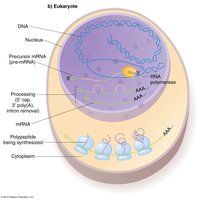
Eukaryotic transcription is more complex than prokaryotic transcription due to the presence of chromatin, multiple RNA polymerases, and extensive mRNA processing.
Protein-coding sequences are a minority of the DNA.
Genes are larger and interrupted by introns.
Transcription occurs in the nucleus; translation occurs in the cytoplasm.
Three RNA polymerases (I, II, III) are present in eukaryotes.
Genes involved in a common process are not physically linked.
DNA is packaged into chromatin, which affects gene accessibility.
Transcription Factors and Regulatory Elements
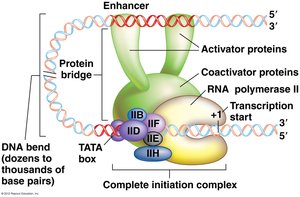
Transcription factors are proteins that bind to specific DNA sequences to regulate gene expression. They can act as activators or repressors and often interact with other proteins to modulate chromatin structure and recruit the transcriptional machinery.
Promoters: DNA sequences where RNA polymerase and general transcription factors assemble.
Enhancers: Distal regulatory elements that increase transcription of associated genes, often by looping DNA to interact with promoters.
Transcription activators: Proteins that increase the rate of transcription initiation by recruiting the preinitiation complex or modifying chromatin structure.
Examples of Eukaryotic Transcriptional Regulation
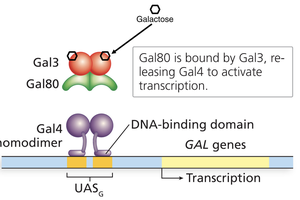
GAL genes in yeast: Regulated by GAL4 (activator) and GAL80 (repressor) in response to galactose.
Steroid hormone receptors: In mammals, steroid hormones activate gene expression by binding to specific receptors that function as transcription factors.
Chromatin Structure and Its Role in Gene Regulation
Nucleosomes and Chromatin Organization
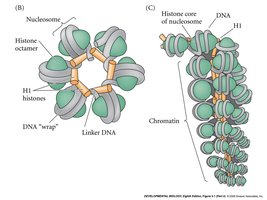
Eukaryotic DNA is wrapped around histone proteins to form nucleosomes, the basic unit of chromatin. Chromatin structure can be dynamic, influencing gene accessibility and transcriptional activity.
Nucleosome: Composed of an octamer of histone proteins (two each of H2A, H2B, H3, H4) and ~147 bp of DNA.
Chromatin: Higher-order structure formed by the folding and compaction of nucleosomes.
Closed vs. Open Chromatin
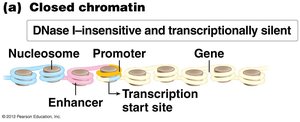
Chromatin can exist in a closed (heterochromatin) or open (euchromatin) state, affecting gene expression.
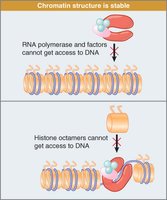
Closed chromatin: DNA is tightly packed, inaccessible to transcription factors, and transcriptionally silent.
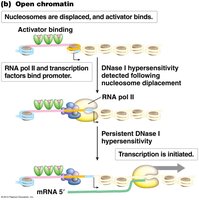
Open chromatin: DNA is less compact, accessible to transcription factors, and transcriptionally active.
Chromatin Remodeling Complexes
Chromatin remodeling complexes are multi-protein machines that use ATP to reposition, eject, or restructure nucleosomes, thereby regulating access to DNA for transcription.
They can slide nucleosomes along DNA or remove them entirely.
Transcription activators recruit these complexes to promoters and enhancers to facilitate gene activation.
The SWI/SNF complex is a well-known chromatin remodeling complex.
Pioneer Transcription Factors
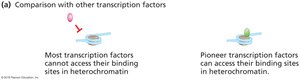
Pioneer transcription factors are unique in their ability to bind to their DNA target sites even when those sites are within nucleosomes (closed chromatin). They initiate chromatin opening, allowing other factors to bind and activate gene expression.
Pioneer factors bind first and recruit chromatin remodeling enzymes.
This process makes the chromatin accessible for the assembly of the preinitiation complex (PIC).
Histone Modifications and Gene Regulation
Types of Histone Modifications
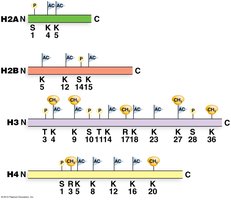
Histone proteins can be chemically modified on their N-terminal tails, affecting chromatin structure and gene expression. The most common modifications are acetylation and methylation of lysine residues.
Acetylation (Ac): Addition of acetyl groups, generally associated with gene activation.
Methylation (Me): Addition of methyl groups, associated with either activation or repression depending on the residue and context.
Histone Acetylation and Deacetylation
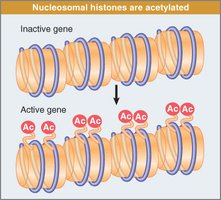
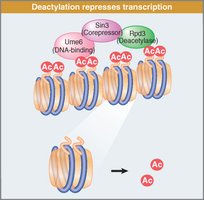
Acetylation of histone tails by histone acetyltransferases (HATs) neutralizes positive charges, loosening DNA-histone interactions and promoting an open chromatin state. Deacetylation by histone deacetylases (HDACs) restores positive charges, leading to chromatin condensation and gene repression.
Active genes have acetylated histones; inactive genes have deacetylated and often methylated histones.
These modifications are reversible and dynamically regulated.
Histone Code and Chromatin States
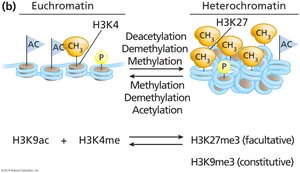
Different combinations of histone modifications constitute a "histone code" that determines chromatin state and gene expression potential.
Acetylation and demethylation are associated with open chromatin (euchromatin).
Deacetylation and methylation are associated with closed chromatin (heterochromatin).
DNA Methylation and Epigenetic Regulation
DNA Methylation
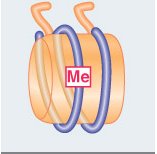
DNA methylation involves the addition of a methyl group to the 5-position of cytosine residues, typically in CpG dinucleotides. This modification is catalyzed by DNA methyltransferases and is associated with long-term gene silencing.
Clusters of methylated CpGs (CpG islands) are often found upstream of gene promoters.
Methylated DNA recruits proteins that interact with HDACs, leading to chromatin condensation and gene repression.
Epigenetic Inheritance and Environmental Effects
Epigenetic marks such as DNA methylation and histone modifications can be inherited through cell divisions and sometimes across generations. Environmental factors, including nutrition and stress, can influence epigenetic states and thus affect gene expression and phenotype.
Epigenetic changes do not alter the DNA sequence but can have lasting effects on gene expression.
Examples include the Dutch Hunger Winter, where prenatal famine exposure led to persistent epigenetic changes in offspring.
Maternal behavior and environmental toxins can also induce epigenetic changes affecting offspring phenotype.

Regulation by Small RNA Molecules
MicroRNAs (miRNAs) and RNA Interference (RNAi)
Small RNA molecules, such as microRNAs (miRNAs), regulate gene expression post-transcriptionally by binding to complementary sequences in target mRNAs, leading to mRNA degradation or inhibition of translation.
miRNAs are processed from longer precursors by the enzyme Dicer.
One strand of the miRNA is incorporated into the RNA-induced silencing complex (RISC), which guides the complex to target mRNAs.
RNA interference (RNAi) is a related process that can be triggered experimentally using short interfering RNAs (siRNAs).
Biological and Experimental Roles of RNAi
RNAi is a natural defense mechanism against viruses and transposable elements and is widely used as a research tool to knock down gene expression and study gene function.
RNAi can be used to silence specific genes in cells or organisms by introducing double-stranded RNA corresponding to the gene of interest.
This approach allows researchers to study gene function without creating permanent mutations.
Summary Table: Chromatin Modifications and Gene Expression
Modification | Enzyme | Effect on Chromatin | Effect on Gene Expression |
|---|---|---|---|
Histone Acetylation | HAT | Opens chromatin | Activates |
Histone Deacetylation | HDAC | Closes chromatin | Represses |
Histone Methylation | Methyltransferase | Usually closes chromatin | Represses (context-dependent) |
DNA Methylation | DNA methyltransferase | Closes chromatin | Represses |
Key Equations and Concepts
Histone acetylation reaction:
DNA methylation reaction:
Additional info: Epigenetic regulation is a rapidly evolving field, with ongoing research into how environmental factors and non-coding RNAs contribute to heritable changes in gene expression.
