 Back
BackRegulation of Gene Expression in Prokaryotes: Operons, Riboswitches, and Antisense RNAs
Study Guide - Smart Notes
 Tailored notes based on your materials, expanded with key definitions, examples, and context.
Regulation of Prokaryotic Gene Expression
Overview of Gene Regulation
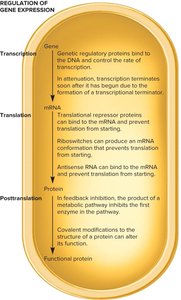
Gene regulation in prokaryotes allows cells to adapt to environmental changes by controlling the expression of specific genes. Regulation can occur at multiple levels: transcription, translation, and posttranslational modification.
Transcriptional regulation: Genetic regulatory proteins bind to DNA and control the rate of transcription. Attenuation can terminate transcription prematurely.
Translational regulation: Translational repressor proteins, riboswitches, and antisense RNAs can prevent translation from starting.
Posttranslational regulation: Feedback inhibition and covalent modifications alter protein function after translation.
Environmental Response and Enzyme Types
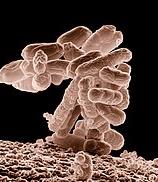
Prokaryotes, such as E. coli, regulate gene expression in response to environmental conditions. This regulation is crucial for metabolic efficiency and adaptation.
Inducible enzymes: Produced only when specific substrates are present.
Constitutive enzymes: Continuously produced regardless of environmental conditions.
Transcriptional Regulation in Bacteria
Regulatory Transcription Factors (RTFs)
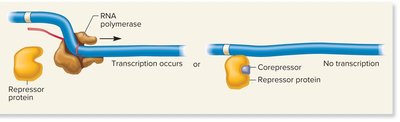
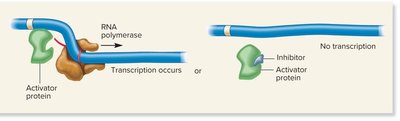
The initiation of transcription is the most common regulatory point in bacteria. Regulatory transcription factors (RTFs) are proteins that bind DNA and influence transcription.
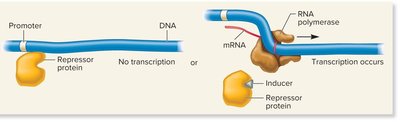
Repressors: Bind to DNA and inhibit transcription (negative control).
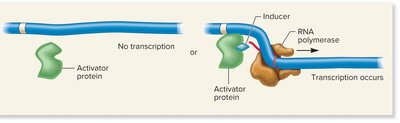
Activators: Bind to DNA and increase transcription (positive control).
Small Effector Molecules
Small effector molecules regulate transcription by interacting with RTFs, not directly with DNA.
Inducers: Increase transcription by binding to activators (enabling DNA binding) or to repressors (preventing DNA binding).
Corepressors: Bind to repressors, enabling them to bind DNA and inhibit transcription.
Inhibitors: Bind to activators, preventing their DNA binding and thus inhibiting transcription.
Lactose Metabolism and the Lac Operon
Inducible System: Enzyme Adaptation
Lactose metabolism in E. coli is regulated by an inducible system. Enzymes for lactose metabolism are produced only when lactose is present, demonstrating enzyme adaptation.
Lactose: Disaccharide composed of galactose and glucose.
Inducible enzymes: Produced in response to lactose presence.
Lactose acts as an inducer.
Operon Structure and Function
Genes with related functions are organized in operons, allowing coordinated regulation. The lac operon is a classic example.
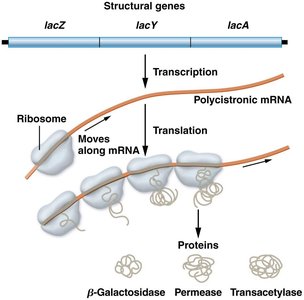
Operon: Cluster of genes under control of a single promoter, producing polycistronic mRNA.
Regulatory region: Includes promoter and operator, upstream of structural genes.
Structural Genes of the Lac Operon
The lac operon contains three structural genes:
lacZ: Encodes β-galactosidase, which converts lactose to glucose and galactose, and to allolactose (the true inducer).
lacY: Encodes permease, facilitating lactose entry into the cell.
lacA: Encodes transacetylase, removing toxic by-products of lactose digestion.

LacI Repressor Gene and Negative Control
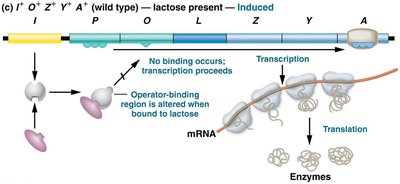
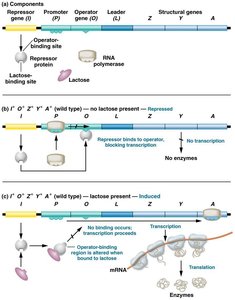
The lacI gene encodes the lac repressor, which regulates the lac operon by binding to the operator. The repressor is allosteric, changing shape when bound to lactose (allolactose).
Negative control: Repressor binds operator, blocking RNA polymerase and preventing transcription when lactose is absent.
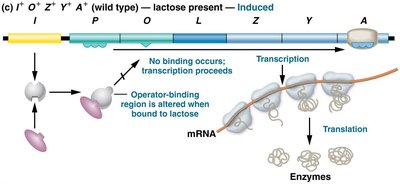
Induction: When lactose is present, it binds the repressor, causing it to release the operator and allowing transcription.

Positive Control: Catabolite Activator Protein (CAP)
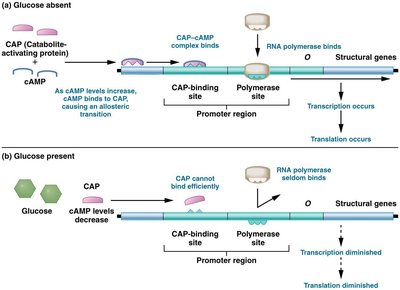
CAP exerts positive control over the lac operon. CAP binds to the CAP site only when cAMP is present, facilitating RNA polymerase binding and transcription. Glucose inhibits cAMP production, preventing CAP binding and diminishing transcription (catabolite repression).
CAP: Catabolite-activating protein, requires cAMP to bind DNA.
Catabolite repression: Glucose presence lowers cAMP, reducing CAP binding and lac operon expression.
Summary Table: Lac Operon Regulation
Condition | Lactose | Glucose | cAMP | CAP | Repressor | Transcription |
|---|---|---|---|---|---|---|
Lactose only | Present | Absent | High | Bound | Unbound | High |
Lactose & Glucose | Present | Present | Low | Unbound | Unbound | Low |
Glucose only | Absent | Present | Low | Unbound | Bound | Low |
Neither | Absent | Absent | High | Bound | Bound | Low |
The Tryptophan (trp) Operon: Repressible Gene System
trp Operon Structure and Function
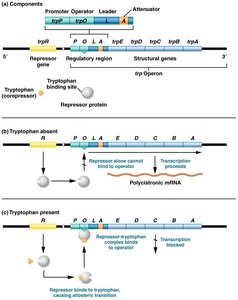
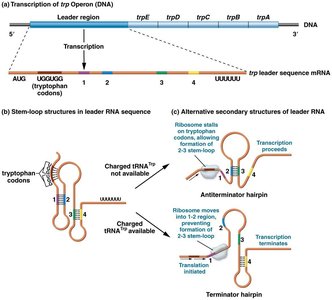
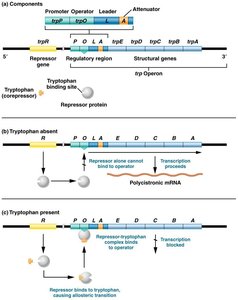
The trp operon is a repressible system controlling tryptophan biosynthesis in E. coli. It contains five structural genes (trpE, trpD, trpC, trpB, trpA) transcribed as a polycistronic mRNA.
trpP: Promoter, binding site for RNA polymerase.
trpO: Operator, binds repressor.
trpR: Encodes trp repressor protein (not part of operon).
trpL: Codes leader peptide, involved in attenuation.
Regulation by Repression and Attenuation
Regulation of the trp operon occurs via two mechanisms:
Repression: When tryptophan is present, it acts as a corepressor, binding the repressor and enabling it to bind the operator, blocking transcription.
Attenuation: Leader sequence forms alternative stem-loop structures in mRNA. In the absence of tryptophan, the anti-terminator hairpin forms, allowing transcription. In its presence, the terminator hairpin forms, terminating transcription.
Riboswitches and Antisense RNAs in Prokaryotic Gene Regulation
Riboswitches
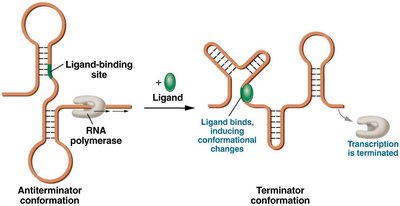
Riboswitches are alternative mRNA secondary structures that bind small ligands, causing conformational changes that regulate transcription or translation.
Aptamer domain: Binds ligand.
Expression platform: Forms terminator or anti-terminator structure.
Function: Allows or prevents transcription based on metabolite sensing.
Antisense RNAs
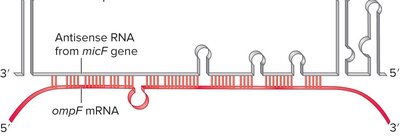
Antisense RNAs are complementary to specific mRNAs and can regulate translation by blocking or exposing ribosome binding sites.
Strategy 1: Antisense RNA sequesters ribosome binding site/start codon, blocking translation initiation.
Strategy 2: Antisense RNA opens mRNA structure, allowing translation initiation.
Key Terms and Concepts
Operon: Cluster of genes under a single promoter, producing polycistronic mRNA.
Inducible system: Gene expression activated by substrate presence (e.g., lac operon).
Repressible system: Gene expression inhibited by product presence (e.g., trp operon).
Attenuation: Regulation by premature transcription termination via mRNA structure.
Riboswitch: mRNA structure that binds ligands to regulate gene expression.
Antisense RNA: RNA complementary to mRNA, regulating translation.
----------------------------------------
