 Back
BackRNA Molecular Structure and Functional Diversity
Study Guide - Smart Notes
 Tailored notes based on your materials, expanded with key definitions, examples, and context.
RNA Molecular Structure and Comparison to DNA
Structural Differences Between RNA and DNA
Ribonucleic acid (RNA) and deoxyribonucleic acid (DNA) are both nucleic acids, but they differ in several key structural aspects that influence their stability, function, and cellular roles.
Sugar Component: RNA contains ribose, which has an extra hydroxyl (–OH) group at the 2' carbon, making RNA more reactive and less stable than DNA, which contains deoxyribose (lacking the 2' –OH group).
Nitrogenous Bases: RNA uses uracil (U) instead of thymine (T). Uracil pairs with adenine (A–U) in RNA, while thymine pairs with adenine (A–T) in DNA.
Strand Configuration: RNA is typically single-stranded (ssRNA), allowing it to fold into complex three-dimensional shapes. DNA is usually double-stranded (dsDNA) and forms a stable double helix.
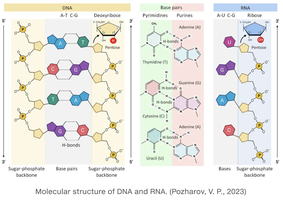
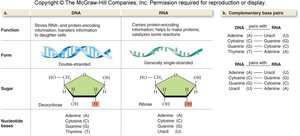
Example: The presence of the 2' hydroxyl group in ribose makes RNA more susceptible to hydrolysis, which is why DNA is the preferred molecule for long-term genetic storage.
Major Classes of RNA and Their Functions
Messenger RNA (mRNA), Ribosomal RNA (rRNA), and Transfer RNA (tRNA)
Cells contain three major classes of RNA, each with distinct roles in gene expression and protein synthesis:
Messenger RNA (mRNA): Serves as the template for protein synthesis by carrying genetic information from DNA in the nucleus to ribosomes in the cytoplasm.
Ribosomal RNA (rRNA): Forms the core structural and catalytic components of ribosomes, facilitating peptide bond formation during translation.
Transfer RNA (tRNA): Delivers amino acids to the ribosome and matches them to the correct codons in the mRNA during protein synthesis.
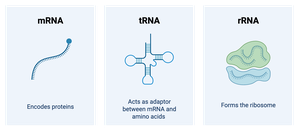
Example: During translation, tRNA molecules recognize specific codons on the mRNA and bring the corresponding amino acid to the growing polypeptide chain.
Unique and Specialized RNAs
In addition to the three major classes, cells contain several specialized RNAs with unique functions:
Telomerase RNA: Acts as a template for extending telomeres during DNA replication at chromosome ends.
RNA Primers: Short RNA sequences that initiate DNA synthesis during replication.
Small Nuclear RNA (snRNA): Components of spliceosomes, which process pre-mRNA by removing introns.
Antisense RNA, microRNA (miRNA), and small interfering RNA (siRNA): Regulate gene expression by binding complementary mRNAs to block translation or trigger degradation.
Example: miRNAs are involved in post-transcriptional regulation of gene expression, playing critical roles in development and disease.
RNA Structure and Folding
Structural Flexibility of RNA
RNA’s single-stranded nature provides it with significant structural flexibility, allowing each nucleotide six to seven degrees of freedom. This flexibility enables RNA to fold into a variety of complex secondary and tertiary structures, unlike the rigid double helix of DNA.
Key Point: The ability to form diverse structures underlies RNA’s functional versatility in the cell.
RNA Secondary Structure: Intrastrand Base Pairing
Complementary regions within an RNA strand can form intrastrand base pairs, resulting in secondary structures such as:
Hairpins (Stem-loops): Formed when a single strand folds back on itself, creating a double-stranded stem and a loop.
Bulges: Occur when unpaired nucleotides are present on one side of a stem.
Internal Loops: Regions where both sides of a stem contain unpaired nucleotides.
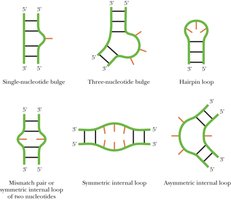
Example: tRNA molecules contain several hairpin loops and bulges that are essential for their function in translation.
RNA Secondary Structural Motifs
Four basic secondary structural elements are commonly found in RNA:
Stems: Double-stranded regions formed by base pairing.
Loops: Unpaired regions at the end of stems (e.g., hairpin loops).
Bulges: Unpaired nucleotides on one side of a stem.
Junctions: Regions where multiple stem-loops meet, allowing for complex three-dimensional folding.
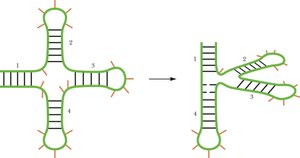
Additional info: Motifs such as U-turns and tetraloops are specialized loop structures that contribute to RNA stability and function.
Summary Table: Comparison of DNA and RNA
Feature | DNA | RNA |
|---|---|---|
Sugar | Deoxyribose | Ribose |
Bases | A, T, C, G | A, U, C, G |
Strand Configuration | Double-stranded | Single-stranded (most) |
Stability | More stable | Less stable |
Main Function | Genetic information storage | Gene expression, catalysis, regulation |
