 Back
BackRNA Transcription and Processing: Molecular Mechanisms and Regulation
Study Guide - Smart Notes
 Tailored notes based on your materials, expanded with key definitions, examples, and context.
RNA Transcription & RNA Processing
Overview of the Central Dogma
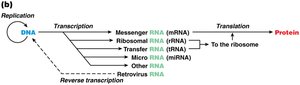
The central dogma of molecular biology describes the flow of genetic information from DNA to RNA to protein. This process involves transcription, where RNA is synthesized from a DNA template, and translation, where proteins are synthesized from RNA.
Transcription: RNA polymerase synthesizes RNA using the DNA template strand.
Translation: Messenger RNA (mRNA) directs the synthesis of proteins.
Reverse Transcription: Some viruses use reverse transcriptase to synthesize DNA from an RNA template.
Micro-RNAs: Small RNA molecules regulate gene expression post-transcriptionally.

RNA Structure and Types
RNA Nucleotides and Structure
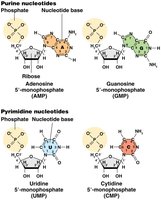
RNA is composed of ribonucleotides, each containing a ribose sugar, a nitrogenous base, and phosphate groups. RNA differs from DNA in two key ways: it uses ribose (with an OH group at C2) and uracil replaces thymine.
Bases: Adenine (A), Guanine (G), Cytosine (C), Uracil (U)
Single-stranded: RNA is typically single-stranded but can form secondary structures via base pairing.
RNA Assembly and Synthesis
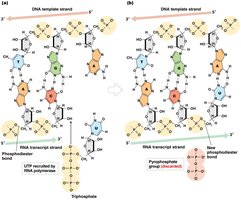
RNA strands are assembled by forming phosphodiester bonds between the 5' phosphate of one nucleotide and the 3' hydroxyl of the adjacent nucleotide. RNA polymerase catalyzes this process, using complementary base pairing (A-U, C-G).
Direction: RNA is synthesized in the 5' to 3' direction.
Phosphodiester bond: Two phosphates are eliminated during bond formation.
Classification of RNA Molecules
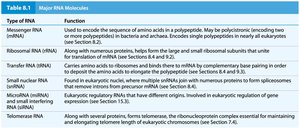
RNA molecules are classified as either messenger RNA (mRNA) or functional RNAs. mRNA is translated into protein, while functional RNAs perform roles in the cell without being translated.
mRNA: Intermediary between DNA and protein; only RNA type translated.
tRNA: Transfers amino acids to ribosomes during translation.
rRNA: Combines with proteins to form ribosomes.
snRNA: Involved in mRNA processing (splicing).
miRNA/siRNA: Regulate gene expression post-transcriptionally.
Telomerase RNA: Template for telomere DNA synthesis.
Type of RNA | Function |
|---|---|
Messenger RNA (mRNA) | Encodes amino acid sequence; translated into protein |
Ribosomal RNA (rRNA) | Forms ribosome structure; catalyzes protein synthesis |
Transfer RNA (tRNA) | Transfers amino acids to ribosome |
Small nuclear RNA (snRNA) | Involved in splicing of pre-mRNA |
Micro RNA (miRNA) / Small interfering RNA (siRNA) | Regulate gene expression |
Telomerase RNA | Template for telomere synthesis |
Transcription Mechanism in Bacteria
Gene Structure and Promoters
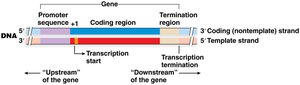
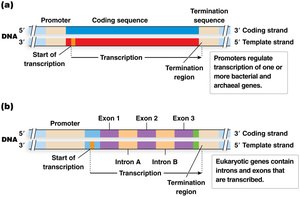
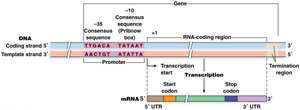
Bacterial genes contain distinct segments: promoter, coding region, and termination region. The promoter is upstream of the transcription start site (+1) and controls RNA polymerase access.
Promoter: RNA polymerase binding site; contains consensus sequences.
Coding region: Contains information for protein synthesis.
Termination region: Signals end of transcription.
Bacterial RNA Polymerase and Sigma Subunits
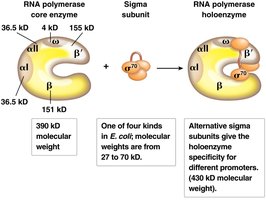
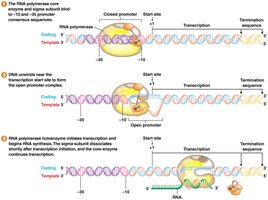
Bacterial RNA polymerase consists of a core enzyme and a sigma (σ) subunit. The sigma subunit is essential for promoter recognition and initiation of transcription.
Core enzyme: Synthesizes RNA but cannot initiate transcription alone.
Sigma subunit: Directs polymerase to specific promoters.
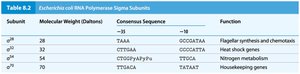
Subunit | Molecular Weight (kDa) | Consensus Sequence (-10) | Consensus Sequence (-35) | Function |
|---|---|---|---|---|
σ28 | 28 | TAAA | CCCGATTA | Flagellar synthesis and chemotaxis |
σ32 | 32 | CTTGAAA | CCCGTATA | Heat shock genes |
σ54 | 54 | CTTGGC/TGGC | TTGCA/TGCA | Nitrogen metabolism |
σ70 | 70 | TTGACA | TATAAT | Housekeeping genes |
Promoter Consensus Sequences
Bacterial promoters contain consensus sequences at the -10 (Pribnow box: TATAAT) and -35 (TTGACA) positions. These sequences are recognized by RNA polymerase and are essential for transcription initiation.
Transcription Initiation, Elongation, and Termination
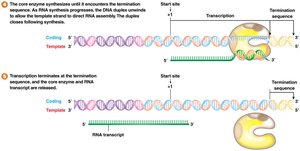
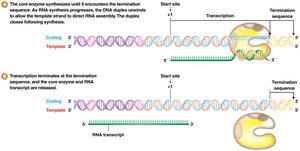
Transcription in bacteria involves several steps: promoter recognition, initiation, elongation, and termination. The sigma subunit dissociates after initiation, and the core enzyme continues elongation.
Initiation: RNA polymerase binds promoter, unwinds DNA, and begins RNA synthesis.
Elongation: RNA polymerase synthesizes RNA, unwinding DNA ahead and rewinding behind.
Termination: RNA polymerase releases the transcript and dissociates from DNA.
Transcription Termination Mechanisms
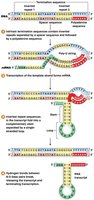
Termination in bacteria can occur via intrinsic (rho-independent) or rho-dependent mechanisms.
Intrinsic termination: Inverted repeats form a hairpin in mRNA, followed by a string of uracils, causing polymerase to release.
Rho-dependent termination: Rho protein binds to rut site (C-rich region) and separates mRNA from polymerase.
Eukaryotic Transcription
Complexity and Chromatin Structure
Eukaryotic transcription is more complex than bacterial transcription, involving multiple RNA polymerases and extensive regulation by chromatin structure and transcription factors.
RNA polymerase I: Transcribes rRNA genes.
RNA polymerase II: Transcribes protein-coding genes and most snRNA genes.
RNA polymerase III: Transcribes tRNA, one snRNA, and one rRNA.
Eukaryotic Promoter Elements
Eukaryotic promoters contain consensus sequences such as the TATA box (Goldberg-Hogness box), CAAT box, and GC-rich box. These elements are recognized by transcription factors and RNA polymerase II.
TATA box: 5'-TATAAA-3', located at -25.
CAAT box: Near -80.
GC-rich box: 5'-GGGCGG-3', near -90 or further upstream.

Transcription Initiation in Eukaryotes
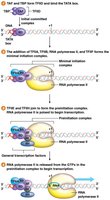
Transcription factors bind to promoter elements and recruit RNA polymerase II. The assembly of the transcription complex is highly regulated and determines the direction and efficiency of transcription.
Transcription factors: Bind to specific DNA sequences and interact with RNA polymerase II.
Initiation complex: Includes general transcription factors and RNA polymerase II positioned at the +1 site.
Enhancers and Silencers
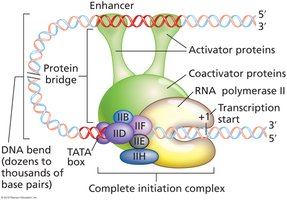
Enhancer and silencer sequences are regulatory DNA elements that modulate gene expression. Enhancers increase transcription by facilitating protein interactions, while silencers repress transcription by bending DNA and blocking access.
Posttranscriptional Processing in Eukaryotes
mRNA Modifications
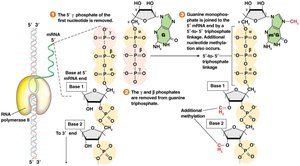
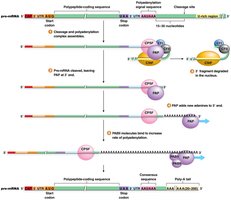
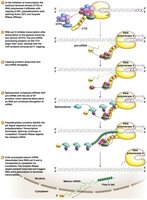
Eukaryotic pre-mRNA undergoes three main modifications: 5' capping, 3' polyadenylation, and intron splicing. These modifications stabilize mRNA, facilitate export, and ensure accurate translation.
5' capping: Addition of methylated guanine to the 5' end.
Polyadenylation: Addition of a poly-A tail to the 3' end.
Intron splicing: Removal of introns and ligation of exons.
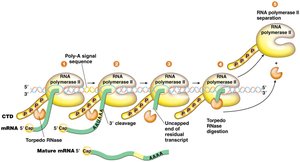
Torpedo Model of Transcription Termination
After polyadenylation, a specialized RNase digests the residual transcript attached to RNA polymerase II, triggering termination and release of the polymerase.
Intron Splicing and Spliceosome Function
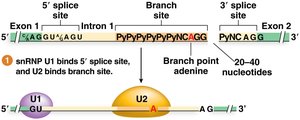
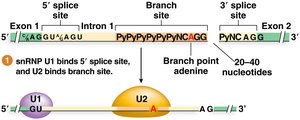
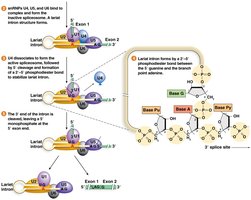
Introns are removed from pre-mRNA by the spliceosome, a complex of snRNA and proteins. Splicing requires recognition of consensus sequences at the 5' and 3' splice sites and the branch site.
5' splice site: GU dinucleotide.
3' splice site: AG dinucleotide.
Branch site: Contains branch point adenine.
Coupling of Pre-mRNA Processing Steps
Pre-mRNA processing steps are tightly coupled and coordinated by the carboxyl terminal domain (CTD) of RNA polymerase II, which acts as a platform for assembly and regulation of processing machinery.
Alternative Transcripts and Gene Regulation
Mechanisms for Producing Alternative Transcripts
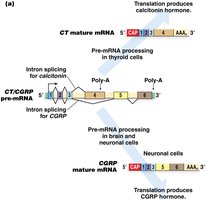
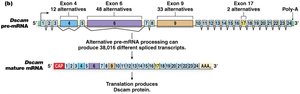
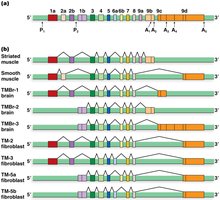
Alternative splicing, promoters, and polyadenylation allow a single gene to produce multiple mRNA and protein variants. This increases proteomic diversity, especially in complex organisms.
Alternative splicing: Different combinations of exons are included in mature mRNA.
Alternative promoters: Distinct +1 start sites in different cell types.
Alternative polyadenylation: Multiple poly-A sites produce different mRNAs.
Summary of Essential Ideas
RNA molecules are transcribed from genes and classified as mRNA or functional RNA.
Bacterial transcription begins with promoter recognition and ends with transcript completion.
Eukaryotic transcription involves homologous proteins and processes, with additional complexity.
Eukaryotic RNAs undergo three processing steps after transcription.
Alternative events during and after transcription allow different transcripts and proteins to be produced from the same DNA sequence.
