 Back
BackSex and Heredity: Modes of Inheritance and Sex Dimorphism
Study Guide - Smart Notes
 Tailored notes based on your materials, expanded with key definitions, examples, and context.
Sex Dimorphism and Modes of Inheritance
Sex Dimorphism
Sex dimorphism refers to differences in appearance or traits between males and females of a species, beyond primary sexual characteristics. These differences can be subtle or pronounced, and are often genetically determined.
Sexually Dimorphic Traits: Traits that differ between males and females, such as coloration, size, or presence of structures like antlers.
Primary vs. Secondary Sexual Characteristics: Primary characteristics are directly involved in reproduction, while secondary characteristics are traits like plumage or antlers.
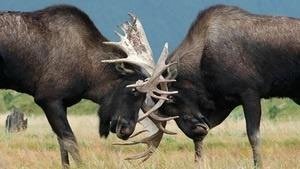
Example: Male moose have antlers, which are used for attracting females and competing with other males. 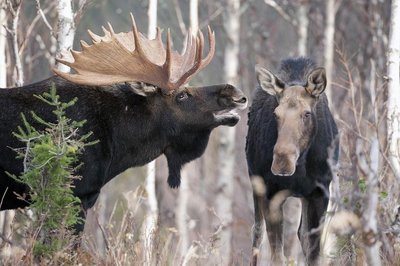
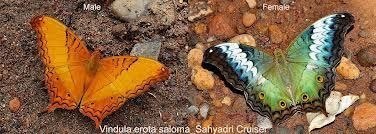
 Example: Peacocks and butterflies show visible differences between sexes.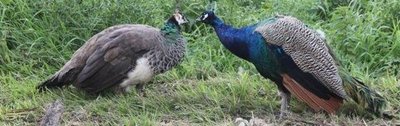
Types of Sexually Dimorphic Traits
Sex Influenced Traits: Expression is affected by the sex of the individual, but both sexes can carry the alleles. These traits are often autosomal, not sex-linked.
Sex Limited Traits: Only expressed in one sex, even though both sexes can carry the alleles. Example: Antlers in moose are only expressed in males.
Sex Linkage and Chromosomal Inheritance
Sex Linkage
Sex linkage describes inheritance patterns resulting from genes located on sex chromosomes (X or Y in mammals, Z or W in birds).
Sex Chromosomes: Presence of sex chromosomes allows for sex-linked inheritance. Without sex chromosomes, traits cannot be sex-linked.
X-linked Traits: Most sex-linked traits are X-linked, as the X chromosome contains many genes.
Y-linked Traits: Traits inherited only through the Y chromosome, passed from father to son.
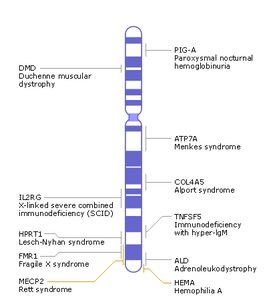
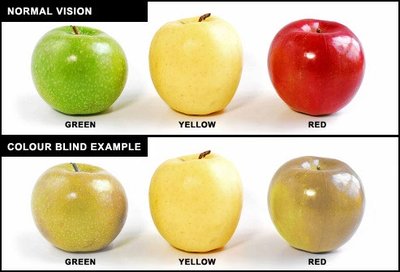
Inheritance Patterns of Sex-Linked Traits
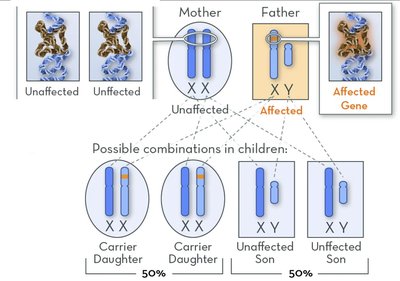
X-linked Recessive: More common in males due to hemizygosity (only one X chromosome). Sons do not inherit the trait from their father. Example: Color blindness.
X-linked Dominant: Affected fathers pass the trait to all daughters, but not to sons. Both sexes can be affected, but inheritance patterns differ.
Y-linked (Holandric): Only males are affected; trait is passed directly from father to son.
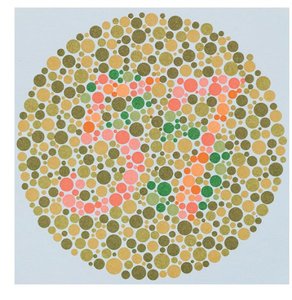
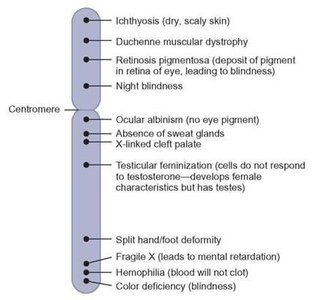
Key Clues for Identifying Sex-Linked Traits
X-linked Recessive:
Common in males
Trait can skip generations
Affected sons inherit the trait from their mother
Affected daughters must have an affected father and a carrier or affected mother
X-linked Dominant:
Affected fathers pass the trait to all daughters
Inheritance patterns differ in reciprocal crosses
Y-linked:
Only males affected
Trait passed from father to son
Predicting Outcomes for Sex-Linked Crosses
Punnett Squares for Sex-Linked Traits
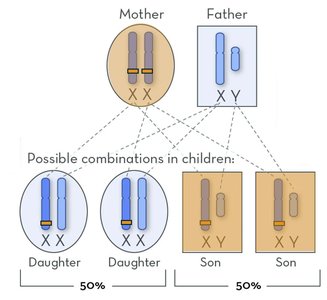
Punnett squares can be used to predict genotypic and phenotypic ratios for crosses involving sex-linked traits.
For XX/XY systems (humans):
Daughters inherit one X from each parent
Sons inherit X from mother and Y from father
For ZZ/ZW systems (birds):
Males are ZZ, females are ZW
Pedigree Analysis and Practice Problems
Pedigree Analysis
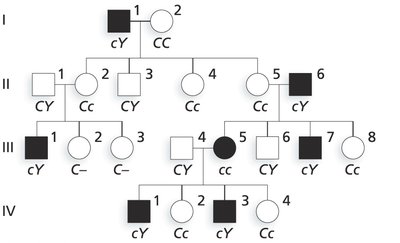
Pedigrees are used to track inheritance patterns in families and identify modes of inheritance.
Filled symbols represent affected individuals
Patterns can help distinguish between autosomal and sex-linked traits
Practice Problem: X-linked Recessive Disorder
Example: Ornithine transcarbamylase deficiency (OTD)
Father has OTD (dY), mother is homozygous wild-type (DD)
Daughter's genotype: Dd
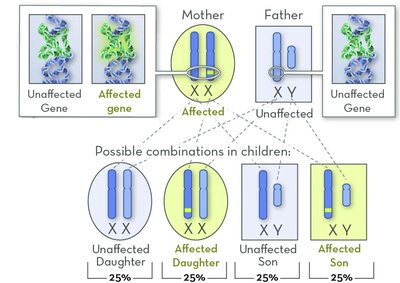
Son with unaffected father: 50% chance of OTD
Daughter with unaffected father: 50% chance of being carrier, 0% chance of OTD
Father genotype for affected daughter: dY
Proportion of affected daughters and sons: 50% each
Summary Table: Modes of Inheritance
Mode | Pattern | Key Clues |
|---|---|---|
Autosomal Dominant | Affected in every generation | Unaffected parents cannot have affected child |
Autosomal Recessive | Can skip generations | Affected child can have unaffected parents |
X-linked Dominant | Affected fathers pass trait to all daughters | Both sexes affected, but patterns differ |
X-linked Recessive | More common in males | Affected sons inherit from mother |
Y-linked | Only males affected | Trait passed father to son |
Summary and Study Guide
Discriminate between sex influenced, sex limited, and sex-linked traits
Use pedigree analysis to infer modes of inheritance
Predict outcomes for crosses involving sex-linked traits
Identify key clues for different inheritance patterns
Additional info: These notes cover content relevant to Ch. 3 (Cell Division and Chromosome Heredity), Ch. 4 (Gene Interaction), and Ch. 5 (Genetic Linkage and Mapping in Eukaryotes), focusing on sex dimorphism, sex linkage, and inheritance patterns.
