 Back
BackSex Determination and Sex Chromosomes: Dosage Compensation, Chromosomal Ratios, and Environmental Effects
Study Guide - Smart Notes
 Tailored notes based on your materials, expanded with key definitions, examples, and context.
Sex Determination and Sex Chromosomes
Dosage Compensation in Mammals
Dosage compensation is a genetic mechanism that ensures equal expression of X-linked genes in males (XY) and females (XX), preventing excessive expression in females. This process is crucial for maintaining genetic balance and normal development.
Dosage Compensation: Balances the dose of X chromosome gene expression between sexes.
Barr Bodies: Inactive X chromosomes in female cells, visible as darkly stained bodies in interphase nuclei.
X-Inactivation: Random inactivation of one X chromosome in each somatic cell, following the N-1 rule (N = total number of X chromosomes; number of Barr bodies = N-1).
Lyon Hypothesis: States that X-inactivation is random and occurs early in embryonic development; all descendant cells retain the same inactivated X.
Exceptions: Not all X chromosomes are fully inactivated; about 15% escape inactivation. X-inactivation does not occur in early gonadal tissue development, explaining syndromes like Turner (XO) and Klinefelter (XXY).
X-inactivation Center (Xic): Region on the X chromosome containing the XIST gene, which is critical for X-inactivation. Other noncoding genes (Tsix, Xite) also play roles.
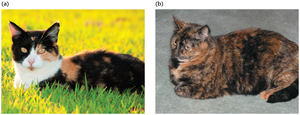
Example: Calico cats exhibit mosaic fur patterns due to random X-inactivation, leading to different expression of coat color genes.
Example: Barr bodies can be observed in interphase nuclei, and their number follows the N-1 rule. For instance, XXY individuals (Klinefelter syndrome) have one Barr body, while XO individuals (Turner syndrome) have none.
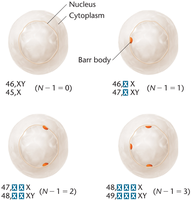
Additional info: The N-1 rule is used to predict Barr body number: , where N is the number of X chromosomes.
Chromosomal Ratios and Sex Determination in Drosophila
In Drosophila melanogaster, sex is determined by the ratio of X chromosomes to sets of autosomes (A). The Y chromosome does not determine sex in this species.
Normal Female: 2X:2A ratio (1.0)
Normal Male: XY:2A ratio (0.5)
Intersex: Ratios between 0.67 and 0.75
Metafemale: Ratio exceeds 1.0 (e.g., 3X:2A)
Dosage Compensation in Drosophila: Unlike mammals, X-inactivation does not occur. Instead, male X-linked genes are transcribed at twice the rate of females.
Sxl (Sex-lethal) Gene: Master switch gene controlling female differentiation and dosage compensation.
Chromosome Formulation | Ratio of X chromosomes to autosome sets | Sexual Morphology |
|---|---|---|
3X:2A | 1.5 | Metafemale |
3X:3A | 1.0 | Female |
2X:2A | 1.0 | Female |
3X:4A | 0.75 | Intersex |
2X:3A | 0.67 | Intersex |
X:2A | 0.50 | Male |
XY:2A | 0.50 | Male |
3X:2A | 0.33 | Metamale |
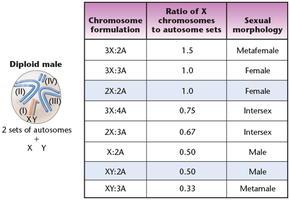
Additional info: The formula for sex determination in Drosophila is .
Sex Determination in Caenorhabditis elegans
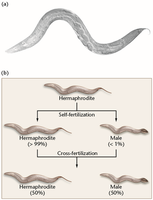
Caenorhabditis elegans is a nematode worm used as a model organism in genetics. It exhibits two sexual phenotypes: males and hermaphrodites.
Males: Have only testes.
Hermaphrodites: Have both testes and ovaries, capable of self-fertilization.
Self-Fertilization: Hermaphrodites produce eggs fertilized by stored sperm, resulting in >99% hermaphrodite offspring.
Cross-Fertilization: Males can mate with hermaphrodites, producing 50% male and 50% hermaphrodite offspring.
Temperature-Dependent Sex Determination in Reptiles
In many reptiles, sex determination is controlled by the temperature at which eggs are incubated during embryonic development. This phenomenon is known as temperature-dependent sex determination (TSD).
TSD Patterns: Three distinct patterns exist, varying by species.
Species: Crocodiles, most turtles, and some lizards exhibit TSD.
Mechanism: Incubation temperature during a critical period determines whether the embryo develops as male or female.
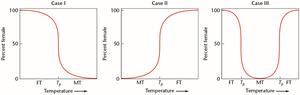
Additional info: TSD is an example of environmental sex determination, contrasting with genotypic sex determination found in mammals and birds.
Review Questions and Key Concepts
Barr Body Calculation: For XXY individuals, expect one Barr body; for XO individuals, expect zero.
X-inactivation Center: The Xic region is the major control center for X-inactivation in mammals.
Drosophila Sex Determination: Sex is determined by the balance between X chromosomes and autosome sets.
Genotypic vs. Environmental Sex Determination: Not all organisms use genotypic sex determination; reptiles use environmental cues (temperature).
