 Back
BackCh 5 Sex Determination and Sex Chromosomes: Mechanisms and Genetic Implications
Study Guide - Smart Notes
 Tailored notes based on your materials, expanded with key definitions, examples, and context.
Sex Determination and Sex Chromosomes
Introduction to Sex Determination
Sex determination refers to the biological system that establishes the development of sexual characteristics in an organism. There is a wide diversity of reproductive modes in nature, ranging from asexual reproduction to complex sexual differentiation. In many species, sexual dimorphism is evident, with distinct male and female phenotypes. The presence of heteromorphic chromosomes, such as X and Y in mammals, is a hallmark of sex determination, but ultimately, it is the genes on these chromosomes that direct sexual development.
Sex Chromosome Systems
Heterogametic Sex: The sex that produces two different types of gametes with respect to sex chromosomes (e.g., XY males in humans, ZW females in birds).
Homogametic Sex: The sex that produces identical gametes regarding sex chromosomes (e.g., XX females in humans, ZZ males in birds).
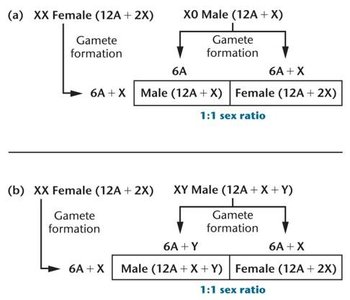
XO System: Some species use an XO system, where males have only one X chromosome (XO) and females have two (XX).
XY System: In the XY system, males are XY (heterogametic) and females are XX (homogametic).
The Human Karyotype and Sex Chromosomes
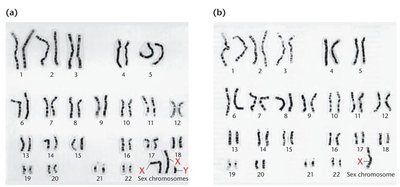
Humans have 23 pairs of chromosomes, with one pair being the sex chromosomes. Females possess two X chromosomes (XX), while males have one X and one Y chromosome (XY). The Y chromosome is critical for male development.
Klinefelter and Turner Syndromes
Klinefelter Syndrome (47,XXY): Individuals have an extra X chromosome and are phenotypically male due to the presence of the Y chromosome.
Turner Syndrome (45,X): Individuals have only one X chromosome and no Y; they are phenotypically female but lack typical sexual development.
Mosaics: Some individuals have a mixture of cell lines with different karyotypes.
Sexual Differentiation in Humans
During early embryonic development, human embryos are sexually indifferent. By the fifth week, gonadal ridges form, which can develop into either ovaries or testes. The presence of the Y chromosome, specifically the SRY gene, triggers male development.
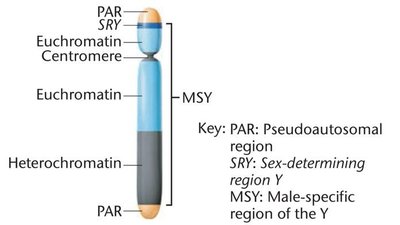
Male-Specific Region of Y (MSY) and SRY Gene
MSY: The male-specific region of the Y chromosome, comprising about 95% of its length, does not recombine with the X chromosome.
SRY (Sex-determining Region Y): A critical gene that initiates male sex determination, becoming active in XY embryos at 6–8 weeks of development.
Dosage Compensation and Barr Bodies
Dosage compensation ensures that males and females have equal expression of X-linked genes, despite females having two X chromosomes. In mammals, this is achieved by inactivating one X chromosome in females, forming a condensed structure known as a Barr body.
Barr Body: An inactivated X chromosome visible in the nuclei of female cells.
Dosage Compensation: Balances the expression of X-linked genes between sexes.
X-Inactivation and the Lyon Hypothesis
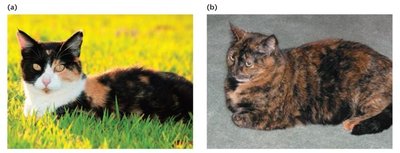
Lyon Hypothesis: X-inactivation is random in each cell, and all descendant cells maintain the same inactive X.
Phenotypic Effects: Mosaicism in females for X-linked traits, as seen in calico cats, where patches of fur color reflect different active X chromosomes.
Mechanism of X-Inactivation
Involves chemical modification of DNA and histone proteins, leading to gene silencing.
Imprinting can also affect gene expression, where only one homolog is expressed.
Sex Determination in Drosophila and C. elegans
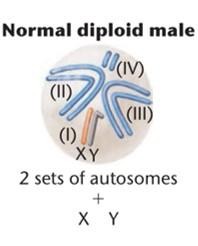
Unlike mammals, sex determination in Drosophila melanogaster and Caenorhabditis elegans is not based on the presence of a Y chromosome but on the ratio of X chromosomes to sets of autosomes (A).
Drosophila: Sex is determined by the X:A ratio. A ratio of 1.0 (2X:2A) produces females, while 0.5 (X:2A) produces males.
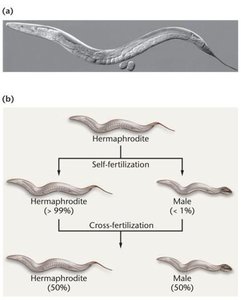
C. elegans: Two sexual phenotypes exist: hermaphrodites (XX) and males (XO). Hermaphrodites can self-fertilize, producing mostly hermaphrodite offspring.
Genetic Balance Theory
The genetic balance theory states that a threshold X:A ratio determines maleness or femaleness. Additional X chromosomes shift the balance toward female differentiation.
Environmental Sex Determination
In some reptiles, sex is determined not by chromosomes but by environmental factors such as temperature. This is known as temperature-dependent sex determination (TSD).
TSD Patterns: Different species exhibit distinct temperature ranges that favor the development of males or females.
Aromatase: An enzyme that converts androgens to estrogens; its activity is influenced by temperature, affecting sex determination in nonmammalian vertebrates.
Summary Table: X:A Ratios and Sexual Morphology in Drosophila
Chromosome Formulation | Ratio of X chromosomes to autosome sets | Sexual Morphology |
|---|---|---|
3X:2A | 1.5 | Metafemale |
3X:3A | 1.0 | Female |
2X:2A | 1.0 | Female |
3X:4A | 0.75 | Intersex |
2X:3A | 0.67 | Intersex |
X:2A | 0.50 | Male |
XY:2A | 0.50 | Male |
XY:3A | 0.33 | Metamale |
Key Equations
X:A Ratio (Drosophila):
Conclusion
Sex determination is a complex process involving genetic, chromosomal, and environmental factors. The mechanisms vary widely among species, but the underlying genetic principles provide a foundation for understanding sexual development, chromosomal abnormalities, and the regulation of gene expression related to sex chromosomes.
