 Back
BackSources of Genetic Variation and Patterns of Inheritance
Study Guide - Smart Notes
 Tailored notes based on your materials, expanded with key definitions, examples, and context.
Sources of Variation During Inheritance
Overview
Genetic variation is fundamental to the process of inheritance and evolution. This variation arises from the behavior of chromosomes and genes during meiosis and fertilization. Understanding how genes are inherited, interact, and assort independently is crucial for explaining the diversity of traits observed in offspring.
Patterns of Single-Gene Inheritance
Monohybrid Crosses and Allelic Interactions
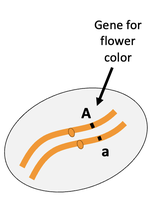
Single-gene inheritance involves one gene controlling one observable trait, such as flower color.
Each gene typically has two alleles (e.g., A or a), which may show complete dominance, incomplete dominance, or codominance.
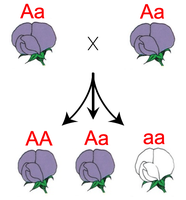
Monohybrid crosses, pedigrees, and X-linked traits are classic examples of single-gene inheritance patterns.
Genotype combinations (e.g., AA, Aa, aa) result in different phenotypes depending on dominance relationships.
Dihybrid Crosses: Two Genes, Independent Traits
Law of Independent Assortment
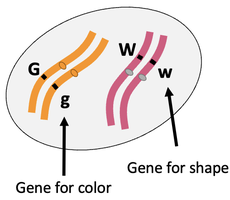
In dihybrid crosses, two genes (e.g., G/g for color and W/w for shape) are considered, each controlling a different trait and located on different chromosomes.
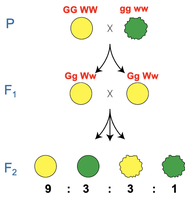
The classic dihybrid cross (GgWw × GgWw) produces four phenotypes in a 9:3:3:1 ratio in the F2 generation.
This demonstrates Mendel’s Law of Independent Assortment: alleles of genes on different chromosomes assort independently during meiosis.
Two Genes, One Trait: No Interaction
Independent Gene Action
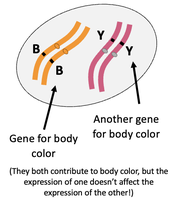
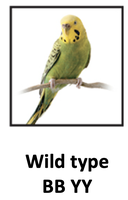
Sometimes, two genes both influence the same trait (e.g., body color), but each acts independently.
Each gene has two alleles (e.g., B/b and Y/y), and their effects are additive or independent.
The expression of one gene does not affect the expression of the other.
Two Genes, One Trait: Gene Interaction (Epistasis)
Epistasis and Phenotypic Modification
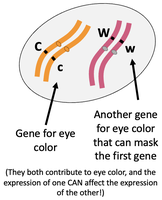
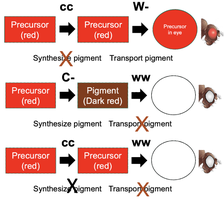
In epistasis, two genes both influence a trait, but the expression of one gene depends on the presence of specific alleles of the other gene.
For example, two genes (C/c and W/w) may both affect eye color, but a recessive allele at one locus can mask the effect of the other gene.
This is known as recessive epistasis.
Sources of Genetic Variation During Inheritance
Independent Assortment and Recombination
Independent assortment refers to the random distribution of different chromosomes into gametes during meiosis, resulting in genetic variation among offspring.
Recombination (crossing over) is the physical exchange of DNA between homologous chromosomes during meiosis, creating new allele combinations.
Gametes in a Dihybrid Cross
Formation of Gametes and Allelic Combinations
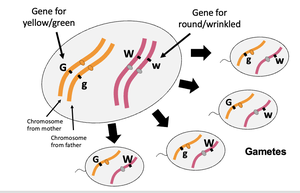
In a dihybrid individual (e.g., GgWw), meiosis produces four types of gametes: GW, Gw, gW, and gw.
This is due to the independent segregation of each chromosome pair.
Chromosomal Basis for Independent Assortment (Mendel’s 2nd Law)
Random Alignment and Gamete Diversity
During Metaphase I of meiosis, homologous chromosomes align randomly at the metaphase plate.
This random alignment leads to different combinations of maternal and paternal chromosomes in gametes, supporting Mendel’s Law of Independent Assortment.
Each possible arrangement is equally likely, resulting in a 1/4 probability for each gamete type in a dihybrid cross.
Parental and Recombinant Gametes
Chromosome Shuffling and Genetic Diversity
Genes on different chromosomes can create both parental (original) and recombinant (new) gametes due to independent assortment and recombination.
For example, crossing pure breeding parents (gg ww × GG WW) produces F1 dihybrids (Gg Ww), which can generate both parental and recombinant gametes.
Mendel’s Law of Independent Assortment
Definition and Consequences
The alleles of genes on different chromosomes assort independently during meiosis.
Each gamete receives one chromosome from each pair, and the random alignment of chromosomes produces many possible allele combinations.
How Meiosis Creates Genetic Variation
Summary of Mechanisms
Movement of chromosomes into gametes during meiosis results in the shuffling of genetic material.
Recombination (crossing over) further increases genetic diversity by exchanging DNA between homologous chromosomes.
