 Back
BackSpeciation, Reproductive Isolation, and Molecular Evolution
Study Guide - Smart Notes
 Tailored notes based on your materials, expanded with key definitions, examples, and context.
Speciation and Species Relationships
Introduction to Species and Reproductive Isolation
The concept of a species is central to evolutionary biology and genetics. According to the biological species concept, a species is defined as a group of organisms capable of interbreeding and producing fertile offspring, but reproductively isolated from other such groups. Reproductive isolation is essential for maintaining distinct species and can occur through various mechanisms that prevent gene flow between populations.
Mechanisms of Reproductive Isolation
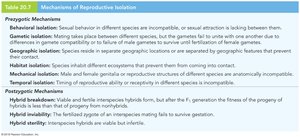
Reproductive barriers are classified as prezygotic or postzygotic mechanisms. These barriers prevent the exchange of genes between populations, thereby facilitating speciation.
Type | Mechanism | Description |
|---|---|---|
Prezygotic | Behavioral Isolation | Differences in mating behavior prevent interbreeding. |
Prezygotic | Gametic Isolation | Gametes are incompatible and cannot fuse to form a zygote. |
Prezygotic | Geographic Isolation | Physical barriers separate populations. |
Prezygotic | Habitat Isolation | Species occupy different habitats within the same area. |
Prezygotic | Mechanical Isolation | Structural differences prevent mating or fertilization. |
Prezygotic | Temporal Isolation | Species breed at different times. |
Postzygotic | Hybrid Inviability | Hybrid offspring fail to develop or survive. |
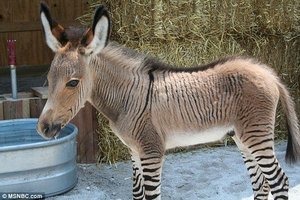
Postzygotic | Hybrid Sterility | Hybrid offspring are sterile (e.g., mule, zonkey). |
Postzygotic | Hybrid Breakdown | First-generation hybrids are viable, but subsequent generations are inviable or sterile. |
Example: A mule is a sterile hybrid resulting from the mating of a horse and a donkey, illustrating postzygotic hybrid sterility.
Speciation Mechanisms
Allopatric Speciation
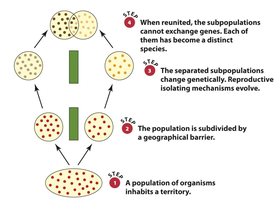
Allopatric speciation occurs when populations are geographically separated by physical barriers such as mountains, rivers, or glaciers. Over time, genetic divergence leads to the evolution of reproductive isolating mechanisms, resulting in the formation of new species.
Step 1: A population inhabits a territory.
Step 2: The population is subdivided by a geographical barrier.
Step 3: The separated subpopulations change genetically; reproductive isolating mechanisms evolve.
Step 4: When reunited, subpopulations cannot exchange genes and are distinct species.
Sympatric Speciation
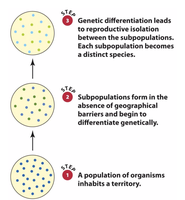
Sympatric speciation occurs without geographical separation. Populations become reproductively isolated due to genetic, behavioral, seasonal, or ecological differences. For example, animals with different activity patterns (nocturnal vs. diurnal) may only mate with those sharing the same pattern, leading to reproductive isolation.
Genetic differentiation occurs within the same environment.
Subpopulations form and become reproductively isolated.
Polyploidy and Instant Speciation
Allopolyploidy is a form of polyploidy where an organism contains multiple sets of chromosomes derived from different species. This is a common mechanism of instant speciation in plants. Initially, hybrids are sterile due to non-homologous chromosomes, but chromosome doubling (via mitotic or meiotic nondisjunction) can restore fertility, resulting in a new, reproductively isolated species.
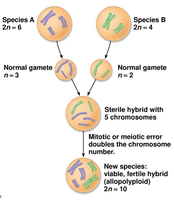
Example: Many crop plants, such as wheat, are allopolyploids.
Phylogenetic Relationships and Tree Interpretation
Phylogenetic Trees and Groupings
Phylogenetic trees are diagrams that depict evolutionary relationships among species based on genetic differences. Branches represent lineages, and nodes represent common ancestors. Groupings can be:
Monophyletic: Includes an ancestor and all its descendants.
Paraphyletic: Includes an ancestor and some, but not all, descendants.
Polyphyletic: Includes species from different ancestors.
Sequence Divergence and Species Relationships
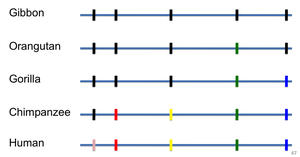
Genetic differences, such as sequence divergence at homologous genes, are used to infer evolutionary relationships. For example, differences in the alpha-globin gene among primates can be used to construct phylogenetic trees.
Parsimony in Phylogenetic Trees
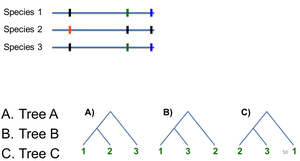
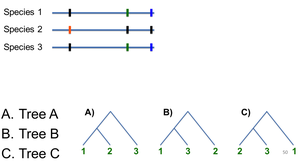
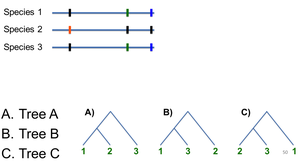
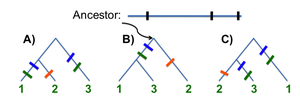
The principle of parsimony states that the best phylogenetic tree is the one that requires the fewest evolutionary changes (mutations). This approach is used to select among alternative tree topologies.
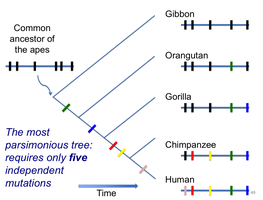
Example: The most parsimonious tree for apes requires only five independent mutations.
Evaluating Alternative Trees
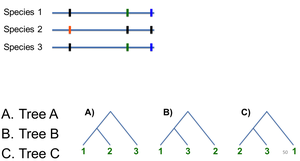
Patterns of sequence divergence can be used to evaluate which phylogenetic tree is most parsimonious. The tree that explains the observed genetic differences with the fewest changes is preferred.
Molecular Evolution and Molecular Clocks
Sequence Divergence and Mutation Fixation
Sequence divergence between species results from mutations that become fixed in one lineage. Sequence analysis can measure nucleotide divergence between species pairs, providing data for evolutionary studies.
Molecular Clocks
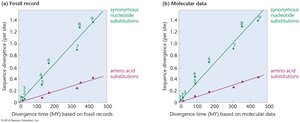
A molecular clock is a method that uses the rate of genetic mutations to estimate the time since two species diverged from a common ancestor. Molecular clocks assume that mutations accumulate at a relatively constant rate and must be calibrated using independent data, such as the fossil record.
Measure nucleotide or amino acid substitutions over time.
Calibrate using fossil data for accurate divergence time estimates.
Mutation Rates and Selection
The rate at which mutations become fixed depends on their effect on protein function:
Beneficial mutations are rare but may become fixed by positive selection.
Deleterious mutations are eliminated by purifying selection.
Neutral mutations may persist or be lost by genetic drift; some become fixed over time.
Synonymous vs. Non-synonymous Substitutions
Synonymous substitutions do not alter the amino acid sequence of a protein and are usually neutral, while non-synonymous substitutions change the amino acid sequence and are often subject to selection. Synonymous substitutions accumulate faster because they are not affected by selection.
Synonymous substitutions are neutral and accumulate rapidly.
Non-synonymous substitutions may be deleterious and are often removed by selection.
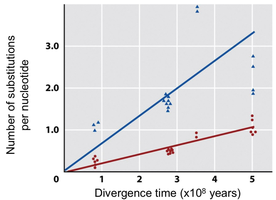
Example: In molecular evolution studies, the rate of synonymous substitutions is used as a baseline to detect selection on protein-coding genes.
Additional info: Understanding the mechanisms of speciation and molecular evolution is fundamental for interpreting genetic diversity, evolutionary history, and the processes that generate new species.
