 Back
Structure of DNA and RNA: Foundations of Genetic Material
Study Guide - Smart Notes
 Tailored notes based on your materials, expanded with key definitions, examples, and context.
Structure of DNA and RNA
Genetic Material: Essential Properties
The genetic material must fulfill four key criteria to serve its biological function: information, transmission, replication, and variation. These properties ensure that DNA can encode the instructions for life, be inherited, copied accurately, and allow for diversity.
Information: Contains the instructions necessary to build and maintain an organism.
Transmission: Must be passed from parent to offspring during reproduction.
Replication: Must be duplicated so each cell receives a complete copy.
Variation: Capable of change, providing the basis for evolution and adaptation.
Discovery of DNA as the Genetic Material
Early 20th-century experiments established DNA as the genetic material, distinguishing it from proteins. Key experiments included Griffith's transformation studies, the Avery-MacLeod-McCarty experiment, and the Hershey-Chase experiment.
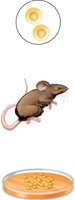
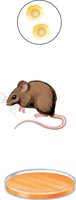
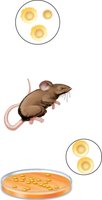
Griffith's Experiment: Demonstrated transformation in Streptococcus pneumoniae, showing that a substance from dead bacteria could genetically alter living bacteria.
Avery-MacLeod-McCarty: Identified DNA as the transforming principle by fractionating bacterial components and testing their ability to transform.
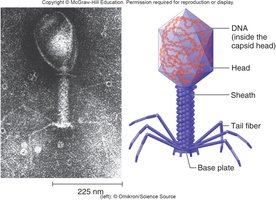
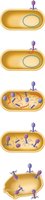
Hershey-Chase Experiment: Used bacteriophage T2 and radioactive labeling to show that DNA, not protein, is injected into bacteria and directs viral replication.

Structure of DNA: Molecular Organization
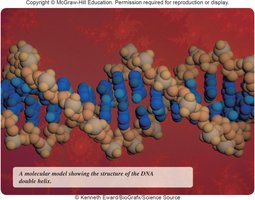
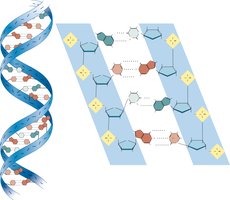
DNA is a polymer of nucleotides, each consisting of a phosphate group, a deoxyribose sugar, and a nitrogenous base. The double helix structure, elucidated by Watson and Crick, is stabilized by hydrogen bonds between complementary bases and stacking interactions.
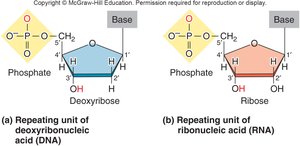
Nucleotides: The building blocks of DNA and RNA, composed of a phosphate, sugar, and base.
Phosphodiester Bonds: Link nucleotides, forming the sugar-phosphate backbone and giving directionality (5' to 3').
Base Pairing: Adenine pairs with thymine (A-T, 2 hydrogen bonds), guanine pairs with cytosine (G-C, 3 hydrogen bonds).
Double Helix: Two antiparallel strands form a right-handed helix, with bases on the inside and backbone on the outside.
Nucleotide Structure and Types
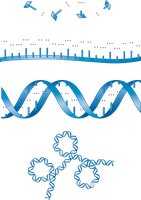
Nucleotides differ between DNA and RNA in their sugar and base composition. DNA contains deoxyribose and the bases adenine, guanine, cytosine, and thymine. RNA contains ribose and replaces thymine with uracil.
Purines: Double-ring bases (adenine, guanine).
Pyrimidines: Single-ring bases (cytosine, thymine in DNA, uracil in RNA).
DNA vs. RNA: DNA has deoxyribose and thymine; RNA has ribose and uracil.
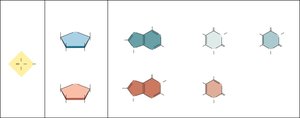
Chargaff's Rules and Base Composition
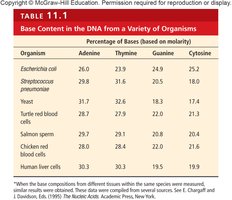
Erwin Chargaff's analysis of DNA from various organisms revealed that the amount of adenine equals thymine, and guanine equals cytosine, supporting the base-pairing model.
Chargaff's Rule: [A] = [T], [G] = [C]
Implication: DNA composition is consistent with complementary base pairing.
Organism | Adenine (%) | Thymine (%) | Guanine (%) | Cytosine (%) |
|---|---|---|---|---|
Escherichia coli | 26.0 | 23.9 | 24.9 | 25.2 |
Streptococcus pneumoniae | 31.6 | 31.6 | 20.5 | 18.2 |
Yeast | 31.7 | 32.9 | 18.3 | 17.1 |
Turtle red blood cells | 28.0 | 28.0 | 22.0 | 22.0 |
Salmon sperm | 29.0 | 29.1 | 20.7 | 21.4 |
Chicken red blood cells | 28.8 | 28.4 | 21.5 | 21.3 |
Human liver cells | 30.3 | 30.3 | 19.5 | 19.9 |
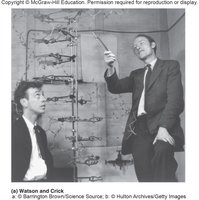
Watson and Crick Model of DNA
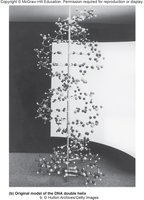
Watson and Crick integrated experimental data to propose the double helix model of DNA. Their model explained the antiparallel nature of strands, complementary base pairing, and the structural features observed in X-ray diffraction studies.
Antiparallel Strands: One strand runs 5' to 3', the other 3' to 5'.
Major and Minor Grooves: The helix has alternating grooves, important for protein-DNA interactions.
Helical Parameters: 10 base pairs per turn, 2 nm diameter, 0.34 nm between base pairs.
Alternative DNA Structures: B-DNA and Z-DNA
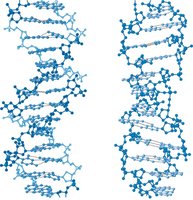
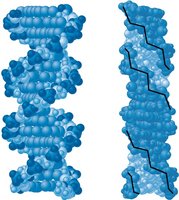
DNA can adopt different conformations. B-DNA is the most common form in cells, while Z-DNA is a left-handed helix that can form under certain conditions.
B-DNA: Right-handed helix, bases perpendicular to axis, major and minor grooves.
Z-DNA: Left-handed helix, bases tilted, backbone zigzag pattern.
Structure of RNA
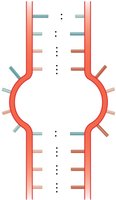
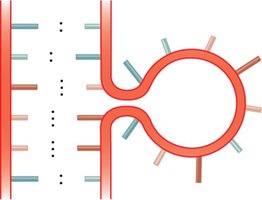
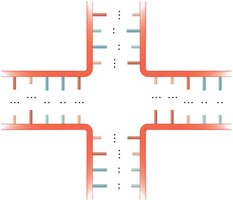
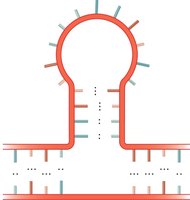
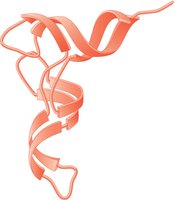
RNA is similar to DNA but usually single-stranded, with ribose sugar and uracil instead of thymine. RNA can form secondary structures such as hairpins, bulge loops, internal loops, and multibranched junctions due to complementary base pairing.
Primary Structure: Linear sequence of nucleotides.
Secondary Structure: Short double-stranded regions formed by base pairing (A-U, C-G).
Major Classes: rRNA (ribosomal), mRNA (messenger), tRNA (transfer).
Summary: The Central Dogma
The flow of genetic information in cells follows the central dogma: DNA is transcribed into RNA, which is then translated into protein. This process underlies all cellular functions and inheritance.
DNA: Stores genetic information.
RNA: Transfers information and participates in protein synthesis.
Protein: Executes cellular functions.
Key Equations:
Chargaff's Rule:
Phosphodiester bond formation:
Additional info: The notes include expanded explanations and context for experimental evidence and structural features, ensuring completeness for exam preparation.
