 Back
BackStudy Guide: Hominid Evolution – Walking Upright & Tool Use
Study Guide - Smart Notes
 Tailored notes based on your materials, expanded with key definitions, examples, and context.
Q1. What three things must humans do in order to maintain balance?
Background
Topic: Bipedalism and Human Anatomy
This question is testing your understanding of the anatomical adaptations required for humans to walk upright and maintain balance.
Key Terms:
Bipedalism: Walking on two legs.
Balance: The ability to maintain a stable posture while standing or moving.
Weight-bearing bones: Bones that support the body's weight during movement.
Step-by-Step Guidance
Consider the physical requirements for standing and walking upright. Think about how the body prevents itself from falling over.
Reflect on the role of the head, spine, and pelvis in keeping the body's center of gravity aligned.
Think about how the feet and legs adjust to shifts in weight, especially when standing on one foot.
Try to identify three distinct actions or anatomical features that contribute to balance.
Try solving on your own before revealing the answer!
Q2. Which three bones are most important for walking upright? Justify your answer for each.
Background
Topic: Skeletal Adaptations for Bipedalism
This question is testing your ability to identify and justify the importance of specific bones in the context of upright walking.
Key Terms:
Pelvis: Supports the upper body and connects the spine to the legs.
Femur: The thigh bone, crucial for movement and weight transfer.
Spine: Maintains posture and balance.
Step-by-Step Guidance
Review the list of major weight-bearing bones: head, spine, pelvis, femur, knee, and foot.
Think about which bones play the largest role in supporting the body during upright walking.
For each bone you select, provide a justification based on its function in bipedal movement.
Consider how each bone contributes to stability, movement, and weight distribution.
Try solving on your own before revealing the answer!
Q3. Fill in the chart comparing Chimp and Human bones related to bipedalism.
Background
Topic: Comparative Anatomy
This question is testing your ability to compare anatomical features between humans and chimpanzees, focusing on bones involved in bipedalism.
Key Terms:
Bipedalism: Walking upright on two legs.
Comparative anatomy: Studying similarities and differences in the anatomy of different species.
Step-by-Step Guidance
Examine the structure of each bone (head, spine, pelvis, femur, knee, foot) in both humans and chimps.
Note differences in shape, orientation, and function that relate to upright walking.
Record brief notes for each bone explaining its relevance to bipedalism.
Focus on how adaptations in humans support walking upright compared to chimps.
Try solving on your own before revealing the answer!
Q4. What similarities do you see between the chimpanzee and the human?
Background
Topic: Human and Primate Evolution
This question is testing your ability to identify anatomical similarities between humans and their closest primate relatives.
Key Terms:
Homology: Similarity due to shared ancestry.
Primate anatomy: Features common to primates, such as opposable thumbs and forward-facing eyes.
Step-by-Step Guidance
Review the chart categories: brain, eyes, nose, teeth, clavicle, hand, thumb.
Identify features that are similar between humans and chimpanzees.
Consider evolutionary reasons for these similarities.
Summarize your observations for each category.
Try solving on your own before revealing the answer!
Q5. Why is Ardi considered to be “a creature of transition?” How does Ardi show evidence for the evolution of bipedalism?
Background
Topic: Transitional Fossils and Bipedal Evolution
This question is testing your understanding of how fossil evidence supports the evolution of bipedalism, using Ardi as an example.
Key Terms:
Transitional fossil: A fossil that shows traits of both ancestral and derived species.
Bipedalism: Walking upright on two legs.
Step-by-Step Guidance
Review the fossil structure of Ardi, focusing on features that indicate bipedalism.
Consider the environment Ardi lived in and how it may have influenced walking upright.
Discuss how Ardi's anatomy bridges the gap between earlier primates and later hominids.
Summarize the evidence for Ardi's transitional status.
Try solving on your own before revealing the answer!
Q6. What happened to each of the weight bearing bones as the hominids became mainly bipedal?
Background
Topic: Skeletal and Muscular Adaptations
This question is testing your understanding of how bones and muscles changed as hominids evolved to walk upright.
Key Terms:
Weight-bearing bones: Bones that support the body's weight during movement.
Muscular adaptation: Changes in muscle structure and function to support new movement patterns.
Step-by-Step Guidance
Identify the main weight-bearing bones: head, spine, pelvis, femur, knee, foot.
Describe how each bone changed in shape, size, or function to support bipedalism.
Discuss the role of muscles around these bones in maintaining upright posture.
Summarize the overall trend in skeletal and muscular adaptation.
Try solving on your own before revealing the answer!
Q7. Propose an explanation as to why Ardi would have begun to spend so much time walking upright as opposed to knuckle walking.
Background
Topic: Evolutionary Adaptations and Environmental Pressures
This question is testing your ability to propose evolutionary explanations for behavioral changes in early hominids.
Key Terms:
Knuckle walking: Walking on all fours using the knuckles.
Bipedalism: Walking upright on two legs.
Environmental adaptation: Changes in behavior or anatomy in response to environmental pressures.
Step-by-Step Guidance
Consider the environmental factors that may have favored upright walking.
Think about the advantages of bipedalism, such as energy efficiency or visibility.
Propose a logical explanation based on evolutionary principles.
Support your explanation with evidence from Ardi's anatomy and environment.
Try solving on your own before revealing the answer!
Q8. Name the 6 major milestones in human evolution (oldest to most recent) and when they occurred.
Background
Topic: Human Evolution Timeline
This question is testing your knowledge of the key milestones in human evolution and their chronological order.
Key Terms:
Milestone: A significant event or development in evolutionary history.
Chronology: The order in which events occurred.
Step-by-Step Guidance
Review the interactive timeline and identify the six major milestones.
Record the name and approximate date for each milestone.
Arrange the milestones in order from oldest to most recent.
Check your list for accuracy and completeness.
Try solving on your own before revealing the answer!
Q9. For each milestone, provide a short explanation as to why it is significant.
Background
Topic: Significance of Evolutionary Milestones
This question is testing your ability to explain the importance of each major milestone in human evolution.
Key Terms:
Evolutionary significance: The impact of a development on the survival and adaptation of a species.
Step-by-Step Guidance
For each milestone, consider how it contributed to human adaptation and survival.
Write a brief explanation for each, focusing on its evolutionary impact.
Use evidence from the timeline and your knowledge of human evolution.
Check that your explanations are clear and concise.
Try solving on your own before revealing the answer!
Q10. Describe the overall trend in climate change throughout hominid evolution.
Background
Topic: Climate Change and Evolution
This question is testing your ability to interpret climate trends and their impact on hominid evolution.
Key Terms:
Climate change: Long-term shifts in temperature, precipitation, and environmental conditions.
Evolutionary pressure: Environmental factors that influence natural selection.
Step-by-Step Guidance
Examine the timeline for patterns in climate change.
Identify periods of significant change and their impact on hominids.
Describe the overall trend and its evolutionary consequences.
Summarize your findings in a clear statement.
Try solving on your own before revealing the answer!
Q11. At which point did Homo sapiens almost die out? Why did this occur?
Background
Topic: Population Bottlenecks and Survival
This question is testing your understanding of critical events in human history that threatened the survival of Homo sapiens.
Key Terms:
Population bottleneck: A sharp reduction in the size of a population due to environmental events.
Survival: The ability of a species to persist through challenging conditions.
Step-by-Step Guidance
Use the timeline to identify the period when Homo sapiens nearly went extinct.
Investigate the environmental or climatic factors that contributed to this event.
Explain why this bottleneck occurred and its impact on human evolution.
Summarize your explanation.
Try solving on your own before revealing the answer!
Q12. Which climate change milestone matches up with the change in brain size milestone? Propose an explanation as to why this may have occurred.
Background
Topic: Correlation Between Climate and Brain Evolution
This question is testing your ability to connect environmental changes with evolutionary developments, such as brain size.
Key Terms:
Milestone: Significant event in evolutionary history.
Correlation: A relationship between two variables.
Step-by-Step Guidance
Identify the climate change milestone and the brain size milestone on the timeline.
Analyze how these events are related in time.
Propose a logical explanation for the correlation, considering environmental pressures and adaptation.
Support your explanation with evidence from evolutionary theory.
Try solving on your own before revealing the answer!
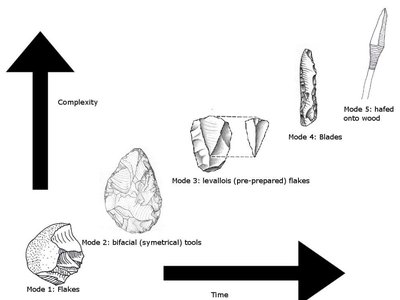
Q13. What is the overall trend of the diagram below? Give one example.
Background
Topic: Tool Complexity in Human Evolution
This question is testing your ability to interpret a diagram showing the progression of tool complexity over time.
Key Terms:
Tool complexity: The sophistication and variety of tools used by hominids.
Evolutionary innovation: The development of new technologies or behaviors.
Step-by-Step Guidance
Examine the diagram for patterns in tool development.
Identify the trend in complexity and provide an example from the diagram.
Describe how tool use evolved over time.
Connect the trend to broader evolutionary changes.
Try solving on your own before revealing the answer!
Q14. Why would stone tools be a pivotal moment for hominid evolution? Consider climate change and the skull evidence in your explanation.
Background
Topic: Technological and Anatomical Evolution
This question is testing your ability to explain the significance of stone tools in the context of environmental and anatomical changes.
Key Terms:
Stone tools: Tools made by shaping stones for specific purposes.
Pivotal moment: A turning point in evolutionary history.
Skull evidence: Fossilized skulls showing changes in brain size and structure.
Step-by-Step Guidance
Consider how stone tools allowed hominids to adapt to changing environments.
Think about the relationship between tool use and brain development.
Explain how stone tools contributed to survival and evolutionary success.
Support your explanation with evidence from climate and skull fossils.
Try solving on your own before revealing the answer!
Q15. Explain correlations between milestones, climate change, and extinction of hominid ancestors.
Background
Topic: Extinction and Evolutionary Trends
This question is testing your ability to synthesize information about evolutionary milestones, climate change, and extinction events.
Key Terms:
Extinction: The disappearance of a species.
Evolutionary milestone: Significant event in the development of a species.
Climate change: Environmental shifts affecting survival.
Step-by-Step Guidance
Review the timeline for patterns linking milestones, climate change, and extinction.
Identify correlations between these events.
Explain how environmental pressures and evolutionary developments influenced extinction.
Support your explanation with examples from the timeline.
Try solving on your own before revealing the answer!
