 Back
BackThe Genetic Code and Transcription: From DNA to Protein
Study Guide - Smart Notes
 Tailored notes based on your materials, expanded with key definitions, examples, and context.
The Central Dogma of Molecular Biology
Overview of Genetic Information Flow
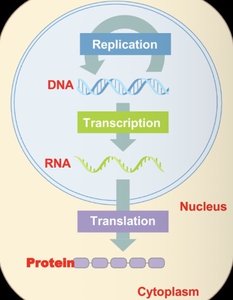
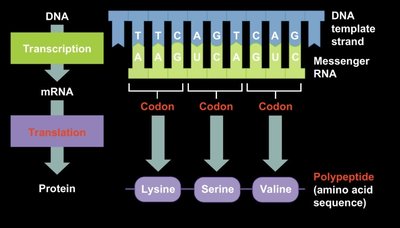
The central dogma describes the directional flow of genetic information within a cell: DNA is replicated, transcribed into RNA, and then translated into protein. This process is fundamental to all living organisms and underlies gene expression and regulation.
Replication: The process by which DNA makes a copy of itself.
Transcription: The synthesis of RNA from a DNA template.
Translation: The synthesis of proteins using the information encoded in mRNA.
DNA and RNA: Structure and Differences
Comparing DNA and RNA
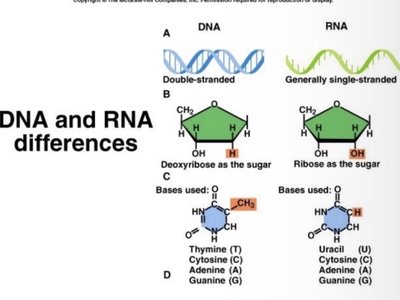
DNA and RNA are nucleic acids that differ in structure, sugar component, and nitrogenous bases. These differences are crucial for their distinct roles in genetic information storage and expression.
DNA: Double-stranded, contains deoxyribose sugar, and uses thymine (T) as a base.
RNA: Generally single-stranded, contains ribose sugar, and uses uracil (U) instead of thymine.
Feature | DNA | RNA |
|---|---|---|
Strandedness | Double-stranded | Single-stranded |
Sugar | Deoxyribose | Ribose |
Bases | A, T, C, G | A, U, C, G |
Transcription: DNA to RNA
Mechanism of Transcription
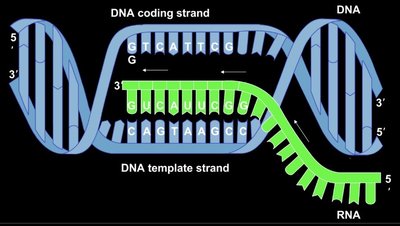
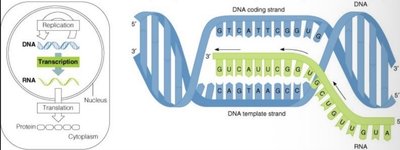
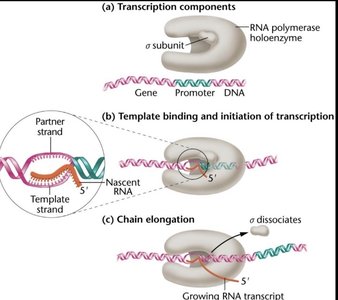
Transcription is the process by which RNA is synthesized from a DNA template. The enzyme RNA polymerase binds to the promoter region of a gene and synthesizes a complementary RNA strand using the DNA template strand.
Template strand: The DNA strand used to synthesize RNA.
Coding strand: The DNA strand with the same sequence as the RNA (except T is replaced by U).
Direction: RNA is synthesized in the 5' to 3' direction.
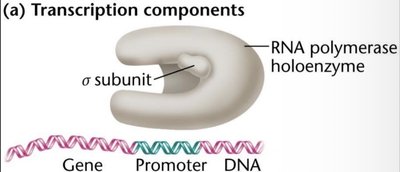
Transcription Components and Steps
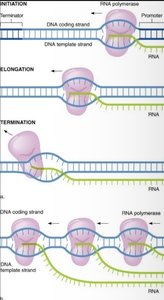
Transcription involves several key components and steps, including the binding of RNA polymerase to the promoter, initiation, elongation, and termination of the RNA transcript.
RNA polymerase holoenzyme: Enzyme responsible for RNA synthesis; contains a sigma (σ) subunit for promoter recognition.
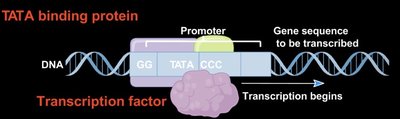
Promoter: DNA sequence where RNA polymerase binds to initiate transcription.
Initiation: RNA polymerase binds to the promoter and unwinds DNA.
Elongation: RNA polymerase synthesizes RNA by adding nucleotides.
Termination: RNA polymerase releases the completed RNA transcript.
Processing of Eukaryotic pre-mRNA
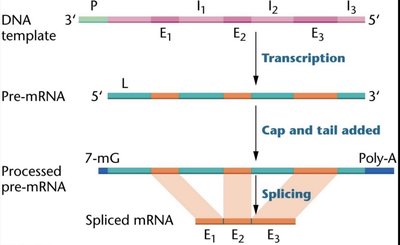
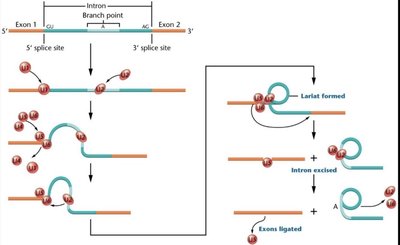
In eukaryotes, the initial RNA transcript (pre-mRNA) undergoes several modifications before becoming mature mRNA. These include the addition of a 5' cap, a 3' poly-A tail, and splicing to remove introns.
5' Capping: Addition of a modified guanine nucleotide to the 5' end.
Polyadenylation: Addition of a poly-A tail to the 3' end.
Splicing: Removal of non-coding introns and joining of exons.
The Genetic Code
Codons and the Non-Overlapping Code
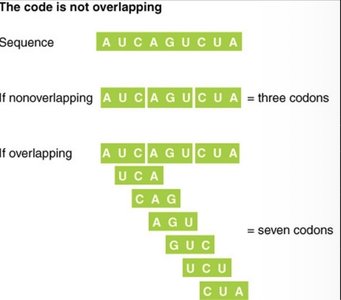
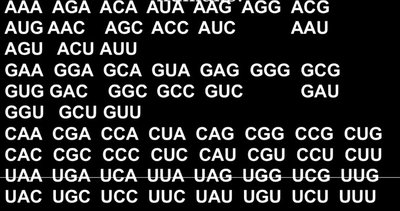
The genetic code is composed of triplets of nucleotides called codons, each specifying an amino acid. The code is non-overlapping, meaning each nucleotide is part of only one codon.
Codon: A sequence of three nucleotides in mRNA that specifies an amino acid.
Non-overlapping: Each nucleotide is read only once in a single reading frame.
Codon Table and Degeneracy
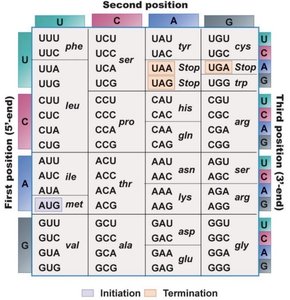
The genetic code is degenerate, meaning that most amino acids are specified by more than one codon. There are 64 possible codons, but only 20 amino acids and three stop signals.
Codon-Anticodon Base Pairing and Wobble
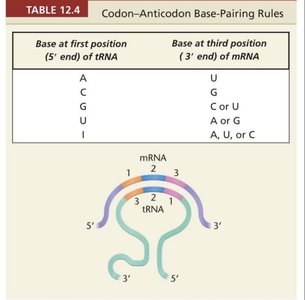
tRNA molecules recognize codons in mRNA through complementary base pairing between the codon and the anticodon. The third position of the codon often allows for 'wobble' pairing, increasing the efficiency of translation.
Base at first position (5' end) of tRNA | Base at third position (3' end) of mRNA |
|---|---|
A | U |
C | G |
G | C or U |
U | A or G |
I | A, U, or C |
Exceptions to the Universal Code
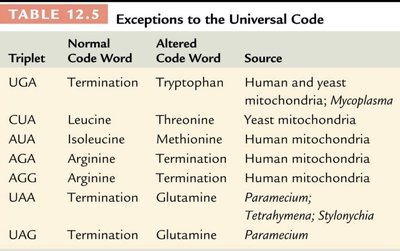
While the genetic code is nearly universal, some organisms and organelles use alternative codons for certain amino acids or stop signals.
Triplet | Normal Code Word | Altered Code Word | Source |
|---|---|---|---|
UGA | Termination | Tryptophan | Human and yeast mitochondria; Mycoplasma |
CUA | Leucine | Threonine | Yeast mitochondria |
AUA | Isoleucine | Methionine | Human mitochondria |
AGA | Arginine | Termination | Human mitochondria |
AGG | Arginine | Termination | Human mitochondria |
UAA | Termination | Glutamine | Paramecium; Tetrahymena; Stylonychia |
UAG | Termination | Glutamine | Paramecium |
Translation: RNA to Protein
Translation Overview
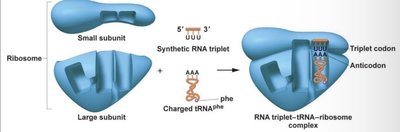
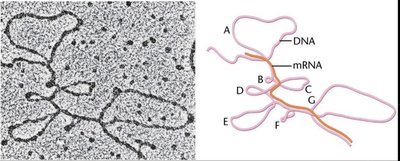
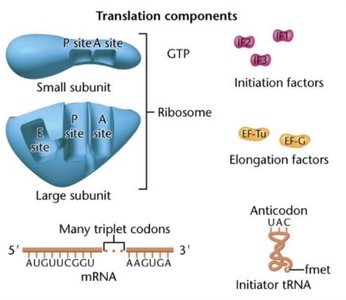
Translation is the process by which the sequence of codons in mRNA is used to assemble a corresponding sequence of amino acids, forming a polypeptide chain. This process occurs in the cytoplasm and involves ribosomes, tRNAs, and various factors.
mRNA: Provides the codon sequence for protein synthesis.
tRNA: Brings amino acids to the ribosome and matches them to the codon via its anticodon.
Ribosome: The molecular machine that catalyzes peptide bond formation.
tRNA Structure and Charging
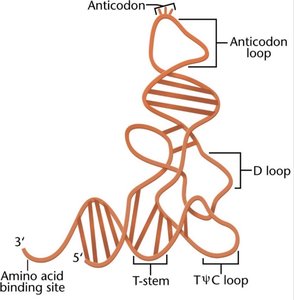
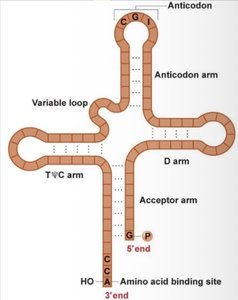
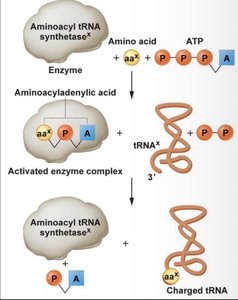
tRNA molecules have a characteristic cloverleaf structure with an anticodon loop and an amino acid binding site. Before translation, tRNAs are 'charged' with their corresponding amino acids by aminoacyl-tRNA synthetases.
Ribosome Structure: Prokaryotes vs. Eukaryotes
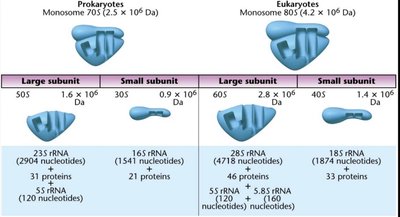
Ribosomes are composed of large and small subunits, each containing rRNA and proteins. Prokaryotic and eukaryotic ribosomes differ in size and composition.
Prokaryotes | Eukaryotes | |
|---|---|---|
Monosome | 70S | 80S |
Large subunit | 50S | 60S |
Small subunit | 30S | 40S |
rRNA & Proteins | 23S, 5S, 16S rRNA + proteins | 28S, 5.8S, 5S, 18S rRNA + proteins |
Steps of Translation
Translation occurs in three main stages: initiation, elongation, and termination. Each stage involves specific factors and molecular events.
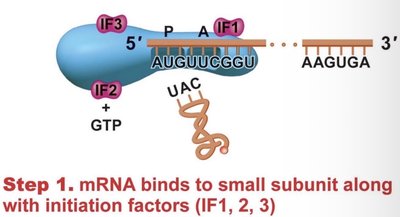
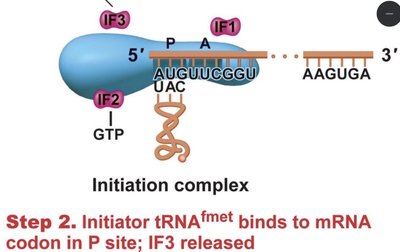
Initiation: The small ribosomal subunit binds to mRNA and the initiator tRNA. Initiation factors (IFs) and GTP are required. The large subunit then joins to form the complete initiation complex.
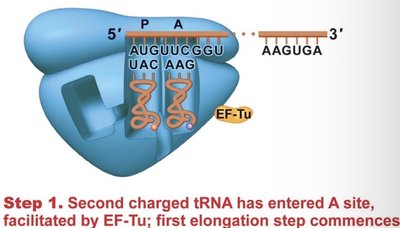
Elongation: Charged tRNAs enter the A site, peptide bonds form, and the ribosome translocates along the mRNA. Elongation factors (EFs) facilitate these steps.
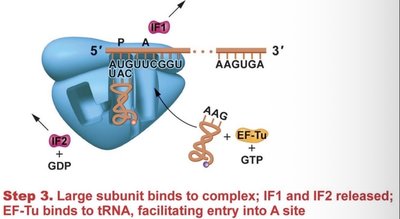
Termination: When a stop codon is reached, release factors promote the release of the completed polypeptide and dissociation of the ribosome.
Genetic Code in Translation
During translation, the sequence of codons in mRNA is read in the 5' to 3' direction, and each codon specifies the addition of a particular amino acid to the growing polypeptide chain.
Summary Table: Key Steps in Gene Expression
Step | Location | Main Enzyme/Component | Product |
|---|---|---|---|
Replication | Nucleus | DNA polymerase | DNA |
Transcription | Nucleus | RNA polymerase | RNA (mRNA, tRNA, rRNA) |
Translation | Cytoplasm | Ribosome | Protein |
Additional info: The notes above integrate foundational concepts from genetics chapters on the genetic code, transcription, and translation, with expanded academic context for clarity and exam preparation.
