 Back
BackThe Genetic Code and Transcription in Eukaryotes
Study Guide - Smart Notes
 Tailored notes based on your materials, expanded with key definitions, examples, and context.
The Genetic Code and Transcription in Eukaryotes
Overview of Eukaryotic Transcription
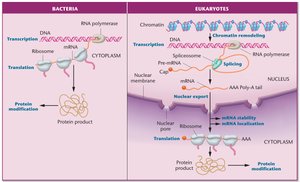
Transcription in eukaryotes is a complex process that involves the synthesis of RNA from a DNA template within the nucleus. This process is distinct from bacterial transcription due to the involvement of multiple RNA polymerases, chromatin remodeling, and extensive regulation by various DNA elements and proteins.
Location: Occurs in the nucleus; mRNA must be exported to the cytoplasm for translation.
RNA Polymerases: Three types are required, each responsible for transcribing different classes of genes.
Chromatin Remodeling: DNA must be made accessible by uncoiling chromatin structure.
Regulation: Controlled by enhancers, silencers, and transcription factors.
RNA Polymerases in Eukaryotes
Eukaryotic cells utilize three main RNA polymerases, each with specialized functions:
RNA Polymerase I: Synthesizes rRNA (except 5S rRNA).
RNA Polymerase II: Transcribes protein-coding genes (mRNA) and some noncoding RNAs (e.g., miRNAs, lncRNAs).
RNA Polymerase III: Synthesizes tRNA, 5S rRNA, and other small RNAs.
These polymerases are larger and more complex than their bacterial counterpart and require additional protein factors for function.
Initiation of Transcription: Promoters and Regulatory Elements
Transcription initiation in eukaryotes is regulated by several cis-acting DNA elements and trans-acting factors:
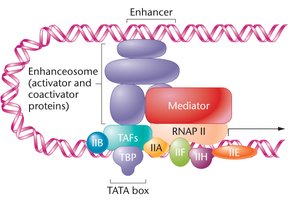
Core Promoter (TATA box): Determines the precise start site for transcription. The TATA-binding protein (TBP) binds here, recruiting other transcription factors.
Proximal-Promoter Elements: Located near the core promoter, these elements modulate the efficiency of transcription initiation.
Enhancers: Increase transcription levels by facilitating the assembly of the transcription machinery, even when located far from the gene.
Silencers: Decrease transcription by recruiting repressors.
Transcription Factors, Activators, and Repressors
Transcription factors are proteins that bind to specific DNA sequences to regulate transcription:
General Transcription Factors (GTFs): Essential for the assembly of the pre-initiation complex and recruitment of RNA polymerase II (e.g., TFIID, TFIIA, TFIIB).
Activators: Bind to enhancers to increase transcription.
Repressors: Bind to silencers to decrease transcription.
DNA looping allows distant enhancers or silencers to interact with the core promoter region, modulating transcription levels.
Termination of Transcription
Termination in eukaryotes is more complex than in bacteria and does not rely on a single consensus sequence:
Polyadenylation Signal (AAUAAA): Signals the end of transcription; RNA polymerase II transcribes beyond this site.
Cleavage and Polyadenylation: The transcript is cleaved, and a poly-A tail is added, destabilizing the RNA polymerase and releasing the transcript.
RNA Processing: Capping, Tailing, and Splicing
Primary transcripts (pre-mRNAs) undergo several modifications before becoming mature mRNAs:
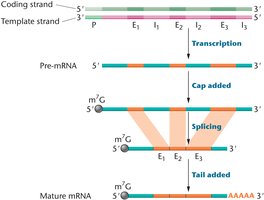
5′ Cap Addition: A 7-methylguanosine cap is added to the 5′ end, protecting mRNA from degradation and aiding in ribosome binding.
3′ Poly-A Tail: Poly-A polymerase adds a tail of ~250 adenylic acid residues to the 3′ end, enhancing stability and export from the nucleus.
Splicing: Introns (noncoding sequences) are removed, and exons (coding sequences) are joined together.
Introns and Exons: Structure and Function
Genes in eukaryotes are often interrupted by introns, which are removed during RNA processing:
Introns: Noncoding sequences that are excised from the pre-mRNA.
Exons: Coding sequences that remain in the mature mRNA.
RNA Splicing: The process of removing introns and joining exons, catalyzed by the spliceosome or, in some cases, by self-splicing RNAs.
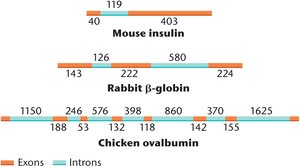
Table: Intron and Exon Structure in Selected Genes
Gene | Exon Lengths (nt) | Intron Lengths (nt) |
|---|---|---|
Mouse insulin | 119, 403 | 40 |
Rabbit β-globin | 126, 580, 224 | 143, 222 |
Chicken ovalbumin | 1150, 246, 576, 398, 860, 370, 1625 | 188, 53, 132, 118, 142, 155 |
Functions of Introns and Alternative Splicing
Introns play several important roles in gene expression and evolution:
Alternative Splicing: Allows a single gene to produce multiple mRNA variants by including or excluding different exons, increasing protein diversity.
Evolutionary Advantage: Exon/intron structure facilitates the evolution of new genes through exon shuffling.
Regulatory Roles: Some introns contain regulatory elements or encode functional noncoding RNAs.
Splicing Mechanisms
Splicing can occur via different mechanisms depending on the RNA type:
Spliceosome-mediated Splicing: The major pathway in nuclear pre-mRNA processing.
Self-Splicing RNAs: Some RNAs, especially in mitochondria and chloroplasts, can catalyze their own splicing without protein enzymes.
Splicing ensures the production of mature mRNA, ready for translation into protein.
