 Back
BackCh 12 The Genetic Code and Transcription: Structure, Function, and Mechanisms
Study Guide - Smart Notes
 Tailored notes based on your materials, expanded with key definitions, examples, and context.
Ch 12 The Genetic Code and Transcription
Introduction to the Genetic Code
The genetic code is the set of rules by which information encoded in DNA is translated into proteins, the functional molecules of the cell. The linear sequence of deoxyribonucleotides in DNA contains the instructions for protein synthesis. During gene expression, one DNA strand serves as a template for the synthesis of messenger RNA (mRNA), which then directs protein synthesis at the ribosome.
DNA stores genetic information in the form of nucleotide sequences.
Transcription is the process by which an mRNA copy is made from a DNA template.
Translation is the process by which ribosomes use mRNA to synthesize proteins.
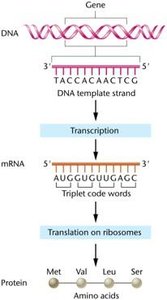
Key Features of the Genetic Code
The genetic code is characterized by several important properties that ensure accurate and efficient translation of genetic information into proteins.
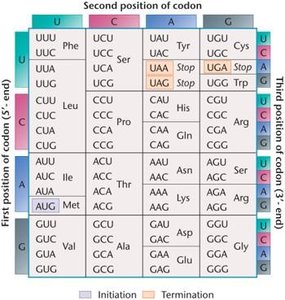
Triplet Code: Each amino acid is encoded by a sequence of three nucleotides (codon) in mRNA.
Unambiguous: Each codon specifies only one amino acid.
Degenerate: Most amino acids are encoded by more than one codon.
Start and Stop Signals: Specific codons signal the initiation (AUG) and termination (UAA, UAG, UGA) of translation.
Commaless: Codons are read sequentially without gaps.
Nonoverlapping: Each nucleotide is part of only one codon.
Nearly Universal: The code is conserved across most organisms, with few exceptions.
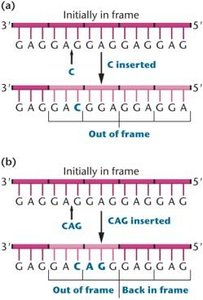
The Triplet Nature of the Code
Experimental evidence, such as frameshift mutations, demonstrated that the genetic code is read in triplets. Insertion or deletion of nucleotides shifts the reading frame, altering downstream amino acid sequence.
Frameshift Mutations: Insertions or deletions that are not multiples of three disrupt the reading frame, leading to nonfunctional proteins.
Triplet Codes: Restore the reading frame if three nucleotides are inserted or deleted.
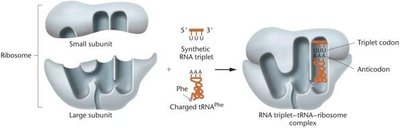
Experimental Elucidation of the Code
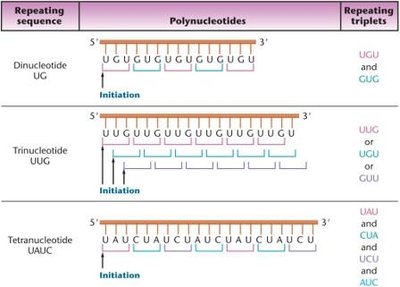
Several experimental approaches were used to decipher the genetic code, including the triplet binding assay and the use of synthetic repeating copolymers.
Triplet Binding Assay: Ribosomes bind to synthetic RNA triplets, allowing identification of codon-amino acid assignments.
Repeating Copolymers: Chemically synthesized RNAs with repeating sequences were used to determine which codons specify which amino acids.
Degeneracy and the Wobble Hypothesis
The genetic code's degeneracy means that multiple codons can specify the same amino acid. The wobble hypothesis explains how the third base of a codon can pair less stringently with the corresponding base in the tRNA anticodon, allowing for flexibility in base pairing.
Wobble Position: The third nucleotide of a codon is less spatially constrained, allowing non-standard base pairing.
Inosine (I): A modified base in tRNA that can pair with A, U, or C in mRNA.
Only Methionine (AUG) and Tryptophan (UGG): Encoded by a single codon.
Base at First Position (5′-end) of tRNA | Base at Third Position (3′-end) of mRNA |
|---|---|
A | U |
C | G |
G | C or U |
U | A or G |
I (Inosine) | A, U, or C |
Additional info: Table above summarizes codon–anticodon base-pairing rules, supporting the wobble hypothesis.
Initiation and Termination Codons
Translation begins at the initiator codon (AUG, methionine) and ends at one of three termination codons (UAA, UAG, UGA), which do not code for any amino acid and signal the end of protein synthesis.
Initiator Codon (AUG): Specifies methionine; in bacteria, a modified form (N-formylmethionine) is used for initiation.
Termination Codons: UAA, UAG, UGA; also called nonsense codons.
Nonsense Mutation: Mutation that introduces a stop codon, resulting in a truncated, nonfunctional protein.
Exceptions to the Universal Code
While the genetic code is nearly universal, some exceptions exist, particularly in mitochondrial DNA and certain unicellular organisms.
Codon | Normal Code Word | Altered Code Word | Source |
|---|---|---|---|
UGA | Termination | Trp | Human and yeast mitochondria; Mycoplasma |
CUA | Leu | Thr | Yeast mitochondria |
AUA | Ile | Met | Human mitochondria |
AGA | Arg | Termination | Human mitochondria |
AGG | Arg | Termination | Human mitochondria |
UAA | Termination | Gln | Paramecium, Tetrahymena, Stylonychia |
UAG | Termination | Gln | Paramecium |
Overlapping Genes
Although the genetic code is nonoverlapping, some viral and prokaryotic genomes contain overlapping genes, where a single mRNA can have multiple initiation points, creating different reading frames and specifying more than one polypeptide.
Transcription: Synthesis of RNA from DNA
Overview of Transcription
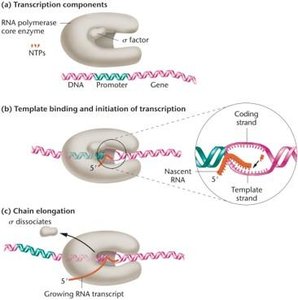
Transcription is the process by which RNA is synthesized from a DNA template. This process is catalyzed by RNA polymerase and results in the formation of single-stranded RNA (ssRNA), which serves as the template for translation.
RNA Polymerase: Enzyme that synthesizes RNA using DNA as a template; does not require a primer.
Template Strand: The DNA strand that is transcribed into RNA.
Coding Strand: The non-template DNA strand, which has the same sequence as the RNA (except T is replaced by U).
Promoters and Initiation of Transcription
Transcription begins when RNA polymerase binds to a promoter, a specific DNA sequence upstream of the gene. In bacteria, the sigma (σ) factor of RNA polymerase recognizes the promoter.
Promoter: DNA sequence that signals the start of a gene; includes consensus sequences such as the -10 (Pribnow box, TATAAT) and -35 (TTGACA) regions in E. coli.
Transcription Start Site: The location where RNA synthesis begins.
Consensus Sequences: Homologous DNA sequences found in promoters of different genes.
Elongation and Termination of Transcription
During elongation, RNA polymerase moves along the DNA template, synthesizing RNA in the 5' to 3' direction. Termination occurs when the polymerase encounters a termination sequence, causing the RNA transcript to be released.
Chain Elongation: Addition of ribonucleotides to the growing RNA chain.
Termination: In bacteria, can involve formation of a hairpin structure in the RNA or require the rho (ρ) factor.
Polycistronic mRNA: In bacteria, a single mRNA can encode multiple proteins; rare in eukaryotes.
Transcription in Eukaryotes
Eukaryotic transcription is more complex than in prokaryotes, involving three distinct RNA polymerases, chromatin remodeling, and extensive regulation by transcription factors, enhancers, and silencers.
RNA Polymerase I: Synthesizes rRNA in the nucleolus.
RNA Polymerase II: Synthesizes mRNA and snRNA in the nucleoplasm.
RNA Polymerase III: Synthesizes 5S rRNA and tRNA in the nucleoplasm.
General Transcription Factors (GTFs): Required for RNA polymerase binding and initiation.
Enhancers and Silencers: Regulatory DNA elements that increase or decrease transcription efficiency.

Cis-acting and Trans-acting Elements
Gene expression is regulated by cis-acting DNA elements (such as promoters, enhancers, and silencers) and trans-acting factors (proteins that bind to these elements).
Cis-acting Elements: DNA sequences adjacent to the gene they regulate.
Trans-acting Factors: Proteins (such as transcription factors) that bind to cis-acting elements to modulate transcription.
Termination and Processing of Eukaryotic RNA
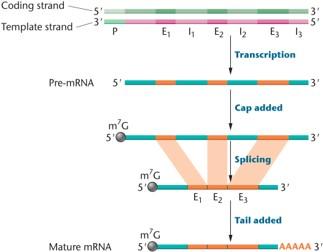
In eukaryotes, transcription termination involves cleavage of the transcript and addition of a poly-A tail. The primary transcript (pre-mRNA) undergoes several modifications before becoming mature mRNA.
5' Cap: Addition of a 7-methylguanosine cap to the 5' end, stabilizing the mRNA and aiding in translation initiation.
Poly-A Tail: Addition of a string of adenylic acid residues to the 3' end, protecting mRNA from degradation.
Splicing: Removal of noncoding introns and joining of exons.
Introns and Exons
Eukaryotic genes contain introns (noncoding sequences) and exons (coding sequences). Introns are removed during RNA processing, and exons are joined to form mature mRNA.
Introns: Intervening sequences removed from pre-mRNA.
Exons: Expressed sequences retained in mature mRNA.
Alternative Splicing: Allows for the production of different proteins from the same gene by varying exon inclusion.
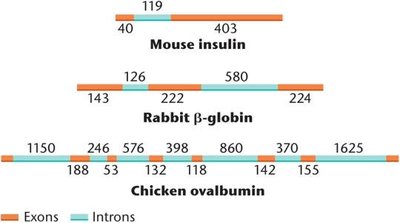
Gene | Gene Size (kb) | mRNA Size (kb) | Number of Introns |
|---|---|---|---|
Insulin | 1.7 | 0.4 | 2 |
Collagen [pro-alpha-2(1)] | 38.0 | 5.0 | 51 |
Albumin | 25.0 | 2.1 | 14 |
Phenylalanine hydroxylase | 90.0 | 2.4 | 12 |
Dystrophin | 2400.0 | 17.0 | 79 |
Splicing Mechanisms
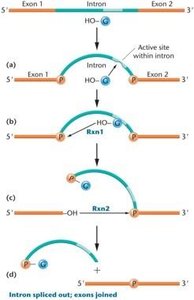
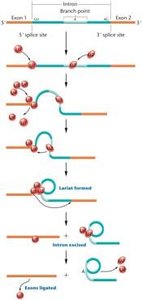
Splicing can occur via self-splicing (group I and II introns) or by the spliceosome, a complex of small nuclear ribonucleoproteins (snRNPs) and proteins.
Self-Splicing: Some introns can remove themselves from RNA transcripts without protein enzymes.
Spliceosome: A large complex that removes introns from pre-mRNA in eukaryotes, forming a lariat structure during the process.
Summary Table: Key Terms and Concepts
Term | Definition |
|---|---|
Codon | Three-nucleotide sequence in mRNA that specifies an amino acid |
Anticodon | Three-nucleotide sequence in tRNA complementary to a codon |
Promoter | DNA sequence where RNA polymerase binds to initiate transcription |
Intron | Noncoding sequence removed from pre-mRNA |
Exon | Coding sequence retained in mature mRNA |
Spliceosome | Complex responsible for removing introns from pre-mRNA |
Wobble Hypothesis | Flexibility in base pairing at the third codon position |
Polycistronic mRNA | mRNA encoding multiple proteins (common in prokaryotes) |
