 Back
BackThe Genetic Code and Transcription: Structure, Function, and Regulation
Study Guide - Smart Notes
 Tailored notes based on your materials, expanded with key definitions, examples, and context.
The Genetic Code and Transcription
Introduction to the Genetic Code
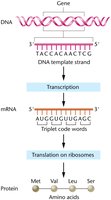
The genetic code is the set of rules by which information encoded in DNA is translated into proteins, the functional molecules of the cell. The linear sequence of deoxyribonucleotides in DNA contains the instructions for protein synthesis. One of the two DNA strands serves as a template for the synthesis of messenger RNA (mRNA), which then associates with ribosomes to direct protein production.
Key Features of the Genetic Code
Triplet Nature: The code is written in linear form using ribonucleotide bases (A, U, G, C) that compose mRNA. Each "word" or codon consists of three ribonucleotides.
Unambiguous: Each codon specifies only one amino acid.
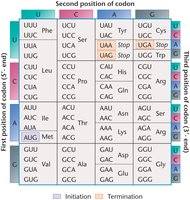
Degenerate: Most amino acids are specified by more than one codon. Only tryptophan (UGG) and methionine (AUG) are encoded by a single codon.
Start and Stop Signals: Specific codons initiate (AUG) and terminate (UAA, UAG, UGA) translation.
Commaless: Codons are read sequentially without breaks.
Nonoverlapping: Each nucleotide is part of only one codon.
Nearly Universal: The genetic code is conserved across most organisms, with rare exceptions.
Degeneracy and the Wobble Hypothesis
The degeneracy of the genetic code means that multiple codons can encode the same amino acid. The wobble hypothesis explains that the third base of a codon is less spatially constrained, allowing for relaxed base pairing. This flexibility enables a single tRNA to recognize multiple codons for the same amino acid.
Initiation and Termination Codons
Initiator Codon (AUG): Specifies methionine, the first amino acid incorporated into proteins. In bacteria, this is a modified form called N-formylmethionine (fMet).
Termination Codons (UAA, UAG, UGA): Do not code for any amino acid and signal the end of translation. These codons are not recognized by tRNA, causing the release of the newly synthesized polypeptide.
Exceptions to the Universal Code
While the genetic code is nearly universal, some exceptions exist, particularly in mitochondrial DNA. For example, UGA, typically a stop codon, encodes tryptophan in human and yeast mitochondria. Similarly, AUA, which usually specifies isoleucine, can encode methionine in human mitochondria.
Codon | Standard Meaning | Mitochondrial Exception |
|---|---|---|
UGA | Stop | Tryptophan (in yeast/human mitochondria) |
AUA | Isoleucine | Methionine (in human mitochondria) |
Additional info: | Other rare exceptions exist in protozoa and fungi. |
Summary of Genetic Code Features
Linear
Triplet code (codon)
Unambiguous
Degenerate
Contains start and stop signals
Commaless
Nonoverlapping
Nearly universal
Transcription: Synthesis of RNA from DNA Template
Overview of Transcription
Transcription is the process by which RNA is synthesized from a DNA template. The resulting mRNA serves as an intermediate, carrying genetic information from DNA to the ribosome for protein synthesis. Each mRNA codon is complementary to the anticodon of a tRNA molecule.
RNA Polymerase and Its Function
RNA Polymerase: The enzyme responsible for synthesizing RNA using a DNA template. It requires ribonucleotide triphosphates (NTPs) as substrates and does not need a primer for initiation.
Structure in E. coli: Composed of subunits α, β, β', and ω. The holoenzyme includes an additional σ (sigma) factor, which is crucial for recognizing promoter sequences and initiating transcription.
Promoters, Template Binding, and the σ Factor
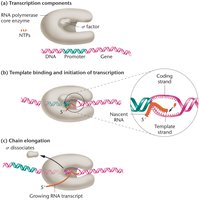
Transcription begins when RNA polymerase binds to a promoter, a specific DNA sequence upstream of the gene. The σ factor of RNA polymerase is responsible for promoter recognition. The DNA strand that is transcribed is called the template strand, while the complementary strand is the coding strand.
Transcription Start Site and Promoter Sequences
Transcription Start Site: The location where RNA synthesis begins. The DNA double helix is unwound to expose the template strand.
Consensus Sequences: Promoters often contain conserved DNA sequences, such as the -35 (TTGACA) and -10 (TATAAT, also known as the Pribnow box) regions in E. coli, which are recognized by the σ factor.
Cis-acting Elements and Trans-acting Factors
Cis-acting DNA Elements: DNA sequences located near the genes they regulate (e.g., promoters, enhancers).
Trans-acting Factors: Proteins or RNAs that bind to cis-acting elements to influence gene expression (e.g., transcription factors, repressors).
Stages of Transcription: Initiation, Elongation, and Termination
Initiation: RNA polymerase binds to the promoter and inserts the first ribonucleotide triphosphate.
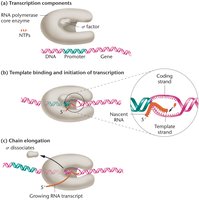
Elongation: The σ subunit dissociates, and the core enzyme adds ribonucleotides to the growing RNA chain.
Termination: RNA polymerase continues until it encounters a termination sequence. In bacteria, termination can involve the formation of a hairpin structure in the RNA or require the rho (ρ) factor.
Polycistronic mRNA in Bacteria
In bacteria, genes with related functions are often clustered and transcribed together as a single, large mRNA molecule called polycistronic mRNA. This mRNA encodes multiple proteins. In contrast, polycistronic mRNA is rare in eukaryotes.
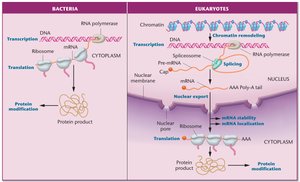
Comparison of Transcription in Prokaryotes and Eukaryotes
Transcription mechanisms differ between prokaryotes and eukaryotes in several key aspects:
Location: In prokaryotes, transcription and translation occur in the cytoplasm. In eukaryotes, transcription occurs in the nucleus, and translation occurs in the cytoplasm.
RNA Processing: Eukaryotic mRNA undergoes capping, polyadenylation, and splicing before export to the cytoplasm. Prokaryotic mRNA does not require these modifications.
Gene Structure: Eukaryotic genes often contain introns (non-coding regions) that are removed during splicing; prokaryotic genes are typically uninterrupted.
Summary Table: Key Differences in Transcription
Feature | Prokaryotes | Eukaryotes |
|---|---|---|
Location | Cytoplasm | Nucleus (transcription), Cytoplasm (translation) |
RNA Processing | None | Capping, polyadenylation, splicing |
Gene Structure | Continuous (no introns) | Interrupted by introns |
Polycistronic mRNA | Common | Rare |
Additional info: The regulation of gene expression involves both cis-acting DNA elements and trans-acting factors, which together ensure precise control of transcription in response to cellular needs.
