 Back
BackThe Molecular Nature of Genetic Material: DNA Structure and Function
Study Guide - Smart Notes
 Tailored notes based on your materials, expanded with key definitions, examples, and context.
Transformation and the Discovery of DNA as Genetic Material
Griffith's Transformation Experiment
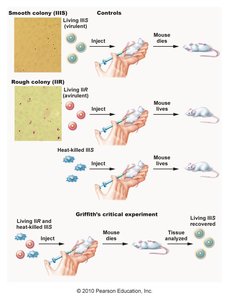
Griffith's classic experiment with Streptococcus pneumoniae demonstrated that a substance from dead bacteria could genetically transform living bacteria. This experiment laid the foundation for identifying DNA as the genetic material.
Smooth (S) strain: Virulent, causes disease in mice.
Rough (R) strain: Non-virulent, does not cause disease.
Key finding: Mice injected with a mixture of heat-killed S cells and live R cells died, and live S cells were recovered, indicating transformation.
Avery, MacLeod, and McCarty's Experiment
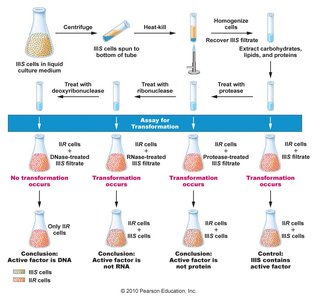
This experiment identified DNA as the 'transforming principle' responsible for heredity. By selectively destroying proteins, RNA, or DNA in extracts from S cells, they showed that only destruction of DNA prevented transformation of R cells into S cells.
Conclusion: DNA is the hereditary material in bacteria.
Significance: Provided the first direct proof that DNA, not protein or RNA, is the genetic material.
DNA as the Universal Genetic Material
Bacteriophage Experiments (Hershey and Chase)
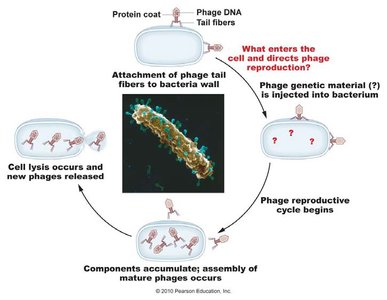
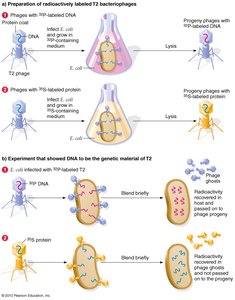
Bacteriophages are viruses that infect bacteria. The Hershey-Chase experiment used radioactive labeling to show that DNA, not protein, enters bacterial cells and directs viral reproduction, confirming DNA as the genetic material in viruses as well.
Radioactive phosphorus (32P): Labels DNA.
Radioactive sulfur (35S): Labels protein.
Result: Only DNA entered the bacteria and was inherited by progeny phages.
Structure of DNA and RNA
Nucleotides and Nitrogenous Bases
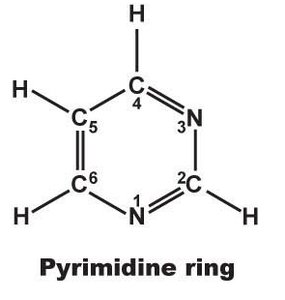
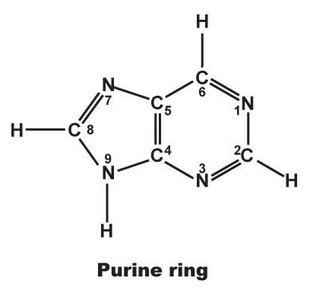
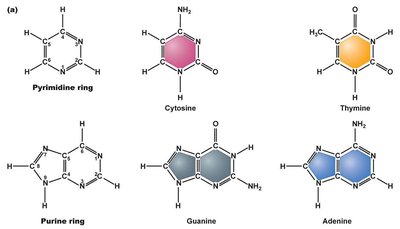
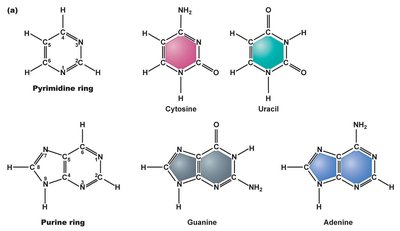
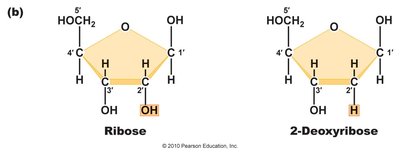
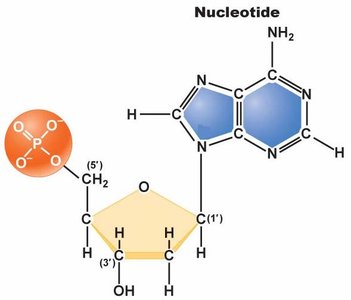
DNA and RNA are polymers of nucleotides, each consisting of a phosphate group, a five-carbon sugar, and a nitrogenous base. There are two types of nitrogenous bases:
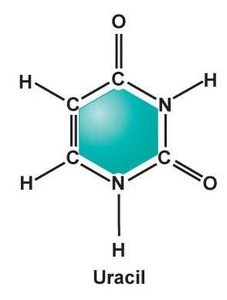
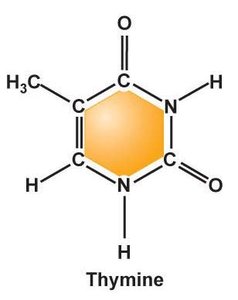
Pyrimidines: Single-ring structures (cytosine, thymine, uracil).
Purines: Double-ring structures (adenine, guanine).
DNA vs. RNA
The main differences between DNA and RNA are the sugar component and one of the bases:
DNA: Contains deoxyribose and thymine.
RNA: Contains ribose and uracil (instead of thymine).
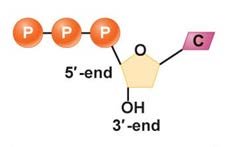
DNA as a Polymer: Directionality and Bonds
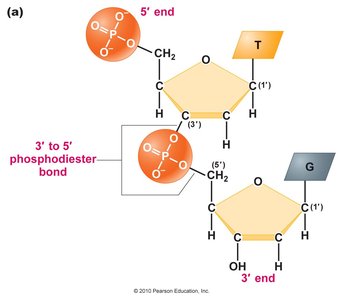
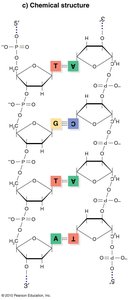
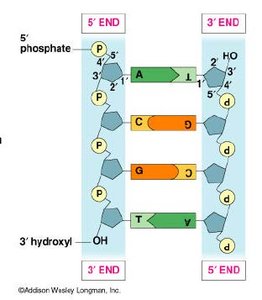
DNA is a long, directional polymer of nucleotides linked by phosphodiester bonds between the 3' hydroxyl of one sugar and the 5' phosphate of the next. This gives DNA a 5' to 3' directionality, which is essential for replication and gene expression.
Phosphodiester bond: Covalent bond joining nucleotides in a DNA strand.
5' end: Has a free phosphate group.
3' end: Has a free hydroxyl group.
Chargaff's Rules and Base Pairing
Chargaff's Rules
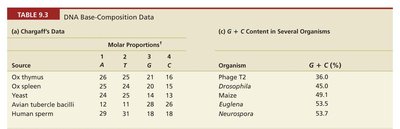
Erwin Chargaff discovered that in DNA, the amount of adenine (A) always equals thymine (T), and the amount of guanine (G) always equals cytosine (C). This provided key evidence for the base-pairing structure of DNA.
A = T
G = C
Purines (A, G) always pair with pyrimidines (T, C)
Source | A | G | T | C |
|---|---|---|---|---|
Ox thymus | 26 | 24 | 26 | 24 |
Ox spleen | 28 | 22 | 28 | 22 |
Yeast | 31 | 18 | 32 | 19 |
Avian tubercle bacilli | 12 | 41 | 18 | 28 |
Human sperm | 29 | 21 | 29 | 21 |
Discovery of the Double Helix
Rosalind Franklin's X-ray Diffraction
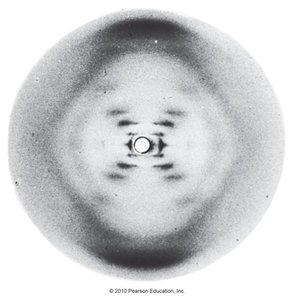
Rosalind Franklin's X-ray diffraction images of DNA provided crucial evidence that DNA is a helical molecule with repeating units spaced 3.4 Å apart. This data was instrumental in solving the structure of DNA.
Watson and Crick's Model
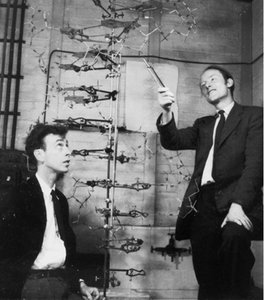
James Watson and Francis Crick integrated chemical and physical data to propose the double helix model of DNA. Their model explained how DNA could replicate and store genetic information.
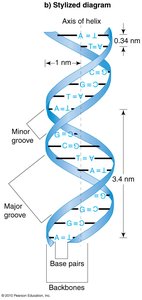
Double helix: Two antiparallel strands wound around each other.
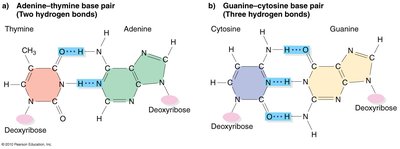
Base pairing: A pairs with T (2 hydrogen bonds), G pairs with C (3 hydrogen bonds).
Backbone: Sugar-phosphate on the outside, bases on the inside.
Antiparallel: One strand runs 5' to 3', the other 3' to 5'.
Watson-Crick Base Pairs
Base pairing is stabilized by hydrogen bonds: A-T pairs have two hydrogen bonds, G-C pairs have three. This specificity ensures accurate replication and transcription.
Complementary Base Pairing and Function
Complementarity and Replication
Complementary base pairing means that the sequence of one DNA strand determines the sequence of the other. This is essential for DNA replication and gene expression.
5' to 3' directionality: DNA and RNA are always synthesized and read in this direction.
Antiparallel strands: Ensure proper base pairing and function.
Structure and Function of RNA
Major Types of RNA
RNA plays several roles in the cell, including acting as a messenger, a structural component, and an adapter in protein synthesis.
mRNA (messenger RNA): Carries genetic information from DNA to ribosomes.
tRNA (transfer RNA): Brings amino acids to the ribosome during translation.
rRNA (ribosomal RNA): Forms the core of the ribosome's structure and catalyzes protein synthesis.
Properties of Genetic Material
Essential Characteristics
For a molecule to serve as genetic material, it must:
Replicate: Be copied accurately for inheritance.
Store information: Contain all instructions for cell function.
Express information: Direct cellular processes and traits.
Allow variation: Permit mutations and genetic diversity.
Hybridization and Applications
Hybridization
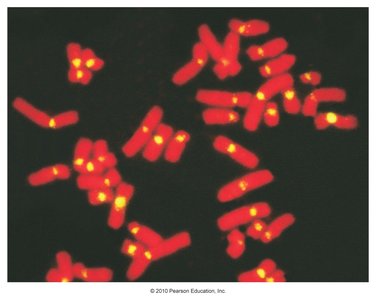
Hybridization is the process by which complementary nucleic acid strands bind to each other. This principle is used in many molecular biology techniques, such as gene mapping and mutation detection.
Fluorescence In Situ Hybridization (FISH)
FISH uses labeled DNA or RNA probes to detect specific sequences on chromosomes, allowing visualization of gene location and structure.
Summary Table: DNA vs. RNA
Feature | DNA | RNA |
|---|---|---|
Sugar | Deoxyribose | Ribose |
Bases | A, T, G, C | A, U, G, C |
Strands | Double-stranded (usually) | Single-stranded (usually) |
Function | Genetic information storage | Information transfer, catalysis |
