 Back
Transcription and mRNA Processing in Prokaryotes and Eukaryotes
Study Guide - Smart Notes
 Tailored notes based on your materials, expanded with key definitions, examples, and context.
Central Dogma of Genetics
Overview
The central dogma of genetics describes the flow of genetic information within a biological system: DNA is transcribed into RNA, which is then translated into protein. This process is fundamental to gene expression and cellular function.
DNA serves as the template for RNA synthesis.
RNA is processed and translated into proteins in the ribosome.
Proteins carry out cellular functions and determine phenotype.
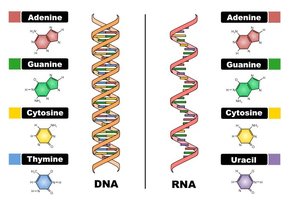
Transcription: Basic Steps
Stages of Transcription
Transcription is the process by which RNA is synthesized from a DNA template. It consists of four main steps:
Binding of RNA polymerase and other factors: RNA polymerase attaches to the promoter region of DNA.
Initiation: The enzyme unwinds DNA and begins RNA synthesis.
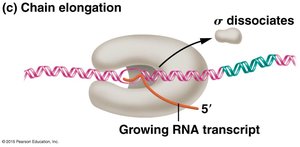
Elongation: RNA polymerase adds nucleotides to the growing RNA strand in the 5’ to 3’ direction.
Release: The RNA transcript is released once a termination signal is reached.
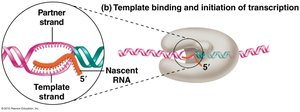
Transcription Machinery and Components
Key Elements
Several components are required for transcription:
Ribonucleoside triphosphates: Building blocks of RNA, containing uracil instead of thymine.
RNA polymerase: Enzyme responsible for synthesizing RNA.
Transcription factors: Proteins that regulate the binding and activity of RNA polymerase.
Promoters, enhancers, silencers: DNA sequences that regulate transcription initiation and rate.
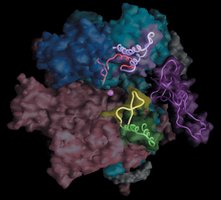
Transcription vs Replication
Comparison
Transcription and DNA replication share similarities but also have distinct differences:
Both use nucleoside triphosphates and form phosphodiester bonds.
RNA polymerase can initiate synthesis without a primer, unlike DNA polymerase.
Only one DNA strand is transcribed at a time.
Prokaryotic Transcription
RNA Polymerase and Sigma Factor
In prokaryotes, a single RNA polymerase holoenzyme (composed of six subunits) carries out transcription. The sigma factor is a specialized transcription factor required for promoter recognition and initiation.
Holoenzyme: Biochemically active form of RNA polymerase.
Sigma factor: Necessary for binding to the promoter; dissociates after initiation.
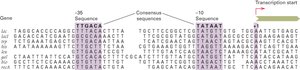
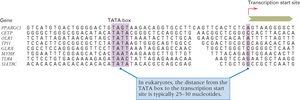
Promoter Regions: TATA Box
The TATA box is a conserved DNA sequence motif found in many prokaryotic and eukaryotic promoters. It is essential for transcription initiation.
Located approximately 10-30 bp upstream of the transcription start site.
Recognized by transcription factors and RNA polymerase.
Transcription Termination in Prokaryotes
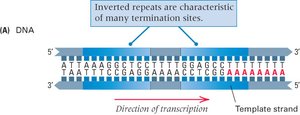
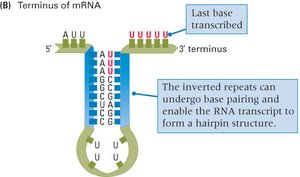
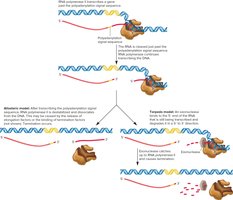
Transcription ends when RNA polymerase encounters a termination sequence, often resulting in a hairpin loop formation in the RNA.
Termination sequence causes the RNA to kink and base-pair with itself.
Hairpin loop signals the release of the RNA transcript.
Prokaryotic mRNA: Polycistronic Transcripts
Structure and Function
Prokaryotic mRNA is often polycistronic, meaning it contains multiple open reading frames (ORFs) corresponding to different genes.
Open Reading Frame (ORF): DNA sequence transcribed into mRNA, flanked by start and stop codons.
Each ORF produces a distinct protein product.
Eukaryotic Transcription
RNA Polymerase II and General Transcription Factors
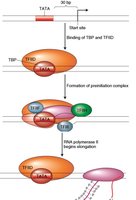
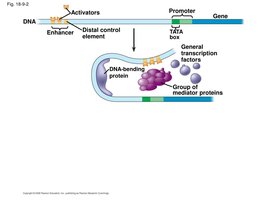
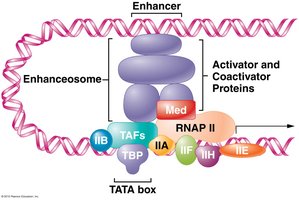
Eukaryotic transcription is more complex, requiring multiple general transcription factors (GTFs) for proper initiation.
TFIIA, TFIIB, TFIID, TFIIE, TFIIF, TFIIH: Each has a specific role in stabilizing, recruiting, and activating RNA polymerase II.
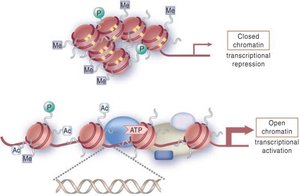
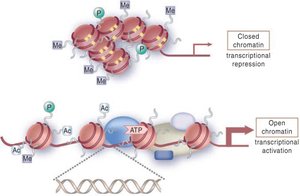
Chromatin structure affects accessibility of DNA for transcription.

Chromatin Structure and Gene Regulation
Chromatin can exist in open (active) or closed (repressed) states, influencing transcriptional activity.
Transcription factors can open chromatin, making genes accessible.
Genes on different chromosomes may associate based on transcriptional state.
Eukaryotic Gene Regulation at Transcription Initiation
Basal vs Activated Transcription
Basal transcription: Low-level expression from the core promoter (TATA box) via GTFs.
Activated transcription: Enhanced expression via additional transcription factors binding to regulatory promoters and enhancers.
Transcription Factors: Activation and Repression
Trans-acting Factors
Transcription factors can act on any DNA molecule, not just the chromosome where they are encoded.
Some transcription factors activate transcription by opening chromatin and recruiting RNA polymerase.
Others repress transcription by binding to DNA and shutting down gene expression.

mRNA Processing in Eukaryotes
Pre-mRNA Modifications
Eukaryotic pre-mRNA undergoes three main processing steps before becoming mature mRNA:
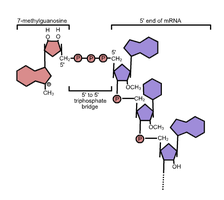
5’ Modification: Addition of a G-cap (modified guanosine) for ribosome loading.
3’ Modification: Addition of a poly-A tail (100-250 adenosines) for transcript stability and export.
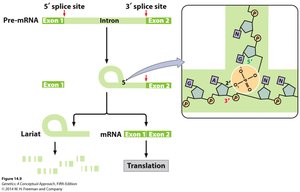
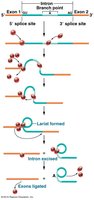
Splicing: Removal of introns and joining of exons by the spliceosome complex.
Exons and Introns
Definitions and Significance
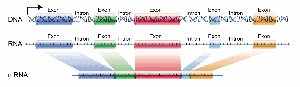
Exons: Coding sequences retained in mature mRNA.
Introns: Non-coding sequences removed during splicing.
Splicing is mediated by the spliceosome, a complex of proteins and snRNAs.
Translation: From mRNA to Protein
Ribosome Structure and Function
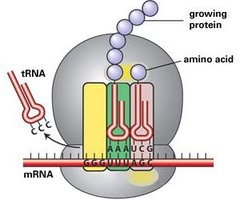
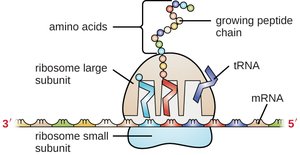
Translation occurs in the ribosome, where mRNA is read and tRNA brings amino acids to build the protein chain.
Ribosome consists of a large (50S) and small (30S) subunit in prokaryotes.
tRNA matches codons in mRNA with the correct amino acid.
Proteins are synthesized as the ribosome moves along the mRNA.
Practice: Central Dogma in Action
Example Conversion
Given a DNA sequence, create the complementary strand.
Transcribe the template strand to mRNA.
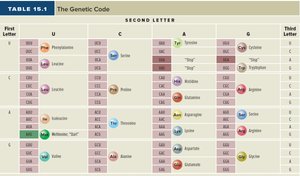
Translate mRNA to protein using the genetic code.
Step | Sequence |
|---|---|
DNA (5' - 3') | CCGATTACATGCACAGCTCAGGAATCGAATGAACTGA |
Complementary DNA (3' - 5') | GGCTAATGTACGTGTCGAGTCCTTAGCTTACTTGACT |
mRNA (5' - 3') | CCGAUUACAUGCACAGCUCAGGAAUCGAAUGAACUGA |
Protein | MET HIS SER SER GLY ILE GLU |
Summary Table: Key Differences in Transcription
Feature | Prokaryotes | Eukaryotes |
|---|---|---|
RNA Polymerase | Single holoenzyme | Multiple types (I, II, III) |
Promoter Recognition | Sigma factor | General transcription factors |
mRNA Structure | Polycistronic | Monocistronic |
mRNA Processing | None | 5' cap, poly-A tail, splicing |
Chromatin | No chromatin | Chromatin structure regulates access |
Conclusion
Understanding transcription and mRNA processing is essential for grasping gene expression and regulation in both prokaryotic and eukaryotic cells. These processes are central to the flow of genetic information and the production of proteins that drive cellular function.
