 Back
BackTranscription and Post-Transcriptional Processing in Prokaryotes and Eukaryotes
Study Guide - Smart Notes
 Tailored notes based on your materials, expanded with key definitions, examples, and context.
Transcription: Overview and Mechanism
Definition and Directionality
Transcription is the process by which a DNA template is used to synthesize a complementary RNA molecule. This process is catalyzed by RNA polymerase and is fundamental to gene expression in all living organisms.
No free 3'OH end or primer is required for initiation of RNA synthesis.
Synthesis occurs in the 5' to 3' direction, using ribonucleoside triphosphates (rNTPs) as precursors.
RNA polymerase is DNA-dependent and copies from the antisense (template) strand of DNA.
The resulting DNA-RNA duplex is less stable than a DNA-DNA duplex, causing the RNA to dissociate from the DNA template after synthesis.
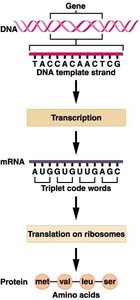
Key Terms:
Coding (Sense) Strand: Has the same sequence as the mRNA (except T instead of U).
Template (Antisense) Strand: Directs synthesis of the complementary mRNA transcript.
Transcription in Prokaryotes vs. Eukaryotes
Major Differences in Gene Expression
Feature | Prokaryotes | Eukaryotes |
|---|---|---|
Unwinding | By gyrases and helicases; no single-strand binding proteins | Possible unwinding by gyrases and helicases; no single-strand binding proteins |
RNA Polymerases | Single RNA polymerase synthesizes all RNA species | Three distinct RNA polymerases (I, II, III) |
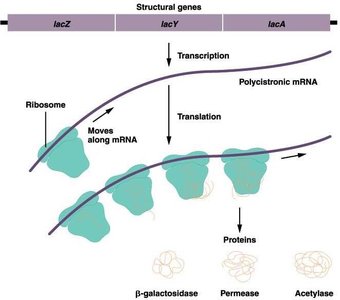
Transcription & Translation | Coupled (occur simultaneously) | Separate (transcription in nucleus, translation in cytoplasm) |
mRNA Processing | None | 5' capping, 3' polyadenylation, splicing |
Gene Structure | Genes are contiguous (no introns) | Genes often interrupted by introns |
mRNA Type | Often polycistronic | Often monocistronic |
Prokaryotic Transcription: Initiation, Elongation, and Termination
Initiation and the Role of Sigma Factor
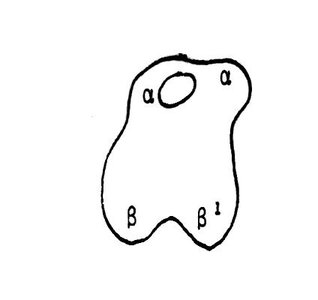
In prokaryotes, the RNA polymerase holoenzyme (core enzyme + sigma factor) binds to the promoter region to initiate transcription. The sigma factor directs the polymerase to specific promoter sequences.
Sigma factors: Different sigma subunits recognize different promoter types (e.g., σ70 for general transcription, σ32 for heat shock genes).
After initiation, the sigma subunit dissociates, and elongation proceeds.
Termination Mechanisms
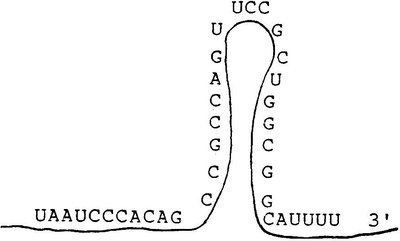
Rho-independent termination: A G-C rich dyad sequence followed by a string of U's forms a hairpin loop in the RNA, causing the polymerase to dissociate.
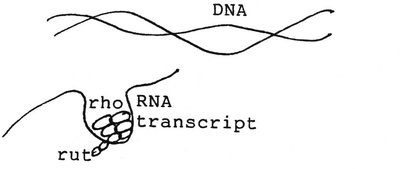
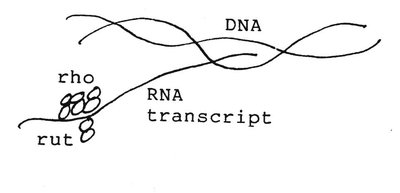
Rho-dependent termination: The rho protein binds to the rut site on the RNA transcript, translocates along the RNA, and causes dissociation from the DNA template.
Prokaryotic Gene Regulation: The lac Operon
lac Operon Structure and Function
The lac operon is a classic example of gene regulation in prokaryotes, controlling the metabolism of lactose in Escherichia coli.
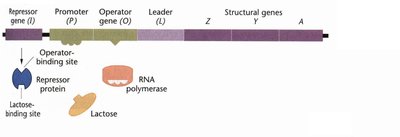
Components: Repressor gene (I), Promoter (P), Operator (O), Structural genes (Z, Y, A).
Regulation: The repressor protein binds to the operator to block transcription. In the presence of lactose, the repressor is inactivated, allowing RNA polymerase to transcribe the operon.
Eukaryotic Transcription: RNA Polymerases and Regulation
Types of RNA Polymerases
RNA Polymerase I: Synthesizes rRNA (in nucleolus).
RNA Polymerase II: Synthesizes pre-mRNA (in nucleoplasm).
RNA Polymerase III: Synthesizes tRNA and small RNAs (in nucleoplasm).
In contrast, prokaryotes have only one RNA polymerase, functionally similar to eukaryotic RNA Pol II.
Transcription Factors and Regulatory Elements
Transcription in eukaryotes requires the assembly of multiple transcription factors (TFs) at the promoter region. These TFs have DNA-binding and trans-acting domains, facilitating the recruitment of RNA polymerase II and the formation of the transcription initiation complex.
Promoters: DNA sequences that bind TFs and RNA Pol II, essential for transcription initiation (e.g., TATA box, CAAT box, GC box).
Enhancers: Regulatory DNA elements that bind TFs, can be distant from the gene, and increase transcription efficiency by looping DNA to bring enhancers and promoters together.
Promoter region elements:
TATA box: Located ~30 bp upstream of the transcription start site.
CAAT box: Located ~70 bp upstream.
GC box: Located ~110 bp upstream.
Termination and Post-Transcriptional Processing in Eukaryotes
Termination Mechanisms
RNA Pol I: Modified rho-independent mechanism with complex sequence requirements.
RNA Pol II: Termination mechanism is not fully understood; processing proteins may help release the transcript.
RNA Pol III: Standard rho-independent termination.
Post-Transcriptional Processing of pre-mRNA
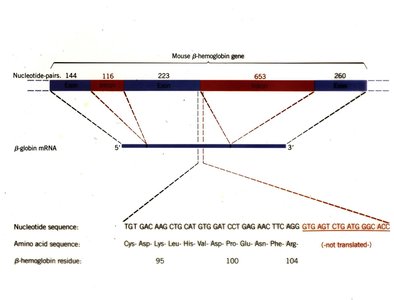
In eukaryotes, the primary transcript (pre-mRNA) undergoes several modifications before becoming mature mRNA:
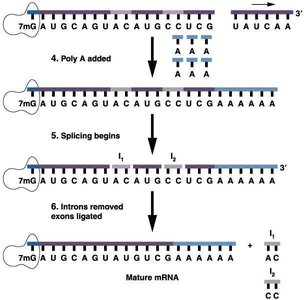
5' Capping: Addition of a 7-methylguanosine cap to the 5' end, which protects mRNA and aids in translation initiation.
3' Polyadenylation: Addition of a poly(A) tail to the 3' end, enhancing mRNA stability and export from the nucleus.
RNA Splicing: Removal of non-coding introns and joining of coding exons.
Post-Transcriptional Processing of tRNA and rRNA
tRNA: 5' end cleavage, addition of CCA at 3' end, base modifications, and intron removal from the terminal loop.
rRNA: Introns are removed by autocatalytic activity of exon regions.
Gene Structure: Exons and Introns
Organization of Eukaryotic Genes
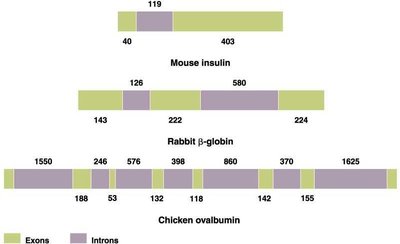
Eukaryotic genes are often interrupted by non-coding sequences called introns, which are removed during RNA processing. The coding regions, exons, are joined to form the mature mRNA.
Gene | Exons (bp) | Introns (bp) |
|---|---|---|
Mouse insulin | 119, 403 | 40 |
Rabbit β-globin | 143, 222, 224 | 126, 580 |
Chicken ovalbumin | 1550, 246, 576, 398, 860, 370, 1625 | 188, 53, 132, 118, 142, 155 |
Summary Table: Key Differences in Transcription
Aspect | Prokaryotes | Eukaryotes |
|---|---|---|
RNA Polymerases | One | Three (I, II, III) |
mRNA Processing | None | Capping, polyadenylation, splicing |
Gene Structure | Continuous | Interrupted by introns |
Transcription & Translation | Coupled | Separate |
