 Back
Transcription and RNA Processing: Mechanisms and Regulation in Genetics
Study Guide - Smart Notes
 Tailored notes based on your materials, expanded with key definitions, examples, and context.
Transcription: The Central Dogma of Molecular Biology
Overview of Genetic Information Flow
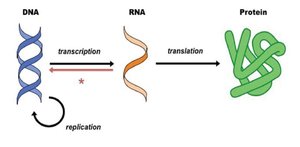
The central dogma of molecular biology describes the flow of genetic information from DNA to RNA to protein. Transcription is the process by which a DNA sequence is copied into RNA, which is then translated into protein. This fundamental pathway underlies gene expression and cellular function.
DNA: Contains the genetic blueprint for all cellular functions.
Transcription: DNA is transcribed into RNA by RNA polymerase.
Translation: RNA is translated into protein at the ribosome.
Transcription: Definition and Key Steps
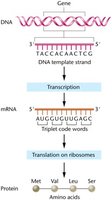
Transcription is the synthesis of RNA from a DNA template. The resulting RNA can be messenger RNA (mRNA), which carries coding information to the ribosome for translation.
Codons: mRNA is read in non-overlapping three-nucleotide sequences called codons.
Anticodon: Codons are complementary to the anticodon of tRNA during translation.
Mechanism of Transcription
Transcription in Bacteria
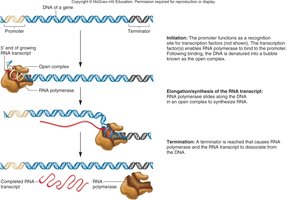
Bacterial transcription involves the binding of RNA polymerase to specific DNA sequences called promoters. The process consists of three main stages: initiation, elongation, and termination.
Initiation: RNA polymerase binds to the promoter region, forming a closed complex. The DNA unwinds, forming an open complex, and transcription begins at the +1 site.
Elongation: RNA polymerase synthesizes RNA in the 5' to 3' direction, using the template strand of DNA.
Termination: Transcription ends when RNA polymerase encounters a terminator sequence, releasing the RNA transcript.
RNA Polymerase Structure and Function
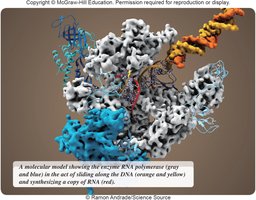
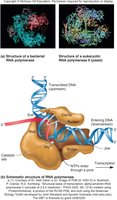
RNA polymerase is the enzyme responsible for synthesizing RNA from a DNA template. In E. coli, the holoenzyme consists of a core enzyme and a sigma factor, each with distinct functions.
Core enzyme: Five subunits (α2ββ'ω) responsible for RNA synthesis.
Sigma factor: One subunit (σ) that recognizes promoter sequences and initiates transcription.
Promoters and Consensus Sequences
Promoters are DNA sequences that direct RNA polymerase to the correct site for transcription initiation. In bacteria, promoters contain consensus sequences at the -35 and -10 regions (Pribnow box).
Consensus sequences: TTGACA at -35 and TATAAT at -10 relative to the transcription start site.
Numbering: Bases upstream of the start site are numbered negatively; downstream bases are positive.
Cis-acting and Trans-acting Elements
Cis-acting elements are DNA sequences adjacent to the gene, such as promoters and enhancers. Trans-acting factors are proteins that bind to cis-acting elements to regulate gene expression (e.g., sigma factor).
Transcription Initiation Complex
The sigma factor enables RNA polymerase to recognize the promoter and form a closed complex. Upon DNA unwinding, an open complex is formed, and the sigma factor is released as elongation proceeds.
Elongation and Directionality
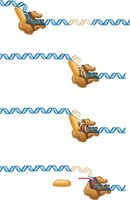
RNA polymerase synthesizes RNA in the 5' to 3' direction, moving along the template strand in the 3' to 5' direction. The coding strand has the same sequence as the RNA transcript, except T is replaced by U.
Termination Mechanisms in Bacteria
Transcription termination in E. coli occurs via two mechanisms:
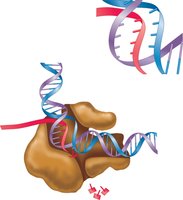
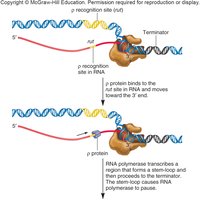
Rho-dependent termination: Requires the rho protein, which binds to the RNA and causes dissociation.
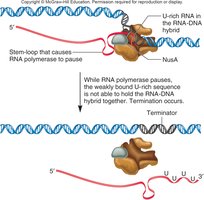
Rho-independent termination: Involves a stem-loop structure in the RNA followed by a uracil-rich sequence, causing RNA polymerase to pause and release the transcript.
Transcription in Eukaryotes
Complexity and Regulation
Eukaryotic transcription is more complex due to larger genomes, cellular complexity, and multicellularity. Regulation ensures genes are expressed only in the right cells at the right time.
RNA Polymerases in Eukaryotes
RNA polymerase I: Transcribes rRNA genes (except 5S rRNA).
RNA polymerase II: Transcribes protein-encoding genes and some snRNA genes.
RNA polymerase III: Transcribes tRNA genes and 5S rRNA gene.
Initiation: Promoters and Regulatory Elements
Eukaryotic promoters include the TATA box and transcriptional start site, forming the core promoter. Additional regulatory elements include enhancers and silencers.
Core promoter: TATA box and start site.
Proximal-promoter elements: Located near the core promoter.
Enhancers and silencers: Regulate transcription by binding activators and repressors.

Transcription Factors
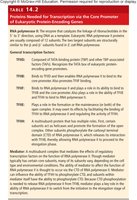
Transcription factors are essential for RNA polymerase binding and initiation. General transcription factors (GTFs) are required for all protein-encoding genes, while regulatory factors modulate expression.
Formation of the Preinitiation Complex
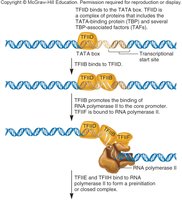
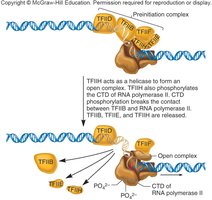
Transcription initiation involves the assembly of the basal transcription apparatus, including RNA polymerase II and five GTFs. The TFIID complex binds the TATA box, followed by other factors and RNA polymerase II.
Termination in Eukaryotes
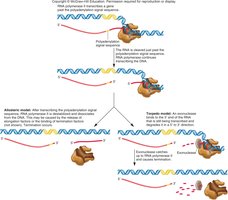
Termination of transcription in eukaryotes involves cleavage of the pre-mRNA and addition of a poly-A tail. Two models explain termination: the allosteric model and the torpedo model.
Post-Transcriptional RNA Processing in Eukaryotes
mRNA Modification
Eukaryotic mRNA undergoes several modifications before leaving the nucleus:
Poly-A tail: A string of adenine nucleotides added to the 3' end, important for stability and translation.
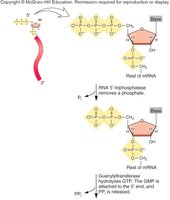
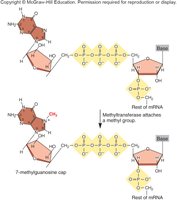
5' Cap: Addition of a 7-methyl guanosine cap at the 5' end, recognized by cap-binding proteins for translation and splicing.
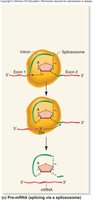
Splicing: Removal of introns from pre-mRNA by the spliceosome, joining exons to form mature mRNA.

Introns and Alternative Splicing
Introns are non-coding regions within pre-mRNA that are spliced out. Alternative splicing allows a single gene to produce multiple mRNA variants, increasing protein diversity.
Evolutionary advantage: Exon/intron structure facilitates gene evolution.
Regulation: Intronic sequences can regulate transcription.
RNA Editing
RNA editing is a posttranscriptional process where nucleotides are inserted, deleted, or substituted, altering the RNA sequence. This is prevalent in mitochondrial and chloroplast RNAs in plants.
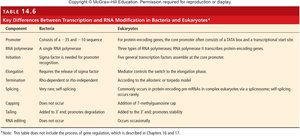
Comparison of Transcription and RNA Modification in Bacteria and Eukaryotes
Key Differences
Bacterial and eukaryotic transcription differ in promoter structure, initiation, elongation, termination, splicing, capping, and polyadenylation.
Component | Bacteria | Eukaryotes |
|---|---|---|
Promoter | -35 and -10 sequences | TATA box and start site |
Initiation | Requires sigma factor | Requires GTFs and transcription factors |
Elongation | RNA polymerase moves along template strand | Similar, but more complex regulation |
Termination | Rho-dependent or independent | Cleavage and polyadenylation |
Splicing | Rare | Common, requires spliceosome |
Capping | Absent | 7-methyl guanosine cap |
Polyadenylation | Absent | Poly-A tail added |
Summary
Transcription is a fundamental process in genetics, converting DNA information into RNA, which is then processed and translated into protein. The mechanisms and regulation of transcription differ between bacteria and eukaryotes, reflecting their complexity and cellular requirements. Understanding these processes is essential for studying gene expression, regulation, and genetic engineering.
----------------------------------------
