 Back
Transcription and RNA Processing: Mechanisms and Regulation in Genetics
Study Guide - Smart Notes
 Tailored notes based on your materials, expanded with key definitions, examples, and context.
Transcription: The Central Dogma of Molecular Biology
Overview of Genetic Information Flow
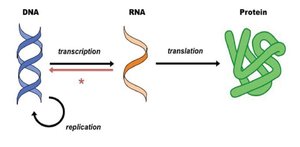
The central dogma describes the directional flow of genetic information in cells: DNA is transcribed into RNA, which is then translated into protein. This process is fundamental to gene expression and cellular function.
Transcription: The synthesis of RNA from a DNA template.
Translation: The decoding of mRNA into a polypeptide chain (protein).
Replication: The copying of DNA to produce identical DNA molecules.
Transcription: Definition and Importance
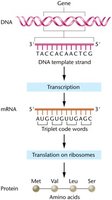
Transcription is the process by which genetic information encoded in DNA is copied into RNA. Messenger RNA (mRNA) carries coding information from a gene to the ribosome, where translation occurs. Coding information is read in nonoverlapping three-nucleotide sequences called codons.
Mechanism of Transcription
Stages of Transcription
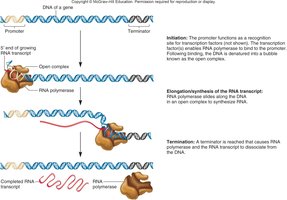
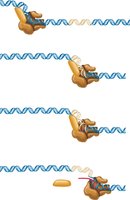
Transcription occurs in three main stages: initiation, elongation, and termination. Each stage involves specific molecular interactions and regulatory elements.
Initiation: RNA polymerase binds to the promoter region of DNA, forming a closed complex. The DNA unwinds, creating an open complex.
Elongation: RNA polymerase synthesizes RNA in the 5' to 3' direction, using the template strand of DNA.
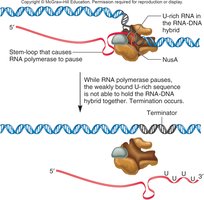
Termination: Transcription ends when RNA polymerase encounters a terminator sequence, releasing the newly synthesized RNA.
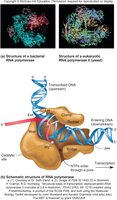
RNA Polymerase: Structure and Function
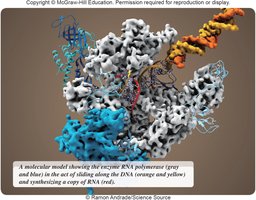
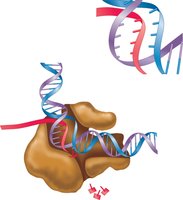
RNA polymerase catalyzes the synthesis of RNA using DNA as a template. It does not require a primer and uses ribonucleotides as substrates. In E. coli, the RNA polymerase holoenzyme consists of a core enzyme (five subunits) and a sigma factor (one subunit).
Transcription in Bacteria
Promoters and Consensus Sequences
Promoters are DNA sequences that direct RNA polymerase to the correct site for transcription initiation. In E. coli, promoters contain two consensus sequences: TTGACA (−35 region) and TATAAT (−10 region, Pribnow box). These sequences are positioned upstream of the transcription start site (+1).
Cis-acting and Trans-acting Elements
Cis-acting elements are DNA sequences located on the same molecule as the gene they regulate, often adjacent to the gene. Trans-acting factors are proteins (such as sigma factors) that bind to cis-acting elements to influence gene expression.
Initiation, Elongation, and Termination in Bacteria
Initiation: Sigma factor recognizes the promoter, allowing RNA polymerase to bind and form a closed complex. The DNA unwinds to form an open complex, and transcription begins.
Elongation: RNA polymerase moves along the template strand, synthesizing RNA in the 5' to 3' direction. The coding strand has the same sequence as the RNA (except T is replaced by U).
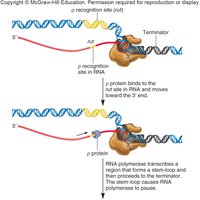
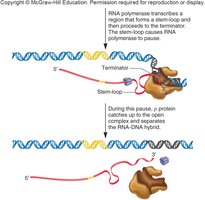
Termination: Two mechanisms exist: rho-dependent (requires the rho protein) and rho-independent (requires a stem-loop structure and a uracil-rich sequence).
Transcription in Eukaryotes
Complexity and Regulation
Eukaryotic transcription is more complex due to larger genomes, cellular complexity, and multicellularity. Regulation ensures genes are expressed only in the correct cells and at the right time.
RNA Polymerases in Eukaryotes
RNA polymerase I: Transcribes all rRNA genes (except 5S rRNA).
RNA polymerase II: Transcribes all protein-encoding genes and some snRNA genes.
RNA polymerase III: Transcribes all tRNA genes and the 5S rRNA gene.
Initiation of Transcription in Eukaryotes
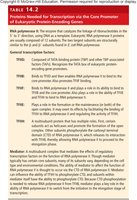
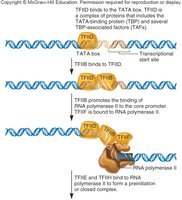
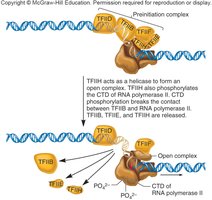
Initiation involves cis-acting DNA elements (core promoter, TATA box, enhancers, silencers) and trans-acting factors (general transcription factors, activators, repressors). The core promoter includes the TATA box and transcriptional start site.

Post-Transcriptional RNA Processing in Eukaryotes
mRNA Modification
Eukaryotic mRNA undergoes several modifications before leaving the nucleus:
Poly-A tail: A string of adenine nucleotides added to the 3' end, important for mRNA stability and translation.
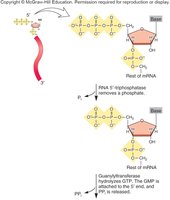
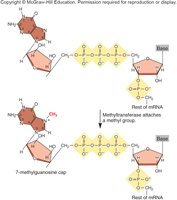
5' Cap: Addition of a 7-methyl guanosine cap at the 5' end, recognized by cap-binding proteins for translation and splicing.
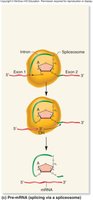
Splicing: Removal of introns from pre-mRNA by the spliceosome, resulting in mature mRNA composed of exons.

Alternative Splicing and RNA Editing
Alternative splicing allows a single gene to produce multiple mRNA variants, increasing protein diversity. RNA editing modifies the nucleotide sequence of RNA post-transcriptionally, through insertion, deletion, or substitution of bases.
Comparison of Transcription and RNA Modification in Bacteria and Eukaryotes
Key Differences
Bacterial transcription is simpler, with fewer regulatory elements and less RNA processing. Eukaryotic transcription involves complex regulation, multiple RNA polymerases, and extensive mRNA modification.
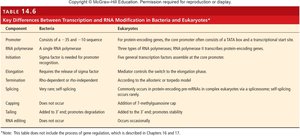
Summary Table: Key Differences Between Bacterial and Eukaryotic Transcription
Component | Bacteria | Eukaryotes |
|---|---|---|
Promoter | −10 and −35 sequences | TATA box and transcriptional start site |
Initiation | Sigma factor required | General transcription factors required |
Elongation | Simple | Complex, regulated |
Termination | Rho-dependent/independent | Polyadenylation signal, various mechanisms |
Splicing | Rare | Common, spliceosome required |
Capping | Absent | 7-methyl guanosine cap |
Poly-A tail | Absent | Present |
Key Terms and Concepts
Codon: Three-nucleotide sequence in mRNA specifying an amino acid.
Promoter: DNA sequence where RNA polymerase binds to initiate transcription.
Terminator: DNA sequence signaling the end of transcription.
Spliceosome: Complex responsible for removing introns from pre-mRNA.
Polyadenylation: Addition of poly-A tail to mRNA.
Alternative splicing: Process generating multiple mRNA variants from a single gene.
----------------------------------------
