 Back
BackTranscription and RNA Processing: Structure, Mechanism, and Regulation
Study Guide - Smart Notes
 Tailored notes based on your materials, expanded with key definitions, examples, and context.
Structure and Types of RNA
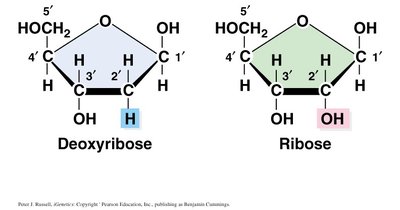
Differences Between DNA and RNA
DNA and RNA are nucleic acids that differ in their sugar components, nitrogenous bases, and structure. These differences are fundamental to their distinct biological roles.
DNA contains deoxyribose sugar, while RNA contains ribose sugar.
DNA uses the bases adenine (A), thymine (T), cytosine (C), and guanine (G); RNA uses uracil (U) instead of thymine.
DNA is typically double-stranded; RNA is usually single-stranded.
Types of RNA and Their Functions
RNA molecules serve various roles in the cell, each with specialized functions:
mRNA (messenger RNA): Carries genetic information from DNA to ribosomes for protein synthesis.
tRNA (transfer RNA): Brings amino acids to the ribosome during translation.
rRNA (ribosomal RNA): Structural and catalytic component of ribosomes.
snRNA (small nuclear RNA): Involved in splicing of pre-mRNA.
miRNA/siRNA (micro/silencing RNA): Regulate gene expression post-transcriptionally.
CRISPR RNA: In prokaryotes, guides Cas proteins to foreign DNA for destruction.
RNA Structure and Secondary Structures
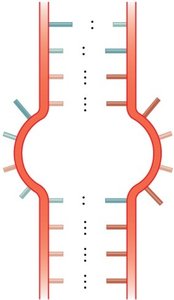
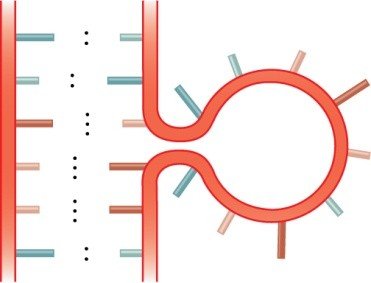
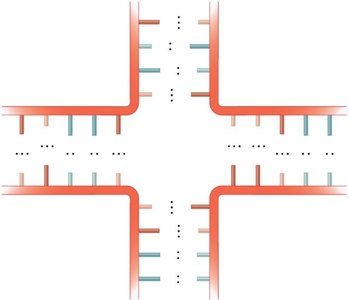
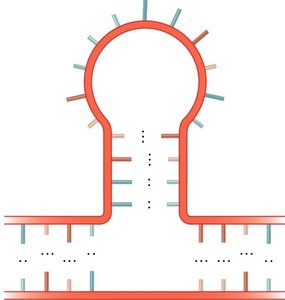
RNA can form complex secondary structures due to intramolecular base pairing. These structures are critical for RNA function.
Bulge loop: A region where one strand contains unpaired bases.
Internal loop: Both strands have unpaired bases opposite each other.
Multibranched junction: Multiple double-stranded regions converge.
Stem-loop (hairpin): A common structure where a single strand folds back on itself, forming a double-stranded stem and a loop.
The Central Dogma and Transcription
The Central Dogma of Molecular Biology
The central dogma describes the flow of genetic information: DNA is transcribed into RNA, which is then translated into protein.
Transcription: Synthesis of RNA from a DNA template.
Translation: Synthesis of protein from an mRNA template.
Transcription: Overview and Mechanism
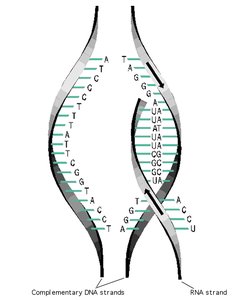
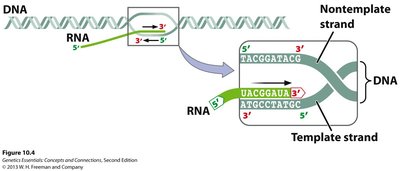
Transcription is the process by which an RNA molecule is synthesized from a DNA template. The RNA produced is complementary and antiparallel to the DNA template strand.
RNA is synthesized in the 5' to 3' direction.
The template DNA strand is read in the 3' to 5' direction.
The non-template (coding) strand has the same sequence as the RNA (except T is replaced by U).
Transcription in Prokaryotes
Initiation
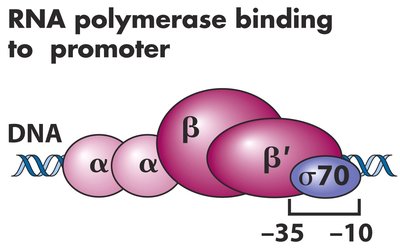
Transcription initiation in prokaryotes involves the recognition of promoter sequences by RNA polymerase and associated factors.
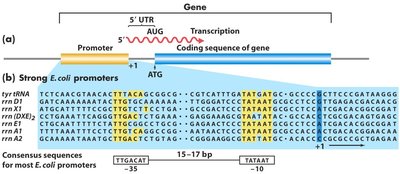
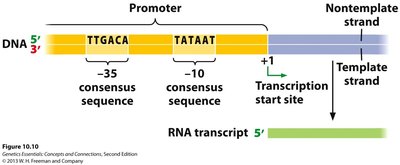
Promoter: DNA sequence upstream of the gene where RNA polymerase binds to initiate transcription.
Key promoter elements: -10 (Pribnow box, TATAAT) and -35 (TTGACA) consensus sequences.
Sigma (σ) factor: Subunit of RNA polymerase that recognizes and binds to the promoter.
Transcription starts at the +1 site.
Elongation
During elongation, RNA polymerase synthesizes the RNA strand by adding ribonucleotides complementary to the DNA template strand.
RNA is synthesized in the 5' to 3' direction.
After initiation, the sigma factor is released, and the core enzyme continues elongation.
Behind the open complex, DNA rewinds into a double helix.
Termination
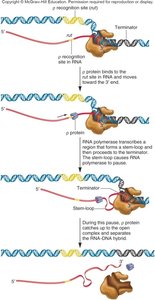
Termination of transcription in prokaryotes can occur via two mechanisms:
Rho-dependent termination: Requires the rho protein, a helicase that unwinds the RNA-DNA hybrid, releasing the RNA transcript.
Rho-independent termination: Relies on the formation of a hairpin structure in the RNA followed by a uracil-rich sequence, destabilizing the RNA-DNA hybrid.
Transcription in Eukaryotes
RNA Polymerases
Eukaryotes have three main RNA polymerases, each responsible for transcribing different types of genes:
RNA polymerase I: Transcribes rRNA genes (except 5S rRNA).
RNA polymerase II: Transcribes protein-coding genes (mRNA) and some snRNA genes.
RNA polymerase III: Transcribes tRNA, 5S rRNA, and some small RNAs.
Promoters and Transcription Factors
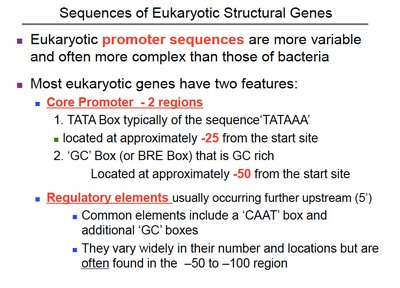
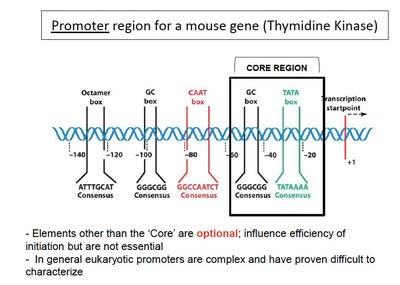
Eukaryotic promoters are more complex than prokaryotic promoters and require multiple transcription factors for initiation.
Core promoter: Contains the TATA box (around -25) and GC box (around -50).
Regulatory elements: Such as CAAT box and additional GC boxes, found further upstream.
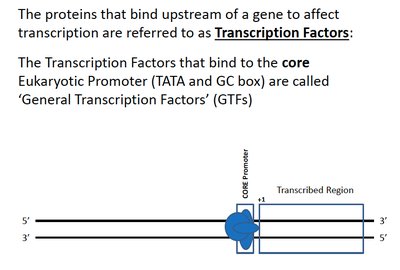
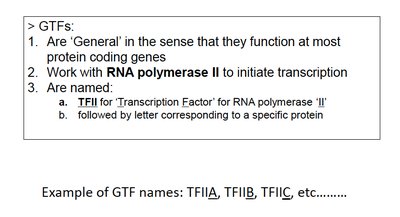
General Transcription Factors (GTFs): Proteins that help RNA polymerase II bind to the promoter and initiate transcription (e.g., TFIIA, TFIIB, TFIID, etc.).
Elongation and Termination
Elongation in eukaryotes is similar to prokaryotes, but termination is distinct:
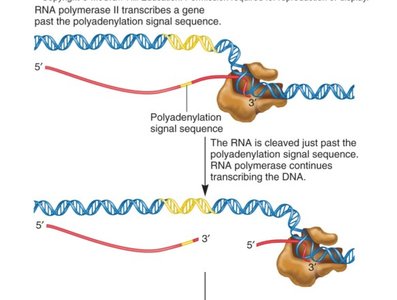
Termination involves cleavage of the transcript at a polyadenylation signal sequence (AAUAAA), followed by degradation of the remaining RNA by Torpedo RNase.
RNA Processing in Eukaryotes
Key Differences Between Prokaryotic and Eukaryotic mRNA
Prokaryotic mRNA is immediately ready for translation after transcription.
Eukaryotic mRNA (pre-mRNA) requires processing before translation.
mRNA Processing Steps
5' Capping: Addition of a methylated guanine nucleotide to the 5' end, protecting mRNA from degradation and aiding in ribosome binding.
3' Polyadenylation: Addition of a poly(A) tail (50-250 adenines) to the 3' end, increasing mRNA stability and facilitating export from the nucleus.
Splicing: Removal of non-coding introns and joining of exons. Most introns begin with GU and end with AG.
Alternative Splicing
Alternative splicing allows a single gene to produce multiple protein isoforms by varying the combination of exons included in the mature mRNA. This increases protein diversity and allows for regulation in different tissues or developmental stages.
CRISPR and Genome Editing
CRISPR/Cas9 System
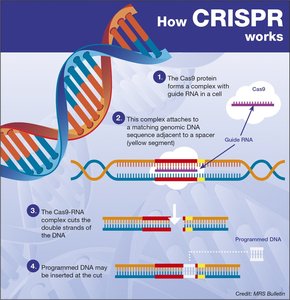
CRISPR (Clustered Regularly Interspaced Short Palindromic Repeats) is a prokaryotic adaptive immune system that has been adapted for genome editing in research and medicine.
CRISPR uses guide RNA to direct the Cas9 protein to a specific DNA sequence, where Cas9 introduces a double-strand break.
This system can be used for gene knockout, correction of mutations, and insertion of new genetic material.
Applications include correcting disease-causing mutations, eradicating viruses, and genome engineering.
Summary Table: Key Differences Between Prokaryotic and Eukaryotic Transcription
Feature | Prokaryotes | Eukaryotes |
|---|---|---|
Location | Cytoplasm | Nucleus |
RNA Polymerases | One | Three (I, II, III) |
Promoter Elements | -10, -35 consensus sequences | TATA box, GC box, CAAT box |
Initiation Factors | Sigma factor | General Transcription Factors |
RNA Processing | None | 5' cap, poly(A) tail, splicing |
Termination | Rho-dependent/independent | Polyadenylation signal, Torpedo RNase |
Take-Home Points
Transcription is the process of synthesizing RNA from a DNA template.
Prokaryotic and eukaryotic transcription differ in complexity, machinery, and RNA processing.
RNA processing in eukaryotes includes capping, polyadenylation, and splicing, which are essential for producing mature mRNA.
CRISPR/Cas9 is a revolutionary tool for genome editing, derived from a bacterial immune system.
