 Back
BackTranscription: DNA to RNA in Prokaryotes and Eukaryotes
Study Guide - Smart Notes
 Tailored notes based on your materials, expanded with key definitions, examples, and context.
Transcription: DNA to RNA
Qualities of Genetic Material
The genetic material must possess several essential qualities to ensure proper inheritance and cellular function:
Accurate Replication: Genetic material must replicate precisely so progeny cells and organisms inherit the same genetic information as the parent.
Information Storage: It must stably contain information that controls cellular form, structure, function, development, and behavior.
Information Transfer: The material must facilitate the transfer of genetic information from DNA to RNA and then to protein, as described by the Central Dogma.
DNA is the primary genetic material in most organisms.
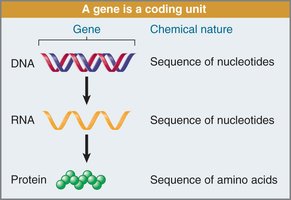
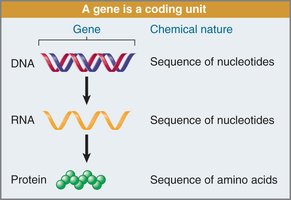
The Central Dogma of Molecular Biology
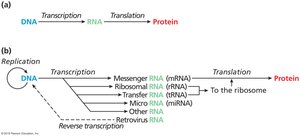
The Central Dogma, proposed by Crick (1956), describes the flow of genetic information:
DNA stores genetic information.
Transcription: DNA is transcribed into RNA.
Translation: RNA is translated into protein.
Proteins are the functional products that determine cellular activities.
Structure and Types of RNA
RNA Structure and Nucleotides
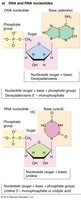
RNA is a nucleic acid composed of nucleotides. Each RNA nucleotide contains:
Ribose sugar (with a 2' OH group)
Phosphate group (attached at 5' carbon)
Nitrogenous base (attached at 1' carbon)
RNA uses uracil (U) instead of thymine (T).
Major Types of RNA
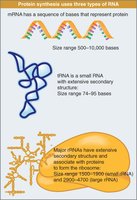
Three main types of RNA are involved in protein synthesis:
mRNA (messenger RNA): Carries genetic information from DNA to ribosomes; diverse and unstable.
tRNA (transfer RNA): Transfers amino acids to the ribosome during translation; stable and structured.
rRNA (ribosomal RNA): Forms the core of ribosome structure and catalyzes protein synthesis; abundant and stable.
Gene Structure and Transcription
Gene Organization
Genes are located on chromosomes, which are long double-stranded DNA helices. Genes are separated by noncoding DNA sequences and encode proteins.
Transcriptional Regions
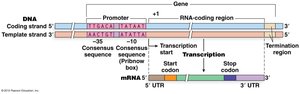
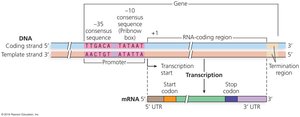
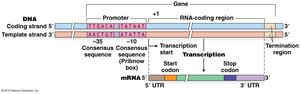
Transcription starts and stops at defined positions. The +1 base marks the start of transcription.
Transcript Structure
Translation starts and stops at defined positions within the transcript, forming the open reading frame (ORF). Transcripts may have untranslated regions (UTRs) at their 5' and 3' ends.
Promoter Regions
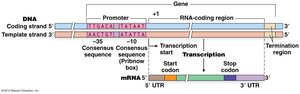
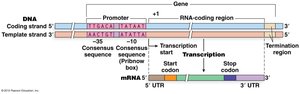
The promoter region indicates where to start making an RNA transcript. It contains information about the transcription start site, strand selection, and direction.
Transcription Process
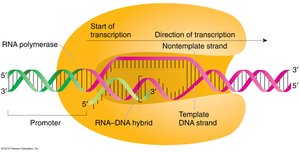
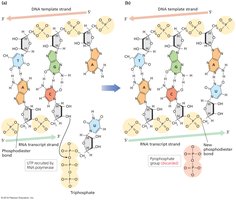
Transcription is carried out by RNA polymerases, which synthesize RNA in the 5' to 3' direction using a DNA template strand. Unlike DNA polymerase, RNA polymerase does not require a primer.
RNA Polymerase Mechanism
RNA polymerase binds to DNA at a specific site and begins transcription. The enzyme forms a phosphodiester bond between the 3' OH of the growing RNA strand and the 5' phosphate of the incoming nucleotide.
Stages of Transcription
Transcription occurs in three stages:
Initiation: RNA polymerase binds to the start of a gene.
Elongation: RNA polymerase moves along DNA, extending the RNA chain.
Termination: Transcription stops and the RNA is released.
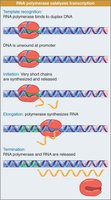
Transcription in Prokaryotes
Bacterial RNA Polymerase and Sigma Factor
Bacterial RNA polymerase consists of multiple subunits. The sigma factor directs the core enzyme to the promoter region, forming the holoenzyme.
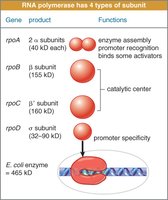
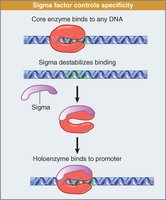
Bacterial Promoters
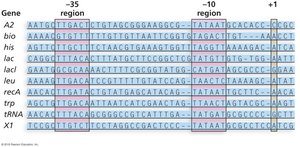
Bacterial gene promoters have two consensus sequences:
-10 site: TATAAT
-35 site: TTGACA
The sigma factor binds these regions to initiate transcription.
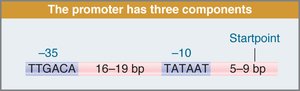
Transcription Initiation: Closed and Open Complex
Transcription initiation involves the formation of a closed complex (sigma factor binding) and an open complex (local DNA unwinding).



Transcription Elongation and Termination
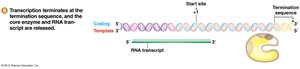
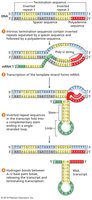
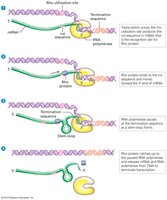
During elongation, the sigma factor dissociates and the core polymerase extends the mRNA. Termination occurs at specific sequences:
Intrinsic termination: RNA forms a hairpin structure.
Rho-dependent termination: Rho protein binds RNA and causes polymerase release.
Transcription in Eukaryotes
Key Differences from Prokaryotes
Protein-coding sequences are a minority of DNA.
Genes are larger, interrupted, and more complex.
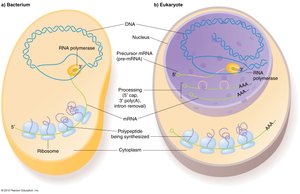
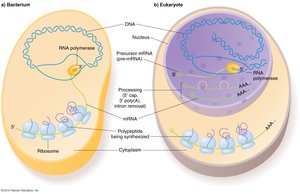
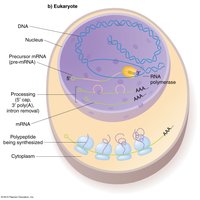
Transcription occurs in the nucleus; mRNA is exported to the cytoplasm.
Three RNA polymerases: I (rRNA), II (mRNA), III (tRNA and small RNAs).
DNA is wrapped around nucleosomes to form chromatin.
Eukaryotic Promoters and General Transcription Factors
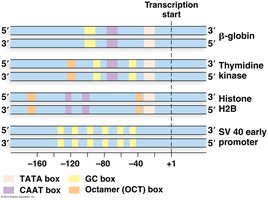
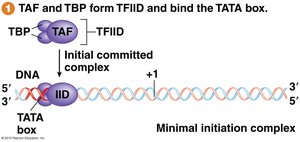
Many eukaryotic genes contain a TATA box upstream of the transcription start site. General Transcription Factors (GTFs) such as TFIID, TFIIB, TFIIE, TFIIF, and TFIIH recruit RNA polymerase II to the promoter.
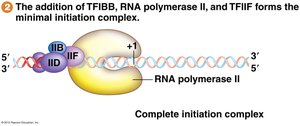
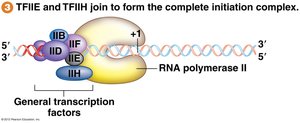
Transcription Elongation and Topoisomerase Function
RNA polymerase II moves forward, synthesizing the mRNA transcript. Topoisomerases prevent overwinding of DNA ahead of the polymerase.
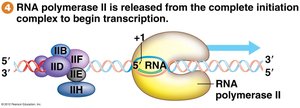
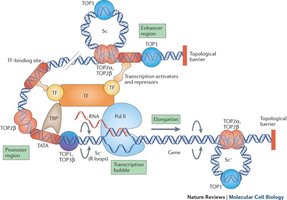
mRNA Processing in Eukaryotes
Modifications of Pre-mRNA
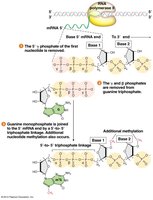
Eukaryotic pre-mRNAs are modified in three ways:
5' capping: Addition of 7-methyl-guanosine to the 5' end.
PolyA tail: Addition of a string of adenines to the 3' end.
Splicing: Removal of introns by the spliceosome.
Splicing and Alternative Splicing
Introns are removed and exons are joined to form mature mRNA. Some genes undergo alternative splicing, producing different proteins from the same gene in different cell types.
Summary Table: Differences Between Prokaryotic and Eukaryotic Transcription
Feature | Prokaryotes | Eukaryotes |
|---|---|---|
Location | Cytoplasm | Nucleus |
RNA Polymerases | One | Three (I, II, III) |
Promoter Elements | -10, -35 consensus | TATA box, other elements |
mRNA Processing | None | 5' cap, polyA tail, splicing |
Gene Structure | Continuous | Interrupted (introns/exons) |
